
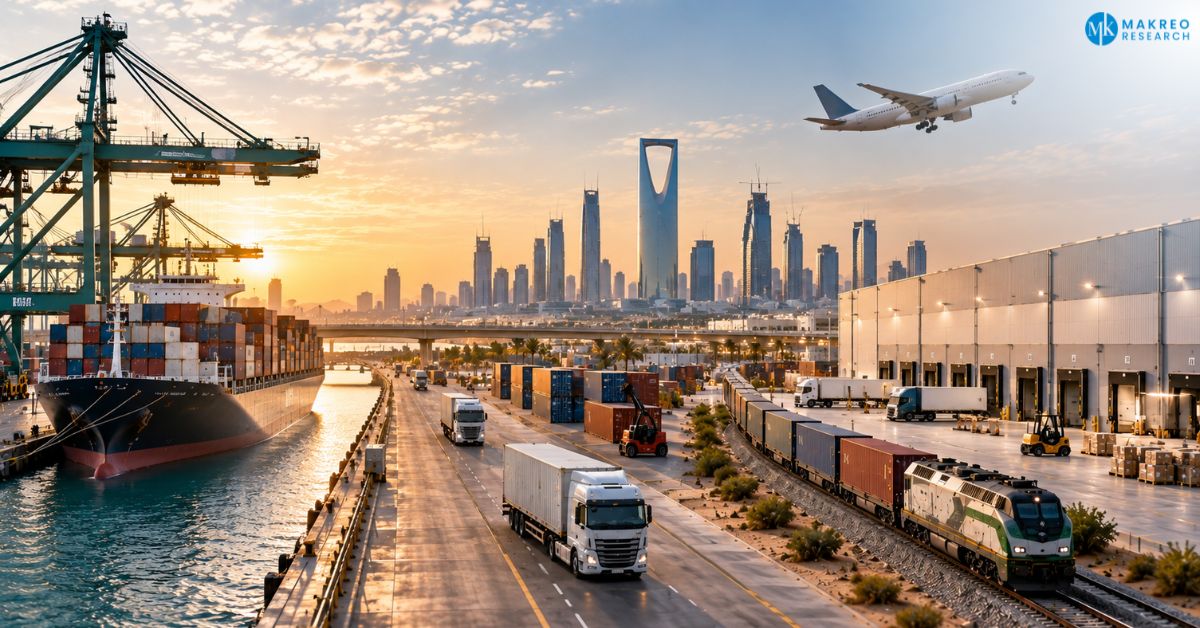
Saudi Arabia Logistics Market 2026 - 34 Logistics Zones, 97% Warehouse Occupancy and Five New Rail Corridors Reshape the Market
Saudi Arabia logistics market reached USD 21.64B in 2025 and is projected to grow at an 18% CAGR through 2030, driven by new rail corridors, Riyadh warehousing and Jeddah logistics investment.
A new multi-client warehouse in Riyadh. A US$173 million logistics fund for Jeddah. Five new rail corridors. A revived Hejaz Railway pact aimed at linking Europe to the Gulf. A record quarter at Bahri. SAL Saudi Logistics Services Company's first international acquisition.
Individually, each of these developments is significant. Together, they confirm that Saudi Arabia's freight, warehousing and cold chain ecosystem is moving faster than most external observers are tracking it.
According to Makreo Research, the Saudi Arabia freight and logistics market grew at a compound annual growth rate (CAGR) of 13.24% between 2021 and 2025, reaching an estimated US$21.64 billion, and is projected to expand at an 18.00% CAGR through 2030. The sector currently contributes approximately 6% of the Kingdom's GDP, a share the National Transport and Logistics Strategy (NTLS) targets doubling to 10% by 2030, supported by an approved investment pipeline of approximately US$133 billion across ports, airports and railways.
Saudi Arabia Logisticsi Market - Vision 2030 Strategy and Infrastructure Investment
Saudi Arabia's National Transport and Logistics Strategy treats logistics not as an enabler of other industries but as a growth sector in its own right. The Kingdom's position along the Arabian Gulf and the Red Sea, handling an estimated 13% of global trade, is the geographic foundation behind that ambition, and the scale of the approved investment pipeline reflects how seriously the government is treating the gap between the sector's current position and its 2030 target.
This strategic intent is visible in how consistently policy language treats sector growth as a policy objective rather than an outcome. Large-scale port upgrades, airport-linked logistics zones and industrial city expansion are the mechanisms through which the government intends to close that gap. Saudi Arabia Railways frames its own expansion explicitly in terms of the National Transport and Logistics Strategy, and the Minister of Transport and Logistics Services, Saleh Al-Jasser, has personally overseen milestones ranging from new rail corridors to port infrastructure launches, a level of ministerial visibility that is unusual for a sector of this technical complexity.
That strategic intent is also starting to show up in operator earnings, not just government announcements. Bahri, the Kingdom's national shipping and logistics champion, reported a record net profit of SAR 2.75 billion for the second quarter of 2026, up 574% year on year, on revenue of SAR 6.31 billion, up 156% year on year, taking first-half 2026 net profit to SAR 4.90 billion. The company grew its owned fleet to a record 107 vessels over the same period and added two new container and roll-on/roll-off vessels to a newbuild orderbook that now stands at 12 vessels scheduled for delivery through 2030. For a sector whose growth story has largely been told through infrastructure announcements, Bahri's results are an early sign that the strategy is translating into operator-level financial performance.
Saudi Freight Transport - Rail, Road and the New Sea-Land Corridors
Road freight still dominates domestic movement, accounting for around 95% of total freight volume on a national road network spanning roughly 316,900 kilometres. But the past six months have brought the most significant multimodal shift the sector has seen since Vision 2030's launch.
Rail is being built out as a genuine alternative to road haulage. On 10 April 2026, SAR announced five new logistics corridors-
-
Gulf ports served- Dammam, Jubail and Ras Al-Khair
-
Inland hubs connected- Riyadh Dry Port, Al-Kharj, Hail and Qurayyat
-
Extended reach- onward to Red Sea ports and northern markets including Jordan
Saudi Railway Company (SAR) chief executive, Bashar Al-Malik, described the expansion as reinforcing the Kingdom's position as a corridor linking east and west, and the routes are explicitly designed to shift high-volume commodities such as petrochemicals and minerals off long-haul trucking.
A separate, longer-horizon rail initiative is aimed squarely at Europe. In June 2026, Saudi Arabia and Turkey signed memoranda of understanding covering railway cooperation and logistics services, part of a wider push, alongside Turkey, Syria and Jordan, to revive the century-old Hejaz Railway along a route exceeding 3,000 kilometres from Riyadh to Istanbul. The project is still at the agreement and feasibility stage rather than under construction, but it is the initiative that most directly matches the "Europe to Gulf" ambition- a land corridor intended to give the Kingdom an overland alternative to the Strait of Hormuz and Suez Canal chokepoints, distinct from the domestic Jeddah-to-Dammam Saudi Landbridge described below.
Sea freight has taken an unusual multimodal turn of its own. Following disruption to Strait of Hormuz transits earlier in 2026, MSC launched a new Europe to Gulf service on 10 May 2026 that calls at Jeddah Islamic Port and King Abdullah Port before trucking containers roughly 1,300 kilometres overland to King Abdulaziz Port in Dammam, where feeder vessels distribute cargo onward across the Gulf. The route connects Jeddah to major European ports, including-
-
Gdansk
-
Bremerhaven
-
Antwerp
-
Valencia
-
Barcelona
-
Gioia Tauro
with capacity for up to 16,000 standard containers, and other carriers, including Hapag-Lloyd and Maersk, have introduced comparable land-bridge concepts. Whatever the duration of the Hormuz disruption that prompted it, the episode has demonstrated that Saudi Arabia's west-to-east road corridor can absorb main-line container volumes at short notice, a capability with implications well beyond the immediate crisis.
Port capacity is expanding in parallel-
-
DP World's $800 million modernisation at Jeddah Islamic Port is lifting its ship-to-shore crane fleet to 17 and taking terminal capacity from 1.8 million to 4 million TEUs, with a further expansion planned to 5 million TEUs; 2025 volumes already reached 1.3 million TEUs, more than double the prior year.
-
The world's largest truck terminal, covering one million square metres, has opened at Jeddah Islamic Port, alongside seven new agreements signed by the Saudi Ports Authority (Mawani) worth more than SAR 1 billion.
-
34 logistics zones now operate within Saudi ports, representing SAR 15 billion in fully private-sector-funded investment, including the expansion of Maersk's largest logistics zone globally at Jeddah Port and a major investment by China's GD Logistics across Jeddah Port and the Al-Khumrah area.
Air freight capacity is being pulled up by the Kingdom's wider aviation build-out. Saudi Arabia's air cargo throughput reached approximately 1.2 million tonnes in 2024, a 30% increase on the prior year, and SAL Saudi Logistics Services, spun off from Saudi Airlines Cargo in 2019, continues to handle around 92% of national cargo volumes across 18 domestic airports. The national carrier build-out that supports this belly and freighter capacity has accelerated too- Boeing confirmed on 20 July 2026 that Riyadh Air has firmed commitments for 67 787 Dreamliners, including 20 of the larger 787-10 variant, alongside 31 firm Airbus A350-1000s, all tied to the carrier's stated ambition of serving more than 100 international destinations by 2030.
Makreo Research's analysis suggests that the scale of this wide-body order book, alongside Saudia Cargo's plan to reach 27 aircraft by 2030 and approximately USD 100 billion in wider airport expansion, points to air cargo capacity expanding significantly beyond current throughput levels, with pharmaceuticals, perishables and e-commerce among the categories most likely to benefit first.
KSA Warehousing and Cold Chain - A Market That Has Already Reached Parity
Within Saudi Arabia's logistics market, cold chain is no longer warehousing's minor counterpart- it is close to parity with it. Makreo Research's segmentation puts warehousing at 50.27% of combined warehousing and cold chain segment value in 2025E, with cold chain at 49.73%, a gap of just over one percentage point. That split is tight enough that treating cold chain as a secondary category materially understates its commercial weight. For organisations assessing this market, whether through competitive benchmarking of warehousing operators or demand-side research into cold chain buyers, this segmentation split is the starting point.
The supply-side story explains why. National warehouse occupancy stood at approximately 97 to 98% by H1 2025, a level tight enough to constrain tenant choice across the Kingdom's principal logistics hubs-
-
Riyadh is the most constrained market, with occupancy near 98% and average industrial lease rates up around 16% year on year in H1 2025, driven by strong demand for light industrial units (LIUs) and modern distribution centres.
-
Jeddah recorded lease rate increases of 8% year on year over the same period.
-
Dammam Metropolitan Area recorded lease rate increases of 9% year on year over the same period.
Jeddah's total warehouse supply of approximately 18 million square metres was already running at 97% occupancy in 2024, with annual growth of 4.8%, according to figures cited alongside the launch of the SAR 650 million ($173 million) Missan Logistics Opportunity Fund on 22 July 2026, a facility designed specifically to add supply to a 320,000-square-metre logistics city site in Jeddah's Al-Kawthar district and expected to meet around 5% of the city's warehouse market demand.
New Grade A warehousing is expanding in response -
-
DP World opened its first multi-client third-party logistics warehouse in Saudi Arabia on 30 July 2026, a 15,250-square-metre facility with more than 17,000 pallet positions at Riyadh's Al Mashael Logistics Hub, built to serve consumer goods, industrial, automotive, retail and technology sectors, with storage areas adaptable for temperature-controlled operations as demand increases.
-
DHL Supply Chain signed a land lease agreement with the Special Integrated Logistics Zone (SILZ) at King Khalid International Airport for a €130 million (SAR 560 million), 78,000-square-metre multi-user facility, with 53,000 square metres of warehouse space under a 26-year term; construction began in the first quarter of 2026 for completion in the second quarter of 2027, part of a wider €500 million DHL Group commitment to the Middle East through 2030.
-
SILZ itself, a 3 million-square-metre zone, has already attracted international tenants including Apple and Shein, and is drawing global technology companies such as Google, Oracle and Huawei into a related, adjacent category, large-scale data centres, which is placing new demand on Grade A power-backed logistics real estate.
Together, these projects reinforce Saudi Arabia's position as a regional distribution hub.
Cold Chain - Specialised Capacity Is Becoming a Strategic Requirement
In June 2026, LogiPoint began construction of a 12,000-square-metre Grade A temperature-controlled logistics facility at Jeddah's 1st Industrial City, built around four temperature-controlled chambers and dedicated loading bays, with specifications tailored to food, pharmaceutical, retail and other temperature-sensitive applications.
The pharmaceutical supply chain is another clear area of development. In April, the Saudi Food and Drug Authority and Saudia Cargo launched an initiative supporting pharmaceutical and medical supply shipments, including shipping cost reductions of up to 50%. Saudia Cargo highlighted its IATA CEIV Pharma and CEIV Fresh certifications and its temperature-controlled logistics capabilities. For organisations tracking pharmaceutical and medical distribution specifically, Makreo Research's healthcare market research coverage extends this analysis into manufacturer and healthcare-professional demand.
Makreo Research's segmentation identifies Riyadh, Makkah and the Eastern Province as important regional markets for warehousing and cold chain. Our analysis suggests that cold chain investment should increasingly be assessed by temperature requirements, customer segment, facility specification, location and last-mile requirements rather than by storage capacity alone.
Saudi Arabia E-Commerce Logistics and CEP - The Demand Layer Behind the Build-Out
Warehousing occupancy at 97 to 98% and a wave of new Grade A capacity only make sense against the demand pulling it. E-commerce logistics is one of the clearest structural drivers behind it, with Makreo Research projecting-
-
11.25% CAGR for the e-commerce logistics segment through 2030
-
224 million+ parcel shipments processed in 2025
-
91% of Saudi consumers now shopping online
That combination of scale and growth rate is why CEP and last-mile networks feature as their own segment in Makreo Research's coverage rather than as a footnote to freight, a theme explored further in Makreo Research's analysis of how Saudi Arabia is rewiring its trade routes through logistics, rail, ports and air cargo expansion.
Western Region - The Kingdom's Logistics Gravity Centre
As of 2024, Saudi Arabia had 23 activated logistics centres covering approximately 34.6 million square metres in total. According to Makreo Research's data, the Western Region holds the largest share of market value nationally, reflecting the concentration of activated logistics centres and port-linked infrastructure around Jeddah. Makkah Region alone accounted for a substantial share of that total area across six logistics centres.
Within the logistics infrastructure segmentation, value concentration varies sharply by zone type-
-
Port-based logistics zones contribute an estimated 22% of total market value despite comprising only four of the 23 activated centres, reflecting the premium value of bonded warehousing, customs-linked services and container handling.
-
Industrial city logistics zones account for the largest number of activated centres at 15, though at a more moderate per-square-metre value.
-
Air freight logistics centres, though limited in number, hold an estimated 12% of value, reflecting the high-value, time-sensitive cargo, including pharmaceuticals, electronics and express shipments, that moves through them.
Several separate developments, Jeddah's port expansion, the Missan fund's new logistics city, DP World's Riyadh warehouse and SILZ's tenant roster, point to continued investment activity across the Kingdom's logistics sector, with the Western Region remaining its most concentrated hub. Operators and investors evaluating market entry into Saudi Arabia's logistics or warehousing sector may wish to prioritise the Western Region in their initial assessment, with the Eastern Province's port and petrochemical-linked infrastructure worth evaluating as a complementary market.
International Expansion, Digital Logistics and Infrastructure - Where the Market Is Shifting
Recent developments point to a structural shift from capacity creation alone towards international network expansion and digitally enabled operations. For companies evaluating market entry, partnerships or expansion, these changes increasingly determine where competitive advantage will be created.
Saudi logistics operators are expanding beyond the domestic market-
-
SAL Saudi Logistics Services completed its acquisition of 100% of Aviapartner Liège for approximately €28 million in August 2026, marking its first operational presence outside Saudi Arabia and expanding its network to 20 stations; Liège gives SAL an operating base in one of Europe's major air cargo hubs and strengthens its ability to connect Saudi cargo flows with international trade corridors.
-
SAL also signed a strategic agreement with China's SF Airlines in July 2026 to provide integrated ground-handling and air-cargo services in Saudi Arabia, combining SAL's local operating capabilities with SF Airlines' international air-cargo network and reinforcing the growing importance of China-Saudi trade flows within the Kingdom's logistics strategy.
Port operations are also being pushed further, beyond the capacity investment already covered above-
-
DP World's South Container Terminal at Jeddah handled more than 221,200 TEUs in July 2026, its highest monthly throughput since operations began in 1999, with first-half 2026 volumes up nearly 79% year on year.
-
DP World deployed 35 electric terminal tractors at the terminal in July, increasing tractor capacity by more than 20% and targeting an approximately 20% reduction in annual CO2 emissions from the terminal tractor fleet.
This illustrates how efficiency and lower-carbon operations are increasingly built into infrastructure investment decisions rather than treated as a separate sustainability initiative.
Digital logistics is moving from experimentation towards operational deployment. In September 2026, SAL and Elm launched CargoGate, a digital operational solution covering shipment collection and delivery appointments, vehicle movement and shipment-related procedures across SAL stations. Its pilot recorded 92% operational adoption across Riyadh, Jeddah, Dammam and Madinah, a concrete indication of how digital tools are being integrated into day-to-day freight operations rather than staying at the pilot stage.
Makreo Research's assessment is that the next phase of competition will be determined by more than infrastructure capacity alone. International network expansion, port throughput and efficiency, and operational digitalisation are collectively pushing Saudi Arabia towards a more integrated logistics model, and this is precisely the competitive landscape mapped in Makreo Research's Saudi Arabia Freight and Logistics Market Competition Assessment Report 2026, covering market share, positioning, M&A activity and company profiles across 17 operators.
Saudi Arabia Logistics Market - Where the Opportunity Is Emerging
Taken together, these developments point to a market where competitive differentiation is shifting from simply having space or transport capacity to how effectively operators connect locations, technology, temperature-controlled infrastructure and customer-specific logistics solutions. That shift makes market-entry assessment and customer-demand mapping increasingly relevant for 3PLs, while investors and developers require location-level feasibility analysis, and established operators need competitive benchmarking to identify where additional capacity, technology or network expansion can strengthen their position.
For organisations assessing market entry, competitive positioning, feasibility, demand or expansion strategy in Saudi Arabia's logistics and warehousing sector, Makreo Research's analysis is built to turn into a decision-ready basis for investment. Explore the full Saudi Arabia Freight and Logistics Market and Forecast to 2030 report, or browse Makreo's wider Logistics and Warehousing coverage.
To discuss a specific requirement, whether it involves feasibility assessment or competitive benchmarking for a warehousing or cold chain asset, customer and demand mapping for cold chain or e-commerce logistics, or a comprehensive market entry and expansion strategy, connect with the Makreo Research team through its Consulting Services and Market Survey capabilities.
Makreo Research and Consulting provides global market intelligence reports, custom research, and consumer market surveys across sectors including logistics, warehousing, freight transport and cold chain. To discuss your market entry, expansion strategy, or competitive benchmarking needs, contact us at [email protected].
Frequently Asked Questions
How Big Is the Saudi Arabia Warehousing Market?
The Saudi Arabia warehousing market accounts for 50.27% of combined warehousing and cold chain segment value in 2025. Grade A facilities nationally are operating at 97–98% occupancy - a supply-demand imbalance that defines the market's near-term investment case more precisely than any growth rate alone.
What Is the Saudi Arabia Logistics Market Growth Outlook?
Makreo Research estimates the Saudi Arabia freight and logistics market reached approximately USD 21.64 billion in 2025, having grown at a 13.24% CAGR between 2021 and 2025. Growth is projected to accelerate to an 18.00% CAGR through 2030, underpinned by Vision 2030's USD 133 billion infrastructure investment pipeline across ports, airports, and railways.
What Is the Saudi Landbridge and How Does It Differ From the Europe-to-Gulf Rail Link?
The Saudi Landbridge is a domestic rail project connecting Jeddah Islamic Port on the Red Sea to Dammam on the Arabian Gulf across approximately 1,300 kilometres, backed by an estimated USD 7 billion investment. The Europe-to-Gulf land bridge is a separate international initiative connecting Europe to the Gulf overland via Turkey, Syria, Jordan, and Saudi Arabia - currently under technical and financing assessment.
What Are the National Transport and Logistics Strategy's Key Targets?
The National Transport and Logistics Strategy targets an 8,080-kilometre national rail network, 40 million TEUs of annual port throughput, and more than 4.5 million tonnes of air cargo capacity. The approved investment pipeline stands at approximately USD 133 billion, with around 80% of funding expected from the private sector.
Who Are the Leading Logistics Companies Operating in Saudi Arabia?
Makreo Research profiles 17 companies across the sector, including Bahri, A.P. Moller-Maersk Saudi Arabia, DHL Express Saudi Arabia, Almajdouie Logistics, SAL Saudi Logistics Services, Agility Logistics Saudi Arabia, LogiPoint, Red Sea Gateway Terminal, UPS Saudi Arabia, and Tamer Logistics, alongside a growing tier of technology-enabled logistics operators.
How Significant Is E-Commerce and CEP Demand in Saudi Arabia's Logistics Market?
E-commerce logistics is projected to grow at an 11.25% CAGR through 2030, supported by more than 224 million parcel shipments in 2025 and 91% of Saudi consumers shopping online. This makes e-commerce a structural rather than cyclical driver of freight and last-mile demand across the Saudi Arabia logistics market.
How Can a Company Assess Entry or Expansion Into Saudi Arabia's Logistics Sector?
Entry considerations typically include warehousing location relative to Riyadh, Jeddah and Dammam, port and rail corridor access, regulatory and customs timelines specific to the Kingdom, and competitive positioning against both established operators and newly capitalised entrants. Makreo Research supports these assessments through its consulting and market survey services.
Saudi Arabia Logistics Market Size, Saudi Arabia Logistics Market Forecast, Saudi Arabia Logistics Market Growth, Saudi Arabia Logistics Industry Analysis, Saudi Arabia Logistics Market 2026, Saudi Arabia Freight and Logistics Market, Saudi Arabia Freight Transport Market, Saudi Arabia Warehousing Market, Saudi Arabia Cold Chain Market, Saudi Arabia Cold Storage Market, Saudi Arabia Logistics Infrastructure, Saudi Arabia Logistics Investment, Saudi Arabia Logistics Opportunities, Saudi Arabia Logistics Market Trends, Saudi Arabia Logistics Demand, Saudi Arabia 3PL Market, Saudi Arabia E-commerce Logistics Market, Saudi Arabia Warehouse Automation, Saudi Arabia Logistics Technology, Saudi Arabia Port Logistics, Saudi Arabia Logistics Companies, Saudi Arabia Logistics Competitive Landscape, Saudi Arabia Logistics Market Entry, Saudi Arabia Logistics Feasibility Study, Saudi Arabia Logistics Competitive Benchmarking