East and Southern Africa Warehousing and Storage Market and Forecast to 2031 - Analysis by Warehouse Type (Bulk Warehousing, Multipurpose Warehousing), Storage Type, Temperature, Logistics Infrastructure, Transport Mode, End-Use Industry, and Geography
East & Southern Africa Warehousing and Storage Market Size
The East and Southern Africa warehousing and storage market has recorded steady growth in recent years, supported by expanding trade activity, rising industrial output, increasing agricultural exports, and continued investment in logistics infrastructure. The region is consolidating its position as a critical gateway for intra-African and global trade, with growing demand for bulk warehousing, multipurpose storage, and cold chain facilities across major economies including South Africa, Kenya, Ethiopia, Tanzania, Rwanda, and Namibia.
Key Drivers Shaping the East & Southern Africa Warehousing and Storage Market
Several structural and infrastructure-driven factors are supporting the growth of the regional warehousing and storage sector.
-
Trade Corridor and Infrastructure Development Driving Warehouse Demand - Ongoing investment in ports, railways, airports, dry ports, logistics hubs, and special economic zones is enhancing regional connectivity and increasing demand for storage infrastructure across East and Southern Africa.
-
Agricultural and Cold Chain Expansion Supporting Specialized Storage Growth - Rising agricultural production and the growing export of fruits, grains, meat, and perishable commodities are driving investment in cold storage facilities and commodity storage infrastructure across the region.
-
Manufacturing, Mining, and Industrial Growth Increasing Storage Requirements - Expanding manufacturing activity, mining exports, and rising industrial production are generating sustained demand for bulk warehousing and multipurpose storage facilities to support both domestic consumption and international trade across the region.
-
E-Commerce and Retail Expansion Boosting Modern Warehousing Needs - The rapid growth of e-commerce, organised retail, and consumer distribution networks is accelerating demand for modern warehouse facilities, fulfilment centres, and value-added logistics services across key urban and industrial centres in the region.
-
Strategic Port and Logistics Hub Developments Strengthening Regional Trade Connectivity - Capacity expansions at major ports including Mombasa, Dar es Salaam, Walvis Bay, and Durban, combined with improvements in multimodal transport infrastructure and logistics corridor development, are enhancing cargo throughput and reinforcing East and Southern Africa's strategic position within regional and international supply chains.
East & Southern Africa Warehousing and Storage Industry Insights
East & Southern Africa Warehousing and Storage Market Revenue Past and Present Performance, 2023-2026E
Makreo Research
Infrastructure Development and Regional Trade Connectivity
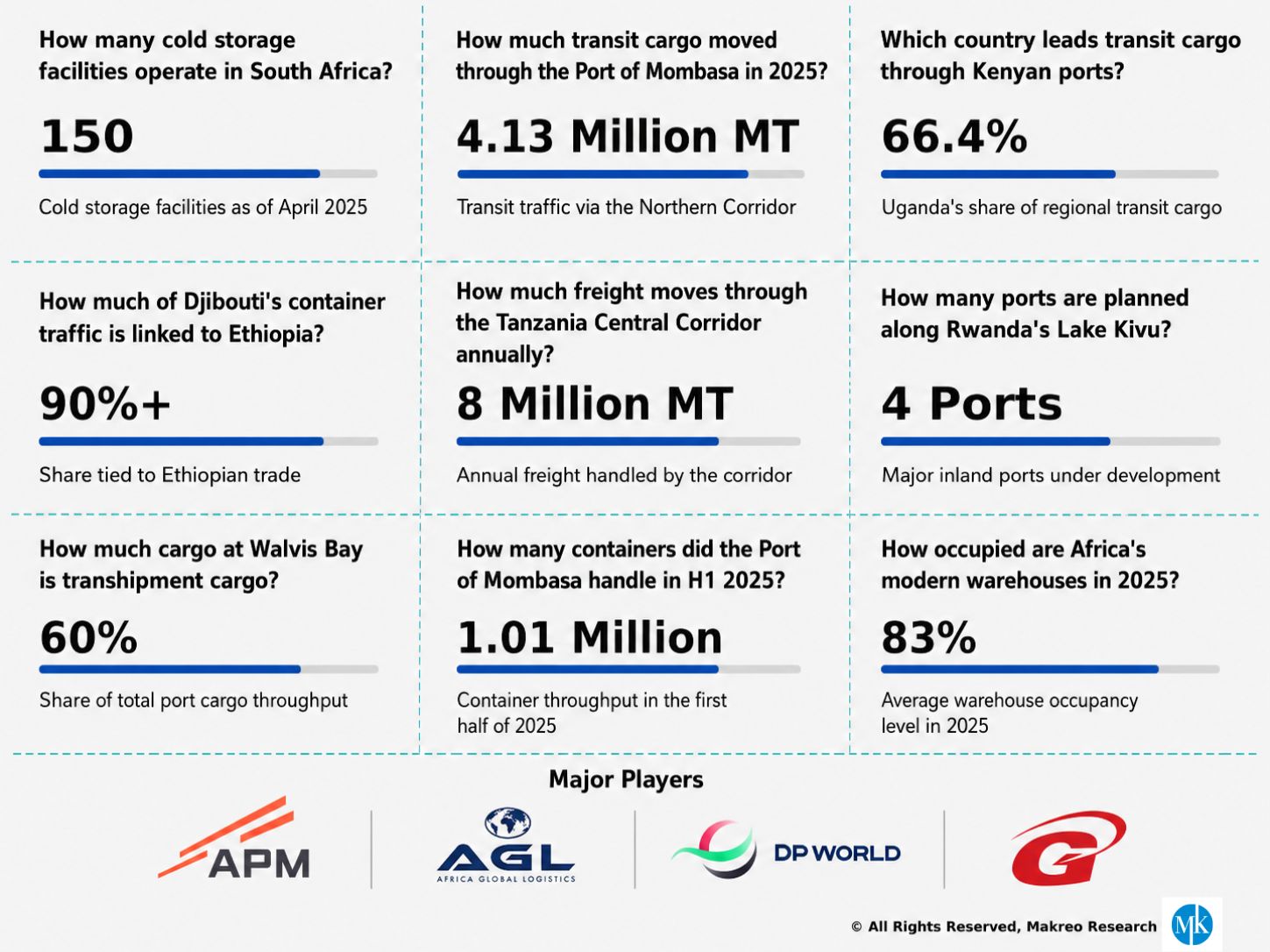
The East & Southern Africa warehousing and storage market is witnessing steady expansion, supported by investments in ports, railways, airports, dry ports, logistics corridors, and special economic zones. Rising trade activity, industrialization, agricultural exports, and the growth of e-commerce are strengthening demand for warehousing and cold chain infrastructure across the region.
The strategic location of countries such as South Africa, Kenya, Tanzania, and Namibia along major Indian Ocean and Atlantic Ocean trade routes further enhances the region's importance within African and global supply chains. Growing cargo volumes and improving multimodal connectivity are reinforcing East & Southern Africa's position as a key logistics and trade gateway for the continent.
Kenya Warehousing and Storage Market Moderate Performance
The Kenya warehousing and storage market witnessed relatively subdued growth during 2023-2026. While the country continued to benefit from its position as East Africa's logistics hub, growth was constrained by weaker private sector activity, high borrowing costs, and supply chain disruptions. Although the market experienced a temporary decline in 2026, Kenya's strategic importance as the gateway to East and Central Africa, coupled with growing e-commerce penetration, expanding agricultural exports, and investments in logistics infrastructure, are expected to support a recovery in warehousing demand.
South Africa E-Commerce Forecast, 2025-2030F
Strategic Investments and Developments in the East & Southern Africa Warehousing and Storage Market
Dar es Salaam Port - Cargo-Handling Capacity and Modernization Expansion
In 2026, the Port of Dar es Salaam advanced major expansion and modernization initiatives designed to improve operational efficiency and increase annual cargo-handling capacity beyond 30 million tonnes by FY 2027. The Tanzania Ports Authority has also established a long-term throughput target of 54.59 million tonnes by FY 2031
Imperial Logistics South Africa Holdings Proprietary Limited - End-to-End Supply-Chain Integration
In March 2025, Dubai-based DP World completed the acquisition of Imperial Logistics for approximately USD 890 million. The strategic transaction was aimed at strengthening DP World’s logistics capabilities across Africa by integrating Imperial Logistics’ regional network and operational expertise to provide comprehensive end-to-end supply-chain, transportation, distribution, and warehousing services.
DHL Africa - EUR 300 Million Logistics Infrastructure Expansion
In October 2025, DHL Group announced plans to invest more than EUR 300 million across Sub-Saharan Africa to expand logistics infrastructure, strengthen supply-chain capabilities, and support regional trade growth. The investment will be deployed through DHL Express, DHL Global Forwarding, and DHL Supply Chain operations, supporting demand across sectors including e-commerce, healthcare, energy, agriculture, and industrial logistics.
Safcor Freight (Pty) Limited - 40,000 m² Automotive Container Yard in South Africa
In November 2025, Bidvest International Logistics, in partnership with BMW Group South Africa and Maersk, launched a custom-built 40,000 m² container yard in Rosslyn, South Africa. The facility was developed to support BMW’s production supply chain through container handling, storage, and integrated logistics services, while expanding Bidvest International Logistics’ capacity to serve additional customers and support future growth in South Africa’s automotive export sector.
Funding Activity in the East & Southern Africa Warehousing and Storage Market
-
In 2025, Transnet SOC Ltd. secured EUR 300 million in financing from the French Development Agency (AFD) to support railway rehabilitation, renewable energy adoption, and port modernization in South Africa.
-
In 2025, DHL Group committed more than EUR 300 million to expand logistics infrastructure, warehousing capacity, and supply-chain operations across Africa.
-
In 2025, Leta Inc., a Nairobi-based logistics technology platform Leta Inc. raised USD 5 million in a Seed funding round led by Speedinvest, with participation from Google’s Africa Investment Fund and Equator. The funding will support the expansion of its AI-powered logistics and supply-chain optimization platform across Africa and the Middle East.
Scope of the Study for East & Southern Africa Warehousing and Storage Market
Makreo Research has published a comprehensive report titled "East and Southern Africa Warehousing and Storage Market and Forecast to 2031 - Analysis by Warehouse Type (Bulk Warehousing, Multipurpose Warehousing), Storage Type, Temperature, Logistics Infrastructure, Transport Mode, End-Use Industry, and Geography". The report provides an in-depth assessment of the East and Southern Africa warehousing and storage market, examining its historical development, current operating environment, evolving industry trends, and long-term growth outlook. The analysis covers key regional economies, including South Africa, Kenya, Ethiopia, Tanzania, Rwanda, and Namibia, with market forecasts extending through 2030.
The report begins by evaluating the overall development of the East & Southern Africa Warehousing and Storage sector, focusing on key structural elements shaping the industry, including:
Revenue and Demand Analysis
The report begins with a detailed assessment of the regional warehousing and storage market, evaluating historical trends and current market size. It provides segmentation analysis across bulk warehousing and multipurpose warehousing and highlights country-wise market performance.
Logistics Infrastructure and Connectivity Analysis
-
The study evaluates the regional logistics ecosystem across the six covered countries, including ports, railway networks, airports, inland logistics hubs, dry ports, industrial parks, and special economic zones.
-
Dedicated sections assess cargo throughput trends, port performance, multimodal transport connectivity, regional trade corridors, and ongoing logistics infrastructure expansion projects across major gateways.
-
Separate sections assess warehouse rental rates, asset pricing, vacancy rates, construction costs, and investment opportunities in major logistics locations.
Cold Chain Infrastructure and End-Use Industry Analysis
-
The report examines the development of cold storage, temperature-controlled warehousing, grain storage, and commodity storage infrastructure across the region.
-
The study further analyzes the major end-use industries driving regional warehousing demand, including agriculture, mining, manufacturing, automotive, chemicals, petroleum, food and beverages, pharmaceuticals, e-commerce, and wholesale and retail sectors.
-
The report also reviews export and import trends, commodity flows, regional trade patterns, and major trading partners across the six countries.
Competitive Landscape and Key Players
-
A dedicated section benchmarks leading port operators, warehouse operators, logistics companies, and commodity storage providers based on geographical presence, operational capabilities, infrastructure scale, and financial performance.
-
Detailed company profiles are included for major players, highlighting business overviews, strategic developments, and financial performance.
-
The study also examines mergers and acquisitions, strategic investments, divestments, joint ventures, partnerships, capacity expansion initiatives, and funding activities influencing the regional warehousing and storage market.
Future Outlook
-
The report concludes with forward-looking projections for the overall market and its bulk and multipurpose warehousing segments through 2030.
-
It identifies emerging opportunities, infrastructure developments, key challenges, and structural trends expected to influence the East & Southern Africa warehousing and storage market during the forecast period.
-
2023 - 2026: Past and Present Scenario
-
2026: Base year of study
-
2026 - 2031: Future Outlook
East & Southern Africa Warehousing and Storage Market Segmentation
-
Bulk Warehousing
-
Multipurpose Warehousing
-
Ambient/Dry Storage
-
Cold Storage
-
Non-Temperature Controlled
-
Temperature-Controlled
-
Agriculture
-
Mining
-
Manufacturing
-
Automotive
-
Chemicals
-
Petroleum
-
E-Commerce
-
Wholesale & Retail
-
Port-Based Warehouses
-
Inland Warehouses
-
Dry Ports
-
SEZ/Industrial Park Warehouses
-
Urban Warehouses
-
Industrial Corridor Warehouses
-
Border Logistics Hubs
-
Port-Centric Warehouses
-
Road Logistics
-
Rail Logistics
-
Maritime Logistics
-
Air Cargo Logistics
Geography Assessed
-
South Africa
-
Kenya
-
Ethiopia
-
Tanzania
-
Rwanda
-
Namibia
-
Competition
-
Mergers, Acquisitions, and Investments
-
Funding Timeline
-
Company Profiles
Companies Covered in the East & Southern Africa Warehousing and Storage Market
-
Grindrod Limited
-
DP World Limited
-
Africa Global Logistics SAS
-
APM Terminals B.V.
The study covers a total of 12 East & Southern Africa Warehousing and Storage Market companies. To know more, please reach out to [email protected].
What Are the Major Growth Drivers of the East & Southern Africa Warehousing and Storage Market? +
What Customer Trends Are Shaping Warehouse Demand in East & Southern Africa? +
What Are the Key Trends in the East & Southern Africa Warehousing and Cold Storage Market? +
Who Are the Key Players in the East & Southern Africa Warehousing and Storage Market +
What Is the Outlook for the East & Southern Africa Warehousing and Storage Market? +
Looking for a Section from Report? Start your Partial Purchase Request
Table of Contents
- 1.Research Methodology
- 1.1Research Objective
- 1.2.Research Design and Procedure
- 1.3.Data Collection Methods
- 1.4.Research Methodology
- 1.5.Analytical Framework
- 2.East & Southern Africa Warehousing and Storage Market Past and Present Performance
- 2.1.East & Southern Africa Warehousing & Storage Market Past & Present Performance
- 2.1.1.East and Southern Africa Warehousing and Storage Market Revenue by Major Countries
- 2.1.2.East and Southern Africa Bulk Warehousing Market Revenue by Major Countries
- 2.1.3.East and Southern Africa Multipurpose Warehousing Market Revenue by Major Countries
- 2.1.East & Southern Africa Warehousing & Storage Market Past & Present Performance
- 3.East & Southern Africa Warehousing and Storage Market Analysis
- 3.1.Africa Air Cargo Landscape and Regional Growth Trends
- 3.2.South Africa Key Ports & Expansion Projects
- 3.2.1.South Africa Port Cargo Handling Statistics
- 3.2.2.South Africa Container Port Throughput & Share
- 3.2.3.South Africa Port Cargo Volume and Share
- 3.2.4.South Africa Port Vessel Arrivals and Cargo Handling
- 3.2.5.Top Locations for Buying Warehouses in South Africa
- 3.2.6.South Africa Small to Mid-Size Warehouses – Investment Overview
- 3.2.7.South Africa Large Warehouses – Investment Overview
- 3.2.8.South Africa Warehouse Rental Rate Details based on Different Regions
- 3.2.9.South Africa Warehouse Vacancy Rates by Region
- 3.2.10.Distribution and Ownership of Cold Storage Facilities in South Africa
- 3.2.11.South Africa Export Volume by Port
- 3.2.12.South Africa Citrus Export Trends & Reefer Container Forecast by Exit Port
- 3.3.Kenya Mombasa Port Container Traffic Performance
- 3.3.1.Kenya Mombasa Port Cargo Throughput by Type, Capacity & Growth Trends
- 3.3.1.1.Mombasa Port Monthly Cargo Throughput & Export Performance
- 3.3.1.2.Mombasa Port Monthly Cargo Throughput & Import Performance
- 3.3.1.3.Mombasa Port Transit Cargo Performance
- 3.3.2.Kenya Lamu Port (LAPSSET Corridor) Development Status
- 3.3.3.Kenya Role of Other Ports in Regional Trade Logistics
- 3.3.4.Kenya Cargo Distribution Across Key Trade Corridors
- 3.3.5.Kenya Rail Infrastructure - Regional Connectivity & Network Coverage
- 3.3.6.Kenya Standard Gauge Railway (SGR) Cargo and Revenue Performance
- 3.3.7.Kenya Meter Gauge Railway (MGR) Cargo and Revenue Performance
- 3.3.8.Kenya Rail Infrastructure Strategic Plan Financial Requirements & Investment
- 3.3.9.Kenya Jomo Kenyatta International Airport Cargo Throughput Trends
- 3.3.9.1.Kenya Jomo Kenyatta International Airport Expansion
- 3.3.10.Kenya Inland Logistics Ecosystem Development Status
- 3.3.11.Kenya Warehouse Rental and Asset Pricing Overview
- 3.3.11.1.Kenya Nairobi Metropolitan Area Industrial Space Rental Rates and Selling Prices
- 3.3.11.2.Kenya Nairobi Warehouse and Cold Storage Cost Overview
- 3.3.11.3.Kenya Warehouse and Cold Storage Construction Cost Trends and Rates
- 3.3.12.Kenya Cold Storage Capacity, Expansion and Future Plans
- 3.3.1.Kenya Mombasa Port Cargo Throughput by Type, Capacity & Growth Trends
- 3.4.Ethiopia Trade Connectivity, Port Dependence & Regional Corridor Developments
- 3.4.1.Ethiopia–Djibouti Maritime Trade and Logistics Overview
- 3.4.2.Ethiopia Freight Trends and Rail Capacity Growth Analysis
- 3.4.3.Ethiopia Air Cargo Trends and Capacity Expansion
- 3.4.4.Ethiopia Cross Border Truck Demand & Capacity Structure for Dry Cargo Movement
- 3.4.5.Ethiopia Dry Ports Network and Logistics Constraints Overview
- 3.4.6.Ethiopia Special Economic Zones Infrastructure
- 3.4.7.Ethiopia Logistics, Dry Port and Warehouse Infrastructure Developments
- 3.4.8.Ethiopia Logistics Performance Trends Transport and Storage Analysis
- 3.4.9.Ethiopia Warehouse Rental Market Overview
- 3.5.Tanzania Freight Transport Structure and Infrastructure Development Overview
- 3.5.1.Tanzania Port Cargo Throughput Growth and Performance Trends 3.5.1.1. Dar es Salaam Port Performance and Regional Trade Dynamics
- 3.5.1.2.Dar es Salaam Port Traffic Forecast and Strategic Trade Connectivity Outlook
- 3.5.1.3.Kigoma and Burundi Ports Maritime Cargo and Handling Projections
- 3.5.1.4.Tanzania Port Infrastructure Development and Expansion Initiatives
- 3.5.2.Tanzania Rail Network Expansion and Central Corridor Cargo Growth
- 3.5.3.Tanzania Aviation Sector Growth and Airport Expansion
- 3.5.4.Tanzania Inland Waterway Trade and Container Transport Outlook
- 3.5.5.Tanzania NFRA Expands Grain Storage Infrastructure and Capacity
- 3.5.6.Tanzania Expanding Storage and Logistics Infrastructure Landscape
- 3.5.7.Tanzania Warehouse Network and Storage Capacity Overview
- 3.5.7.1.Tanzania Warehouse Rental Market Overview
- 3.5.1.Tanzania Port Cargo Throughput Growth and Performance Trends 3.5.1.1. Dar es Salaam Port Performance and Regional Trade Dynamics
- 3.6.Rwanda Overview of National and Regional Connectivity
- 3.6.1.Rwanda Trade Distribution by Transport Mode
- 3.6.2.Rwanda Aviation Performance, Cargo Trends and Strategic Targets
- 3.6.3.Rwanda Lake Kivu Ports and Rusizi Corridor Trade and Cargo Overview
- 3.6.3.1.Rwanda Lake Kivu Ports and Rusizi Corridor Trade and Cargo Movements
- 3.6.4.Rwanda Logistics and SEZ Infrastructure Overview
- 3.6.5.Rwanda Post-Harvest Management and Storage Infrastructure Overview
- 3.6.6.Rwanda Industrial Zones Portfolio Overview
- 3.6.7.Kigali Warehouse Rental Market Overview
- 3.7.Namibia Multimodal Cargo Movement and Sea Freight Breakdown
- 3.7.1.Namibia Port Cargo Throughput and Handling Trends
- 3.7.2.Namibia Port Performance and Operational Efficiency Trends
- 3.7.3.Namport Performance Against Key Performance Indicators
- 3.7.3.1.Namport Cross-Border Cargo Trends and Trade Flow Analysis
- 3.7.4.Namibia Walvis Bay Transit Cargo and Transport Group Projections
- 3.7.5.Namibia Road Cargo Composition and Sea Cargo Index Trends
- 3.7.5.1.Namibia Cargo Index Trends Across Transport Modes
- 3.7.6.Namibia Rail Cargo Composition and Road Cargo Index Trends
- 3.7.6.1.Namibia Rail Cargo Volume and Transport Mode Projections
- 3.7.7.Namibia Air Cargo Composition and Air Cargo Index Trends
- 3.7.8.Namibia Logistics Hub Centre Development Programme
- 3.7.8.1.Namibia Logistics Infrastructure Expansion and Projected Traffic Volumes
- 3.7.9.Namibia Cold Storage Capacity, Expansion and Future Plans
- 4.East & Southern Africa Key Industry Analysis
- 4.1.South Africa Automotive Industry - Growth, EV Transition, and Market Outlook
- 4.1.1.South Africa E-Commerce Market Future Outlook
- 4.1.2.South Africa Agricultural Export Growth & Cold Chain Infrastructure Development
- 4.1.2.1.South Africa Citrus Production Trends and Vision 260 Projections
- 4.1.3.South Africa Warehousing for Chemicals & Dangerous Goods
- 4.2.Kenya Manufacturing Industry Overview
- 4.2.1.Kenya Manufacturing Sector Quarterly Growth Trends
- 4.2.2.Kenya Consumer and Industrial Imports Analysis
- 4.2.3.Kenya Agriculture Sector Output and Performance Indicators
- 4.2.3.1.NCPB Depot Network and Regional Distribution
- 4.2.4.Kenya Petroleum Pipeline and Storage Infrastructure Overview
- 4.2.5.Kenya E-Commerce Market Structure by Platform and Industry
- 4.3.Ethiopia Agricultural Production and Land Potential Overview
- 4.4.Tanzania Mining Sector Performance and Strategic Development Initiatives
- 4.4.1.Tanzania Mining Sector Export and Investment Performance
- 4.4.2.Tanzania Industrial Production & Construction Materials Overview
- 4.4.3.Tanzania Agricultural Production and Harvested Area Trends
- 4.5.Rwanda Agriculture Land Structure & Agricultural Inputs Overview
- 4.5.1.Rwanda Agricultural Output and Harvested Area Analysis
- 4.5.2.Rwanda Mining Sector Growth and Mineral Export Expansion
- 4.5.3.Rwanda Construction Sector Performance and Building Material Trends
- 4.5.4.Rwanda Wholesale and Retail Sector Growth and Revenue Trends
- 4.6.Namibia Mining Sector Performance and Composite Mineral Index Trends
- 4.6.1.Namibia Agricultural and Livestock Sector Performance Overview
- 4.6.2.Namibia Beverage Production and Consumer Price Inflation Trends
- 4.6.2.1.Namibia Food and Beverage Import Trends
- 4.6.3.Namibia Energy and Environmental Performance Indicators
- 4.1.South Africa Automotive Industry - Growth, EV Transition, and Market Outlook
- 5.East & Southern Africa Trade Analysis
- 5.1.South Africa Export and Import Statistics
- 5.1.1.South Africa Domestic Export and Import Statistics by Commodities
- 5.1.2.South Africa Domestic Export and Import Statistics by Key Partners
- 5.2.Kenya Export and Import Statistics
- 5.2.1.Kenya Domestic Export and Import Statistics by Commodities
- 5.2.2.Kenya Domestic Export and Import Statistics by Key Partners
- 5.3.Ethiopia Export and Import Statistics
- 5.3.1.Ethiopia Export and Import Statistics by Commodities
- 5.3.2.Ethiopia Export and Import Statistics by Key Partners
- 5.4.Tanzania Export and Import Statistics
- 5.4.1.Tanzania Export and Import Statistics by Commodities
- 5.4.2.Tanzania Export and Import Statistics by Key Partners
- 5.5.Rwanda Export and Import Statistics
- 5.5.1.Rwanda Export and Import Statistics by Commodities
- 5.5.2.Rwanda Export and Import Statistics by Key Partners
- 5.6.Namibia Trade Distribution by Mode and Key Border Gateways
- 5.6.1.Namibia Export and Import Statistics
- 5.6.2.Namibia Export and Import Statistics by Commodities
- 5.6.3.Namibia Export and Import Statistics by Key Partners
- 5.1.South Africa Export and Import Statistics
- 6.East & Southern Africa Warehousing and Storage Market Competitive Landscape
- 6.1.East & Southern Africa Warehousing & Storage Market Key Players Comparative Analysis
- 6.2.Product Category Comparison of Africa Warehousing & Storage Market Companies
- 6.3.Africa Warehousing & Storage Market Players Geographical Presence
- 6.4.Africa Warehousing & Storage Market Infrastructure & Operational Capacity
- 6.5.Africa Warehousing & Storage Market Warehouse & Operational Scale Analysis
- 7.East & Southern Africa Warehousing and Storage Market Mergers /Acquisitions/ Investments/ Divestments
- 7.1.Mergers /Acquisitions/ Investments/ Divestments
- 8.East & Southern Africa Warehousing and Storage Market Funding Timeline
- 8.1.Funding Timeline
- 9.Port Terminal & Bulk Handling Operators Company Profiles
- 9.1.Player 1 – Business Overview
- 9.1.1Marine Transport and Logistics Network Across Africa
- 9.1.2.Company Timeline
- 9.1.3.Business Highlights
- 9.1.4.Business Financials
- 9.2.Player 2 – Business Overview
- 9.2.1.Company Timeline
- 9.2.2.Business Highlights
- 9.2.3.Business Financials
- 9.3.Player 3 – Business Overview
- 9.3.1.Company Timeline
- 9.3.2.Business Highlights
- 9.4.Player 4 – Business Overview
- 9.4.1.Company Timeline
- 9.4.2.Business Highlights
- 9.4.3.Business Financials
- 9.5.Player 5 – Business Overview
- 9.5.1.Business Highlights
- 9.5.2.Business Financials
- 9.1.Player 1 – Business Overview
- 10.Africa Warehouse Operators Company Profiles
- 10.1.Player 1 – Business Overview
- 10.1.1.Business Highlights
- 10.2.Player 2 – Business Overview
- 10.2.1.Business Highlights
- 10.2.2.Business Financials
- 10.3.Player 3 – Business Overview
- 10.3.1.Business Highlights
- 10.1.Player 1 – Business Overview
- 11.Commodity Storage Providers Operators Company Profiles
- 11.1.Player 1 – Business Overview
- 11.1.1.Business Highlights
- 11.1.2.Business Financials
- 11.2.Player 2 – Business Overview
- 11.2.1.Business Overview & Highlights
- 11.3.Player 3 – Business Overview
- 11.3.1.Business Units and Capabilities
- 11.3.2.Business Highlights
- 11.4.Player 4 – Business Overview
- 11.4.1.Business Highlights
- 11.4.2.Business Financials
- 11.1.Player 1 – Business Overview
- 12.East & Southern Africa Warehousing and Storage Market Challenges
- 12.1.East & Southern Africa Warehousing and Storage Market Challenges Overview
- 12.1.1.East & Southern Africa Warehousing and Storage Market Challenges
- 12.1.East & Southern Africa Warehousing and Storage Market Challenges Overview
- 13.East & Southern Africa Warehousing and Storage Market Opportunities
- 13.1.East & Southern Africa Warehousing and Storage Market Opportunities Overview
- 13.1.1.East & Southern Africa Warehousing and Storage Market Opportunities
- 13.1.East & Southern Africa Warehousing and Storage Market Opportunities Overview
- 14.East & Southern Africa Warehousing and Storage Market Future Outlook
- 14.1.East & Southern Africa Warehousing and Storage Market Future Outlook
- 14.1.1.East & Southern Africa Warehousing & Storage Market Future Outlook by Major Countries
- 14.1.2.East & Southern Africa Bulk Warehousing Market Future Outlook by Major Countries
- 14.1.3.East & Southern Africa Multipurpose Warehousing Market Future Outlook by Major Countries
- 14.1.East & Southern Africa Warehousing and Storage Market Future Outlook
- Limitations of the Study
Related Reports - Automotive & Transportation