Saudi Arabia Waste Management Market and Forecast to 2031 - Analysis by Source (Households, Industrial, Construction, Agriculture, Forestry and Fishing and Others), Waste Type, Service Type, Ownership, and Province
Saudi Arabia Waste Management Market Size
The Saudi Arabia waste management market has recorded steady growth in recent years, supported by rapid urbanization, increasing waste generation, large-scale infrastructure development, and stronger government emphasis on sustainability.
The market is projected to register a CAGR of 12.34% during 2023–2026, driven by rising government investment in waste management infrastructure, the implementation of circular economy initiatives, the expansion of recycling and waste-to-energy projects, and growing municipal and industrial waste volumes linked to urbanization and economic diversification.
Under Vision 2030 and the National Environment Strategy, Saudi Arabia is advancing its transition toward a circular economy, with targets of up to 90% landfill diversion by 2040, a 40% national recycling rate by 2030, and recycling of up to 95% of total waste over the long term. These initiatives are positioning waste management as a key pillar of the Kingdom’s environmental and economic diversification agenda.
Key Drivers Shaping the Saudi Arabia Waste Management Market
Several structural, environmental, and policy-led factors are accelerating growth across the Saudi Arabia waste management market, supporting investment in waste collection, recycling, treatment, and circular economy infrastructure.
-
Vision 2030 and Circular Economy Initiatives Driving Sector Transformation - Saudi Arabia’s Vision 2030 and National Environment Strategy are key catalysts for the development of the waste management sector. Government initiatives focused on increasing recycling rates, reducing landfill dependence, and promoting resource recovery are driving investment across the waste value chain while supporting the transition toward a circular economy model.
-
Rising Waste Generation Creating Sustained Demand for Waste Management Services - Rapid population growth, urbanization, industrial expansion, and changing consumption patterns are increasing waste volumes across municipal, industrial, commercial, and construction sectors. The continued rise in waste generation is creating long-term demand for collection, transportation, treatment, recycling, and disposal services throughout the Kingdom.
-
Expansion of Recycling Infrastructure Strengthening Resource Recovery Capabilities - Saudi Arabia is expanding its recycling ecosystem through the development of recycling facilities, material recovery centres, and specialised waste processing infrastructure. The growing network of recycling operators and treatment facilities is improving waste diversion rates while supporting the recovery of valuable materials from multiple waste streams.
-
Mega Projects and Industrial Development Generating New Waste Management Requirements – Large-scale developments, including NEOM, the Red Sea Project, Qiddiya, and expanding industrial zones, are generating substantial demand for integrated waste management services. These projects are incorporating sustainability and circular economy principles into infrastructure planning, creating opportunities for advanced waste collection, treatment, recycling, and wastewater management solutions.
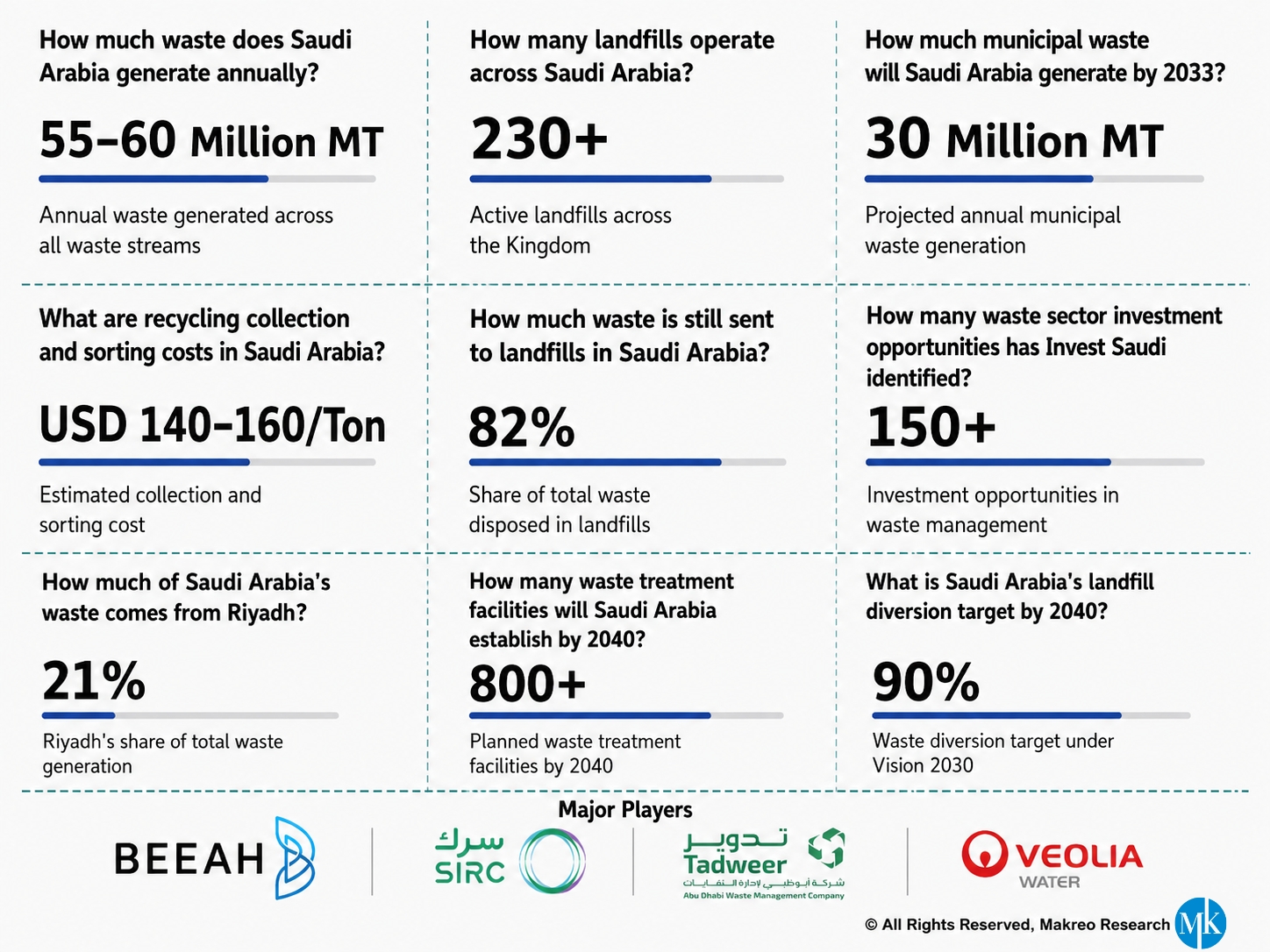
Saudi Arabia Waste Management Industry Insights
Saudi Arabia Waste Management Market Revenue, 2023 – 2026E
Makreo Research
Infrastructure Expansion and Strategic Trade Position
The Saudi Arabia waste management market is undergoing significant transformation, driven by rising waste generation, rapid urbanization, industrial expansion, and the government’s sustainability commitments under Vision 2030. Growing investment in waste collection systems, recycling infrastructure, resource recovery facilities, and advanced treatment technologies are accelerating the shift from a landfill-dependent waste management model toward a more integrated circular economy framework.
audi Arabia remains one of the largest waste generators in the Middle East, producing substantial volumes of municipal, industrial, construction, and hazardous waste annually. To address the environmental and economic pressures associated with increasing waste volumes, the Kingdom has established ambitious recycling and landfill diversion targets while supporting large-scale investment in recycling facilities, waste treatment infrastructure, and Saudi Arabia circular economy initiatives. These initiatives are positioning waste management as a strategic sector within Saudi Arabia's broader environmental sustainability and economic diversification agenda.
Saudi Arabia Waste Generation by Sector, 2024
Makreo Research
Organic and Construction Waste Driving Demand for Advanced Waste Management Solutions
Organic and construction waste constitute the largest waste streams in Saudi Arabia, collectively accounting for nearly 70% of the country's total waste generation. This waste composition is shaping investment priorities for both policymakers and waste management companies, with increasing emphasis on expanding recycling, composting, construction and demolition (C&D) waste processing, and resource recovery infrastructure.
In 2024, organic waste accounted for 45.7% of total waste generation, while construction and demolition waste represented 22.8%. Plastic waste contributed 7.8 million tons, equivalent to 5.8% of the total waste generated. The country's waste profile reflects rapid urbanization, rising consumption levels, and continued large-scale infrastructure and real estate development under national economic diversification initiatives.
Strategic Investments and Developments
-
National Environmental Recycling Company (Tadweeer) - In February 2026, Tadweeer signed a SAR 63.85 million raw materials purchase agreement with Topal Advanced Trading Company for recycling purposes. The contract has an indefinite duration and is expected to support a continuous supply of feedstock for recycling operations.
-
Saudi Investment Recycling Company (SIRC) - In January 2026, Hydrogen Utopia International and Saudi Investment Recycling Company signed a Memorandum of Understanding (MoU) to collaborate on waste-to-hydrogen and Sustainable Aviation Fuel (SAF) projects in Saudi Arabia, supporting the Kingdom’s clean energy transition and circular economy objectives.
-
Veolia Middle East Water Services LLC - In September 2025, Veolia, in consortium with Marafiq and Lamar, signed an agreement with SATORP to develop a large-scale industrial water treatment and recycling project in Jubail Industrial City. The project involves the construction, operation, and maintenance of the Middle East's largest industrial wastewater reuse plant, with an annual treatment capacity of approximately 8.8 million m³.
Scope of the Study for Saudi Arabia Waste Management Market
Makreo Research has published a comprehensive report titled "Saudi Arabia Waste Management Market and Forecast to 2031 - Analysis by Source (Households, Industrial, Construction, Agriculture, Forestry and Fishing and Others), Waste Type, Service Type, Ownership, and Province", The report provides a structured, in-depth evaluation of the Kingdom's waste management ecosystem, covering historical performance, current market dynamics, and forward-looking projections through 2030.
The study evaluates the development of the Saudi Arabia waste management sector, focusing on the principal structural factors shaping the industry, including:
Market Revenue and Category Analysis
The report presents a detailed assessment of the Saudi Arabia waste management market, examining historical performance, current Saudi Arabia waste management market size, and future growth prospects. It provides a comprehensive evaluation of waste generation trends, waste treatment activities, and revenue dynamics across the Kingdom's evolving waste management ecosystem. The analysis also covers Saudi Arabia waste management market segmentation by source, waste type, service type, ownership structure, and province, highlighting key demand drivers, operational characteristics, and regional variations.
Infrastructure and Service Ecosystem Analysis
-
The report evaluates Saudi Arabia's waste management ecosystem across municipal, industrial, hazardous, construction and demolition, and wastewater treatment segments, assessing waste generation patterns, treatment capacity, Saudi Arabia’s recycling infrastructure, and disposal practices.
-
Dedicated analysis examines recycling facilities, material recovery operations, landfill infrastructure, wastewater treatment assets, and Saudi Arabia’s circular economy initiatives, highlighting capacity expansion, waste diversion efforts, and resource recovery developments across the Kingdom.
-
Separate sections assess major waste management projects, regional market dynamics, service segmentation, and the operational capabilities of leading waste management companies, providing insights into infrastructure development and evolving waste treatment and recycling capabilities.
Competitive Landscape of Key Players
-
A dedicated section benchmarks leading waste management companies in Saudi Arabia across waste collection and treatment capabilities, recycling infrastructure, geographic presence, service portfolio, technology adoption, operational capacity, and facility networks.
-
Detailed Saudi Arabia waste management company profiles cover major waste management and recycling operators, highlighting business overviews, operational strengths, service offerings, strategic initiatives, sustainability programmes, infrastructure development, and key business highlights.
-
The report also examines mergers, acquisitions, investments, partnerships, and major project developments shaping the competitive dynamics of the Saudi Arabia waste management market and supporting the Kingdom's transition toward a circular economy.
Future Outlook and Strategic Considerations
-
The report concludes with forward-looking projections for the Saudi Arabia waste management market through 2031, covering waste generation trends, recycling and waste treatment capacity expansion, landfill diversion progress, and the evolution of circular economy initiatives across the Kingdom.
-
It identifies emerging opportunities in recycling, resource recovery, waste-to-energy projects, advanced waste treatment technologies, and sustainable waste infrastructure development, while assessing key challenges and policy developments expected to influence the Saudi Arabia waste management market outlook during the forecast period.
-
The study further examines the Saudi Arabia regional waste generation forecast, environmental targets, technology adoption trends, and strategic initiatives under Vision 2030. It provides insights into the long-term transformation of the sector and its transition toward a more sustainable and integrated waste management ecosystem.
-
2023 - 2026: Past and Present Scenario
-
2025: Base year of study
-
2026 – 2031: Future Outlook
Saudi Arabia Waste Management Market Segmentation
-
Household (Residential)
-
Industrial Sector
-
Construction Sector
-
Agriculture Sector
-
Forestry & Fishing Sector
-
Other Activities
-
Municiple Solid Waste (MSW)
-
Industrial Wate
-
Construction and Hazadous Waste
-
Agriculture Waste
-
E-Waste
-
Other Specialized Waste
-
Disposal & Treatment Services
-
Collection & Transportation Services
-
Recycling & Material Recovery Services
-
Waste Processing & Conversion Services
-
Government / Municipality Managed
-
Public-Private Partnership (PPP) Projects
-
Private Waste Management Operators
-
Soverign Backed / Semi – Government Operators
Geography Assessed
-
Riyadh
-
Makkah
-
Eastern Province
-
Rest of Saudi Arabia
-
Competition
-
Mergers, Acquisitions, and Investments
-
Company Profiles
Companies Covered in the Saudi Arabia Waste Management Market
-
Saudi Investment Recycling Company (SIRC)
-
Veolia Middle East Water Services LLC
-
BEEAH Group
-
SUEZ S.A.
-
National Environmental Recycling Company (Tadweeer)
The study covers a total of 10 Saudi Arabia Waste Management Market companies. To know more, please reach out to [email protected]
What's driving the Saudi Arabia waste management market? +
Which segment dominates the Saudi Arabia waste management market? +
Which waste streams dominate the Saudi Arabia waste management market? +
Who are the key players in the Saudi Arabia waste management market? +
What is the future outlook for the Saudi Arabia waste management market? +
Looking for a Section from Report? Start your Partial Purchase Request
Table of Contents
- 1.Research Methodology
- 1.1.Research Objective
- 1.2.Saudi Arabia Waste Management Market Definitions
- 1.3.Research Design and Procedure
- 1.4.Data Collection Methods
- 1.5.Research Methodology
- 1.6.Analytical Framework
- 2.Saudi Arabia Waste Management Market Analysis
- 2.1.Saudi Arabia Waste Management Market Overview
- 2.2.Saudi Arabia Waste Management Market Past and Present Performance
- 2.3.Saudi Arabia Waste Generation Volume Trends and Sectoral Distribution
- 2.4.Saudi Arabia Waste Streams and Material Composition
- 2.5.Saudi Arabia Industrial Waste Generation Landscape
- 2.6.Saudi Arabia Municipal Waste Generation Trends
- 2.6.1.Saudi Arabia Municipal Solid Waste Composition and Management Overview
- 2.7.Saudi Arabia Waste Disposal Methods Analysis
- 2.8.Saudi Arabia Desalination and Wastewater Treatment Landscape
- 2.9.Saudi Arabia Key Circular Economy Framework and Initiatives
- 2.10.Saudi Arabia Major Recent Waste Management Projects
- 2.11.Saudi Arabia Waste Management Cost Structure Analysis
- 3.Saudi Arabia Waste Management Market Segmentation
- 3.1.Saudi Arabia Waste Management Market Segmentation
- 3.1.1.Saudi Arabia Waste Management Market Segmentation by Source
- 3.1.2.Saudi Arabia Waste Management Market Segmentation by Waste Type
- 3.1.3.Saudi Arabia Waste Management Market Segmentation by Service Type
- 3.1.4.Saudi Arabia Waste Management Market Segmentation by Ownership
- 3.1.5.Saudi Arabia Waste Management Market Segmentation by Province
- 3.1.Saudi Arabia Waste Management Market Segmentation
- 4.Saudi Arabia Waste Management Market Case Studies
- 4.1.Saudi Arabia Waste Management Market Case Studies
- 5.Saudi Arabia Waste Management Infrastructure Analysis of Key Projects
- 5.1.NEOM Circular Economy and Advanced Wastewater Management Infrastructure
- 5.2.Red Sea Sustainable Waste Management & Circular Economy Infrastructure
- 5.3.Qiddiya Sustainable Waste Management Infrastructure
- 6.Saudi Arabia Waste Management Market Competitive Landscape
- 6.1.Saudi Arabi Top Companies Key Waste Management Statistics
- 6.2.Key Saudi Arabia Waste Management Companies Geographical Reach Comparison
- 6.3.Saudi Arabia Waste Management Market Key Companies Service Coverage Portfolio
- 6.4.Saudi Arabia Waste Management Market Key Companies Technology Capability Matrix
- 6.5.Saudi Arabia Top Companies Waste Management Facilities Comparison
- 6.6.Saudi Arabia Top Waste Management Companies Operational Capacity
- 7.Saudi Arabia Waste Management Market Mergers /Acquisitions/ Investments/ Divestments
- 7.1.Mergers /Acquisitions/ Investments/ Divestments
- 8.Saudi Arabia Waste Management Market Company Profiles
- 8.1.Player 1 - Business Overview
- 8.1.1.Key Subsidiaries
- 8.1.2.Circular Economy Framework
- 8.1.3.Company Timeline
- 8.1.4.Business Highlights
- 8.2.Player 2 - Business Overview
- 8.2.1.Service Portfolio
- 8.2.2.Business Highlights
- 8.2.3.Business Financials
- 8.3.Player 3 - Business Overview
- 8.3.1.Company Timeline
- 8.3.2.Operational Highlights
- 8.3.3.Business Highlights
- 8.4.Player 4 - Business Overview
- 8.4.1.Operational Highlights
- 8.4.2.Business Highlights
- 8.4.3.Key Waste Indicators
- 8.4.4.Business Financials
- 8.5.Player 5 - Business Overview
- 8.5.1.Operational Highlights
- 8.5.2.Business Highlights
- 8.5.3.Business Financials
- 8.6.Player 6 - Business Overview
- 8.6.1.Company Timeline
- 8.6.2.Waste Management Service portfolio
- 8.7.Player 7 - Business Overview
- 8.7.1.Waste Management Business Units
- 8.7.2.Waste Management Impact Statistics
- 8.7.3.Business Highlights
- 8.8.Player 8 - Business Overview
- 8.8.1.Service Portfolio
- 8.9.Player 9 - Business Overview
- 8.9.1.Waste Management Services
- 8.9.2.Client Portfolio
- 8.10.Player 10 - Business Overview
- 8.10.1.Company Timeline & Recycling Streams
- 8.10.2.Waste Management Service Portfolio
- 8.10.3.Business Highlights
- 8.1.Player 1 - Business Overview
- 9.Saudi Arabia Waste Management Market Challenges
- 9.1.Saudi Arabia Waste Management Market Challenges Overview
- 9.1.1.Saudi Arabia Waste Management Market Challenges
- 9.1.Saudi Arabia Waste Management Market Challenges Overview
- 10.Saudi Arabia Waste Management Market Opportunities
- 10.1.Saudi Arabia Waste Management Market Opportunities Overview
- 10.1.1Saudi Arabia Waste Management Market Opportunities
- 10.1.Saudi Arabia Waste Management Market Opportunities Overview
- 11.Saudi Arabia Waste Management Market Future Outlook
- 11.1.Saudi Arabia Waste Management Market Future Outlook
- 11.2.Saudi Arabia Recycling and Waste Treatment Capacity Outlook
- 11.3.Saudi Arabia Landfill Diversion Targets
- 11.4.Saudi Arabia Waste Generation Trends Forecast Across Key Regions
- 11.5.Saudi Arabia Waste Management Technology Developments and Future Trends
- 11.6.Saudi Arabia Environmental and Waste Management Goals and Initiatives
- 11.7.Saudi Arabia Waste Management Market Scenario Analysis
- Limitations of the Study
Related Reports - Services