
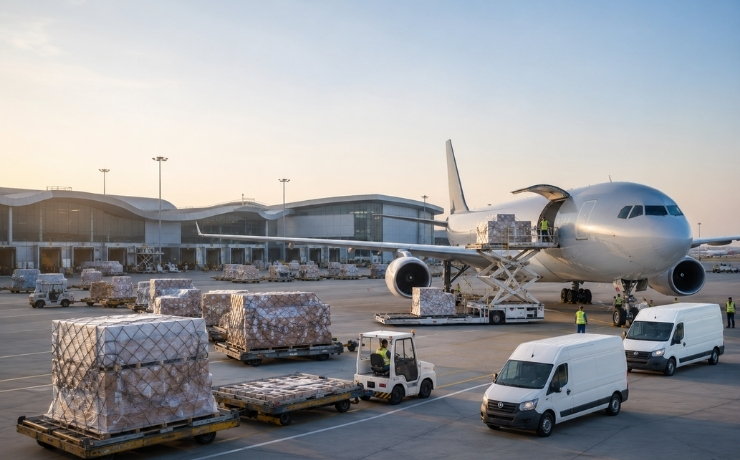
India Air Cargo Market 2026 - Traffic Reaches 3.96 Million Tonnes as New Airport Hubs and Export Demand Reshape the Industry
Explore India's Air Cargo and Express Logistics Market 2026, with 3.96M tonnes of freight traffic, new airport hubs, export demand, capacity trends and industry outlook.
India's air cargo and express logistics sector is entering one of its most consequential periods in years. Within a year, the government has scaled up a national transshipment reform, two new airports have handled their first international cargo shipments, global integrators have committed fresh capital to automated hubs, and India's export basket has shifted decisively toward electronics.
Makreo Research estimates that India's air cargo traffic could rise from approximately 3.9 million tonnes in FY2026 to 6.9 million tonnes by FY2030. Achieving this trajectory will require faster throughput growth, supported by new airport capacity, export-oriented manufacturing, rising express demand and a larger role for India as a regional transshipment gateway. This estimate represents Makreo Research's proprietary forecast. The latest public baseline reported for FY2025-26 is approximately 3.96 million tonnes, up 6.2% year on year, across a network of 74 airports handling cargo operations.
India Air Cargo Capacity Reaches 3.9 Million Tonne
According to Makreo Research's India Air Cargo and Express Logistics Market and Forecast to 2031 report, India's air cargo capacity reached 3.9 million tonnes in FY2026, representing a 47% increase over the past decade. As of January 2026, India ranked sixth globally and third in domestic air freight, according to the study. The report covers FY2023 to FY2031, with FY2026E as the base year, and forecasts a study-period volume CAGR of 1.30%.
Within the combined India Air Cargo and Courier Services market, air cargo accounted for 88.90% of volume in FY2026, while courier and express parcel movement represented the remaining 11.10%.
Government policy has set a considerably more ambitious target, with air cargo capacity expected to reach 10 million tonnes by 2030 and 21 million tonnes by 2047. The gap between the study-period volume CAGR and these policy targets provides an important lens for the market outlook. Infrastructure investment, procedural reforms and changes in cargo demand, rather than historical growth alone, will determine how much of this capacity ambition can be realised.
Demand Shifts as Electronics, Services, Perishables and E-commerce Exports Expand
India's combined goods and services exports reached a record USD 863.1 billion in FY2025-26, according to the Ministry of Commerce and Industry, up 4.6 percent on the prior year. Merchandise exports rose a modest 0.93 percent to USD 441.8 billion, while services surged 8.71 percent to USD 421.3 billion, a shift that leaves the two nearly at parity. Electronics has emerged as the standout goods category: mobile phone exports reached approximately INR 2.59 lakh crore in FY2025-26, a 165 fold increase over the past decade, according to figures cited by the Ministry of Electronics and Information Technology, while overall electronics exports reached INR 4.24 lakh crore. That momentum carried into the new fiscal year, with smartphone exports of USD 9.84 billion in April to June 2026, up 23.4 percent year on year and equal to 64.8 percent of India's USD 15.2 billion electronics exports that quarter; the United States accounted for roughly 71 percent of export value.
On the cargo side specifically, Makreo Research's analysis estimates India's total agricultural exports at approximately USD 52.55 billion in FY2026, with seafood the largest perishables contributor at roughly USD 8.28 billion (INR 72,325 crore) across nearly 1.93 million tonnes, driven substantially by frozen shrimp. Maharashtra alone handled around 33,638 metric tonnes of air shipped perishables, supported by more than 130 export oriented units. Express and e-commerce logistics have concentrated further - Shadowfax Technologies, which listed on Indian exchanges in January 2026 after raising roughly INR 1,907 crore, grew its share of e-commerce parcel shipments from about 8 percent in FY2022 to roughly 23 percent by the first half of FY2026, while Delhivery completed its acquisition of Ecom Express in July 2025 at a final consideration of INR 1,369 crore, consolidating two of the country's largest last mile networks.
India Air Cargo Infrastructure Expands With New Gateways and Transshipment Reform
-
Navi Mumbai International Airport moved from a purely domestic facility to an international cargo gateway within weeks. Air India Express carried the airport's first international export shipment, a 1.79 tonne consignment of Konkan guava and moringa, to Abu Dhabi on 15 July 2026, and Hong Kong Air Cargo became the first international carrier to launch dedicated freighter operations from NMIA on 16 August 2026, opening a new international cargo channel for western India.
-
Noida International Airport, with the IATA code DXN, received its DGCA aerodrome licence on 6 March 2026 and welcomed its first commercial passenger flights on 15 June 2026. Its Integrated Cargo Terminal, developed by Air India SATS, offers 22,000 square metres of warehouse space, two dedicated freighter bays operating around the clock, 19 truck docks and nine X-ray machines. On 24 August 2026, Air India SATS signed a memorandum of understanding with Spicexpress and Total Solutions to expand freighter operations, positioning the terminal as a multi-modal cargo hub for North India; the airport's original masterplan sets out cargo capacity rising from roughly 250,000 tonnes in Phase I to more than 1.1 million tonnes at full build-out.
-
Delhi's Indira Gandhi International Airport recorded two step changes of its own. On 19 August 2026, the Ministry of Civil Aviation scaled up its transshipment cargo reform, removing the requirement to re-screen secure transshipment cargo. A proof of concept on the Chennai to Delhi to Frankfurt route had already cut average end to end transit time from around 60 hours to 20 hours and lifted aircraft capacity utilisation from roughly 75 percent toward 100 percent; the network has since been extended to four more domestic origins, Bengaluru, Ahmedabad, Mumbai and Hyderabad, and two new international destinations, London and Copenhagen, a change projected to lift Air India's monthly cargo carriage on these lanes from 1,763 to 3,183 tonnes. Separately, on 25 August 2026, FedEx announced a proposed USD 150 million, 230,000 square foot automated air cargo hub at GMR Cargo City, designed to raise processing capacity from 600 to 5,000 packages an hour within a wider 50 acre, up to 2 million square foot cargo development.
-
Bengaluru's Kempegowda International Airport added a 60,000 square foot FedEx hub at the AISATS Logistics Park in December 2025, with throughput of nearly 4,000 packages an hour, as the airport works toward nearly doubling annual cargo capacity to 1 million tonnes. Airports Authority of India data show total cargo volume across Indian airports reached 3.62 million tonnes in the 2025-26 year to February, with roughly 90 percent of traffic concentrated at a handful of hubs: Delhi around 30 percent of national volume and over 1.04 million tonnes, followed by Mumbai at over 0.84 million tonnes, Bengaluru at over 0.48 million tonnes and Chennai at over 0.38 million tonnes. Monthly AAI figures show cargo volumes continuing to climb through the year, from 328,613 tonnes in February 2026 to 343,399 tonnes in March.
India Air Cargo Trade Flows Diversify as Gulf Disruption Reshapes Global Freight Routes
The past year has not been uniformly smooth. According to the International Air Transport Association data, notes that global cargo tonne-kilometres fell 4.8 percent year on year in March 2026 and international air cargo traffic fell 5.5 percent, with Middle Eastern air cargo demand contracting 54.3 percent as Gulf hub connectivity weakened; Africa gained 7.0 percent from diverted traffic and the Europe to Asia lane expanded 14.2 percent. India's exposure to this Gulf-linked disruption has been partly offset by Chennai's electronics-led export growth, an illustration of how India's air cargo demand is diversifying across trade lanes rather than concentrating on any single corridor.
Pharmaceuticals and perishables remain structurally reliant on cold chain capability; India's cold storage network has expanded past 8,800 facilities nationally, per Makreo Research's analysis, underpinning growth in agricultural and pharmaceutical exports even as general cargo growth stays comparatively modest. Electronics, meanwhile, continues to be the fastest growing high value category, reinforcing airport and forwarder investment in dimensioning, security and bonded customs infrastructure built specifically for time sensitive, high value shipments.
Cargo-Specific Requirements Are Reshaping Air Freight Procurement in India
Procurement priorities vary sharply by cargo type. Pharmaceutical and healthcare shippers prioritise temperature control and certification; Air India Cargo, for example, has built its perishables and pharma handling around GDP certified facilities, cool dollies and thermal blankets to preserve cold chain integrity from origin to destination. Electronics and high value manufacturers value processing speed, security and dimensioning accuracy, which is why the new hubs at Bengaluru and Delhi have been built around high speed, non-contact dimensioning equipment, advanced X-ray systems and auto-sorters capable of several thousand packages an hour.
Perishables exporters need consistent transit times and cold chain continuity at both ends of a shipment; Air India's new Navi Mumbai to Abu Dhabi route, for instance, was engineered around temperature controlled handling between 15 and 25 degrees Celsius before and after the flight. E-commerce and express shippers weigh network coverage, reverse logistics reliability and cost competitiveness; Delhivery's post-acquisition network now spans more than 18,800 pin codes and over 48,000 active customers, while integrators continue to expand automated sort centres and gateway facilities. Across cargo types, providers able to combine physical infrastructure with digital visibility, customs expertise and nationwide distribution are best placed to win share, a dynamic reflected in Allcargo Logistics' own Vision 2030 target of roughly doubling its air freight volume from about 34,000 to 60,000 tonnes, according to Makreo Research's analysis.
India Air Cargo Technology Moves From Automation Pilots to Hub-Wide Deployment
Regulatory technology change has driven some of the year's largest efficiency gains. Delhi's transshipment reform replaced mandatory physical re-screening with dedicated Transfer Cargo Security Hold Areas, under a security framework first notified by the Bureau of Civil Aviation Security in July 2025 and then scaled nationally in August 2026. Physical automation is following at pace: FedEx's new Bengaluru and Delhi hubs are built around auto-sorters, high speed dimensioning and intelligent package handling systems, while Noida's Integrated Cargo Terminal runs on cargo community systems for real time tracking and smarter operations.
Digital twins are also emerging at metro cargo terminals, creating virtual replicas of physical operations to shift planning from reactive to predictive, according to industry reporting on the Airports Authority of India's cargo modernisation programme. On the express parcel side, Delhivery's infrastructure now includes 50 automated sort centres and 123 gateways nationally, illustrating how technology investment has spread from air cargo terminals into the broader express and e-commerce logistics stack that increasingly interconnects with air freight.
India Express Logistics Market Sees Consolidation, Automation and Infrastructure Investment
Blue Dart Express, part of DHL Group's eCommerce division, reported revenue from operations of INR 6,141 crore for the year ended March 2026, up from INR 5,720 crore the prior year, with profit after tax of INR 240 crore; the company attributed the growth to sustained momentum across e-commerce and B2B surface express solutions. DHL Group announced in November 2025 that it will invest around EUR 1 billion across its Indian business units by 2030, spanning a new health logistics hub in Bhiwandi, a low emission integrated facility for Blue Dart in Bijwasan, an automated sorting centre for DHL Express in Delhi, a fifth IT services centre in Indore, and electric vehicle and battery logistics centres of excellence in Chennai and Mumbai.
The express parcel segment consolidated further over the same period.
-
Delhivery's acquisition of Ecom Express completed in July 2025 at a final consideration of INR 1,369 crore.
-
Shadowfax Technologies took a different route to scale, listing on Indian exchanges in January 2026 after growing FY2025 revenue 31.8 percent to roughly INR 2,485 crore.
-
FedEx, meanwhile, has made India a focal point of its regional strategy, following its Bengaluru hub with the proposed USD 150 million Delhi facility; combined with GMR's wider Cargo City development, the investment signals sustained confidence in Delhi's role as a global air cargo gateway.
Together, these developments point to a competitive landscape where scale, automation and multi-modal infrastructure access, rather than fleet size alone, increasingly determine positioning.
Where Are India's Strongest Air Cargo Opportunities
Domestic express offers the clearest volume opportunity as e-commerce, omnichannel retail and urgent B2B replenishment create dense non-metro lanes. International express is smaller but potentially higher value across SME exports, cross-border e-commerce, customs support and time-definite delivery to the United States, Europe, Australia and the Gulf.
General air cargo will remain tied to trade cycles and passenger schedules. Temperature-controlled cargo offers a more defensible specialist opportunity because pharma, vaccines, diagnostics and selected perishables require validated facilities, monitoring and trained handling. Electronics, semiconductors, automotive components and aerospace spares create another high-value pool where security, speed and production-continuity economics matter more than shipment weight.
Near-term geographic opportunities cluster around Noida and Navi Mumbai, southern manufacturing corridors anchored by Chennai, Bengaluru and Hyderabad, and selected Tier-II cities with export industry or perishables. Infrastructure should match each hinterland's cargo rather than replicate one terminal model nationwide.
India Air Cargo and Express Logistics Market outlook to 2031- What Drives Growth
Makreo Research and Consulting's India Air Cargo and Express Logistics Market and Forecast to 2031 study projects a study period CAGR of 1.30 percent by volume from FY2023 to FY2031, a modest headline figure for a market layering substantial new capacity, automated infrastructure and policy reform on top of its existing base.
Several variables will determine how much of that infrastructure investment converts into faster volume growth through 2031: the pace at which Middle East hub disruption normalises and Indian carriers absorb diverted demand; how quickly dedicated freighter capacity supplements India's traditionally belly-cargo-dependent model; whether Tier II and Tier III airports close their infrastructure gap in cold chain, warehousing and handling equipment; and how far the transshipment framework extends beyond domestic-to-international routes into international-to-international and international-to-domestic movements, a direction the Ministry of Civil Aviation has signalled it intends to pursue.
Government capacity targets of 10 million tonnes by 2030 and 21 million tonnes by 2047 imply a materially steeper trajectory than the study period average, underscoring the scale of infrastructure and policy execution still required, and the extent to which the next several years, rather than the historical decade, will determine whether India's air cargo and express logistics market meets its stated ambition.
Strategic Considerations for India India Air Cargo and Express Logistics Industry
The developments outlined above carry different implications depending on where a business sits in the value chain.
-
Airlines and cargo carriers face a widening opportunity in transshipment and freighter capacity, but will need to weigh fleet investment against the pace of hub and security framework rollout.
-
Express integrators and freight forwarders are increasingly competing on automation and multi-modal connectivity rather than network size alone, as the Bengaluru and Delhi hub investments illustrate.
-
Airport operators and ground handling companies have a widening role in shaping cargo competitiveness through terminal design, digital systems and cold chain infrastructure, particularly at Navi Mumbai, Noida and Tier II and III locations.
-
Manufacturers, exporters and e-commerce businesses stand to benefit from faster international connectivity and reformed transshipment procedures, but need logistics partners capable of matching product-specific requirements, from cold chain to high value security.
-
Technology providers have an expanding addressable market across automated handling, digital twins, customs technology and shipment visibility, as terminals across the network modernise in parallel.
As India’s air cargo and express logistics ecosystem expands through new gateways, streamlined procedures and industry consolidation, understanding market demand, cargo flows, customer segments, regional opportunities, capacity, competitive positioning, procurement requirements, technology adoption and pricing dynamics is becoming essential for market entry, feasibility assessment, partnerships and expansion planning.
Makreo Research’s India Air Cargo and Express Logistics Market analysis supports these decisions by combining proprietary market sizing and segmentation with structured competitive benchmarking across shipment categories, service types, cargo types, capacity types and geographies.
Companies seeking to assess demand, cargo flows, competitive positioning, infrastructure and regional opportunities across India’s air cargo, express delivery, courier and broader logistics ecosystem can draw on Makreo Research’s Consulting Services, feasibility studies, competitive benchmarking, customer mapping, partnership assessment, market-entry strategy and Market Survey Services.
To discuss market-entry, expansion or competitive-benchmarking requirements, contact Makreo Research and Consulting at [email protected].
India air cargo market, India air freight market, India logistics market, India express logistics market, air cargo industry India, logistics industry in India, air cargo services India, air freight services India, freight forwarding India, India freight and logistics market, courier express and parcel market India, India courier market, India e-commerce logistics market, express delivery market India, India cargo traffic, airport cargo infrastructure India, India air cargo market size, India air cargo market forecast, India air cargo market 2026, India air cargo market forecast 2031, India logistics market size, India logistics market forecast, air cargo growth in India, future of air cargo in India, how big is India air cargo market, India cross-border e-commerce logistics, India pharmaceutical logistics market, India cold chain logistics market, India air cargo automation, India air cargo transshipment hub