
Vietnam's E-Commerce Market 2026 - How TikTok Shop, Rising Platform Fees, and a New E-Commerce Law Are Redefining a $32 Billion Industry
Vietnam's e-commerce market hit $32B in 2025. New fees, a July 2026 law, and TikTok Shop's rise are rewriting who wins. See what Makreo found.
For a decade, Vietnam's e-commerce story was a subsidy story: free shipping, deep discounts, and a race for user acquisition. That story just ended. In 2025, platforms began raising fees, regulators began enforcing them, and Vietnamese shoppers started asking harder questions before they clicked “buy.” What comes next will decide which operators actually make it to 2030.
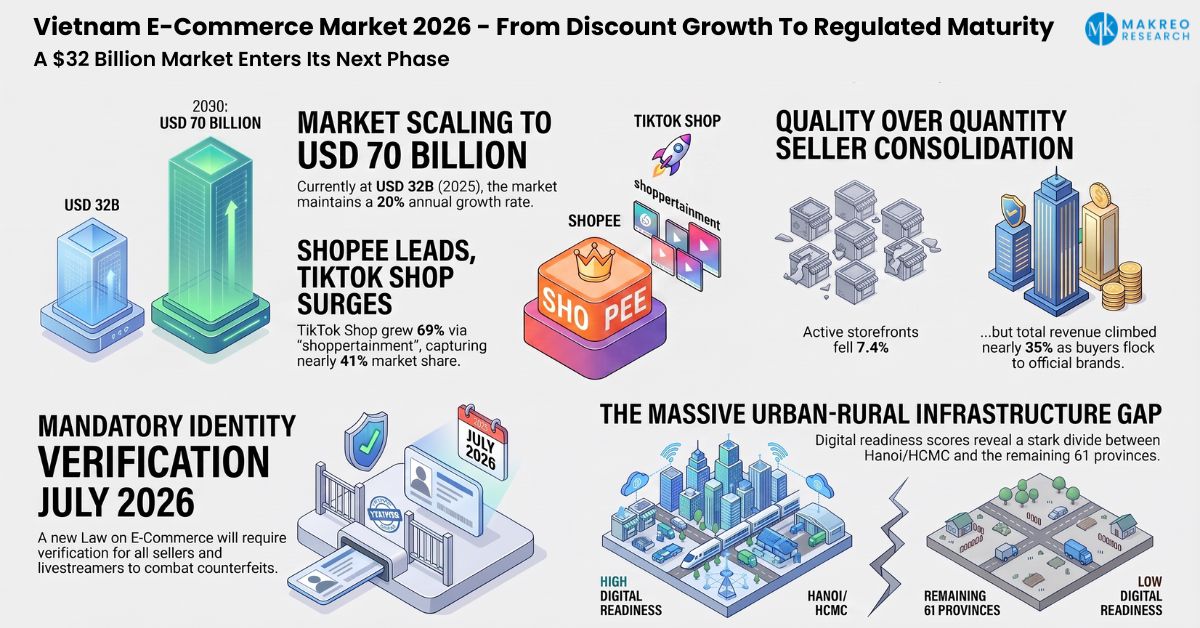
Vietnam's online retail market crossed USD 32 billion in 2025, sustaining 20 percent annual growth and pushing e-commerce to roughly 12 percent of total retail and consumer services revenue, according to Vietnam's Ministry of Industry and Trade. That places Vietnam among the top three e-commerce markets in Southeast Asia, and by 2030, the Ministry expects retail e-commerce revenue to reach as high as USD 70 billion, ranking third in the region behind Thailand and Indonesia.
The headline number, though, is the least interesting part of this story. The real narrative is structural: a market moving from cash-burning growth to disciplined, fee-based, regulated commerce, with clear winners and clear casualties already emerging.
Entering Vietnam's e-commerce market? Makreo's Consumer Products & Retail practice has run 15,000+ consumer surveys across 20+ countries and 25+ sub-sectors, including apparel, e-commerce, electronics, and home furnishing. Speak to an Analyst →
Where the Vietnam ECommerce Growth Is Actually Coming From
Vietnam's e-commerce and digital economy agency under the Ministry of Industry and Trade confirms that 2025 sustained double digit growth of 20 percent even as the underlying dynamics shifted hard. Tax authorities collected VND 208.8 trillion from e-commerce activity in 2025, up 80 percent year on year, evidence that the informal, untracked corner of the market is shrinking fast under enforcement pressure.
At the same time, consumer demand keeps broadening. Categories once dominated by electronics and fashion now see near-daily purchases of FMCG, fresh food, and health products, with e-wallets and QR codes now covering the majority of transactions. This is no longer a market defined by occasional big-ticket purchases; it is one where e-commerce has become part of daily consumption.
Shopee's Lead Is Real. So Is TikTok Shop's Momentum
Vietnam's four dominant platforms, Shopee, TikTok Shop, Lazada, and Tiki, are no longer competing on the same terms. Shopee still leads with roughly 56 to 58 percent revenue share, but its growth has slowed sharply to around 4 percent year on year in Q3 2025. TikTok Shop, by contrast, posted 69 percent revenue growth over the same period, expanding its market share from around 29 percent to 39 to 41 percent, according to data from Vietnamese e-commerce analytics platform Metric.vn.
That shift is not just about discounting anymore; it is about format. TikTok Shop's growth is built on shoppertainment, where livestreaming and short-form video convert browsing into buying in real time. Vietnamese e-commerce expert Tran Lam, founder of local brands Julyhouse and Macaland, points to a quieter but equally consequential shift: rising platform fees. “The fees are not raised in one move, but gradually and continuously,” he noted. “Each increase may seem small, but together they create significant pressure on sellers.”
That pressure is visible in the numbers. Active seller storefronts across the four major platforms fell 7.4 percent year on year to 601,800 by the end of 2025, with more than 13,700 shops removed by regulators for selling counterfeit, banned, or untraceable goods. Yet combined platform revenue still climbed to VND 429 trillion (USD 16.5 billion), up nearly 34.8 percent. The market is not shrinking; it is consolidating around fewer, stronger, better-compliant sellers.
The Consumer Has Changed the Question From “How Cheap” to “How Trustworthy”
Vietnam's shopper has become measurably more selective. In Q4 2025, transaction volumes on the major platforms fell 8 percent year on year even as average selling prices rose 33 percent, driven largely by sellers passing higher platform fees through to consumers. Rather than retreating, buyers are filtering: the share of revenue flowing to official brand stores rose from around 25 percent in early 2024 to nearly 32 percent a year later, even though official stores still account for under 3 percent of total shop listings.
Transparency, credibility, and consistent service now sit alongside price as decision factors. For brands and platforms still competing purely on discount depth, that is an increasingly losing strategy.
A New Law Changes the Rules on July 1
Vietnam's Law on E-Commerce takes effect on July 1, 2026, and it marks the most significant regulatory shift the sector has seen. The law introduces mandatory identity verification for sellers and livestreamers, a measure the Vietnam Association for Anti-Counterfeiting and Trademark Protection expects to become a central tool against counterfeit goods and intellectual property violations. Le Thi Ha of the Vietnam E-Commerce and Digital Economy Agency describes it as a foundational step in building a transparent, safe, and sustainable digital trade environment, rather than a barrier to online commerce.
For platforms and sellers, this means new compliance costs and new verification workflows arriving at the same time fee structures are already rising. For consumers, it should mean fewer counterfeit listings and clearer recourse when something goes wrong. For market entrants, it means Vietnam is no longer a lightly regulated market where speed alone wins; regulatory readiness is now a market entry requirement, not an afterthought.
The Logistics Backbone Is Strong in Two Cities and Thin Everywhere Else
Vietnam's parcel networks processed an estimated 3.2 billion parcels in 2024, with roughly 75 percent tied to e-commerce, a 30 percent year-on-year increase, alongside more than 75 percent of transactions now completed through e-wallets or QR codes. That is a genuinely mature logistics and payments backbone by regional standards.
But the Vietnam E-Business Index 2025 from the Vietnam E-commerce Association shows exactly where that strength stops. Hanoi scored 74.7 points and Ho Chi Minh City scored 73.5, against a national average of just 9.3. The best-performing of the remaining 61 provinces reached only 4.5 points in B2C digital readiness. That is not a minor regional gap; it is a structural divide between two metro hubs and the rest of the country, and it defines where the next phase of growth, and the next phase of investment risk, will actually play out.
Cross-Border Trade - The Opportunity Vietnam Has Barely Touched
Vietnam's cross-border e-commerce position is unusual: strong on imports, still largely untapped on exports. On the import side, foreign goods sold through Vietnam's four major platforms reached USD 285 million in H1 2025, with more than 164 million products transacted, a 7 percent year-on-year increase, building on a 2024 that saw a 38 percent rise in cross-border product arrivals and a 43 percent jump in associated sales value.
On the export side, the potential is significantly larger than current execution. Vietnam's e-commerce exports are projected to grow 1.7 times between 2023 and 2028, from USD 3.5 billion to USD 5.8 billion, with MSMEs contributing around 25 percent of that value. Yet according to recent industry analysis, an estimated 85 percent of Vietnam's cross-border e-commerce potential remains untapped, largely because Vietnamese manufacturers still sell heavily through contract manufacturing and foreign private labels rather than building their own export-ready brands. Logistics costs, customs complexity, and limited digital marketing and marketplace management experience remain the biggest constraints for SMEs looking to make that shift from producer to global brand.
Capital Is Already Repositioning Around This Shift
The scale of recent investment activity confirms that global and regional players are not waiting for the market to settle before committing capital.
-
TikTok Shop Vietnam invested USD 125 million into Ho Chi Minh City in Q1 2026 alone, ranking among the city's top ten FDI projects for the quarter. The platform has filed to establish three new onshore entities inside Ho Chi Minh City's Vietnam International Financial Centre: a logistics operation designed to handle one to two billion transactions annually, a digital payments entity serving TikTok's roughly 45 million Vietnamese users, and an e-commerce business targeting over USD 10 billion in annual GMV.
-
AnyMind Group, a BPaaS platform for marketing and e-commerce, agreed to acquire Vietnamese live and social commerce agency Vibula, its first acquisition in Vietnam and eleventh globally. Vibula operates 40 livestreaming studios in Ho Chi Minh City and brings a deep influencer and live-host network, capabilities AnyMind is positioning at the center of its regional live commerce strategy.
-
In offline retail, Thailand's Central Retail exited its Nguyen Kim electronics chain, selling it to rival Pico for approximately USD 36 million and booking an impairment loss of more than USD 190 million, a clear signal of how much pressure e-commerce and channel consolidation are putting on legacy electronics retail formats.
-
Mobile World Investment Corporation approved plans for its Dien May Xanh Investment subsidiary, Vietnam's dominant electronics retail chain, to pursue an IPO and stock market listing in 2026.
Together, these moves show capital consolidating around infrastructure, live commerce capability, and retail quality rather than simply chasing platform growth for its own sake.
What This Means Through 2030
Three forces will define who wins the next phase of Vietnam's e-commerce market. Consolidation will continue, with larger platforms, brand-authorized stores, and compliant sellers capturing a growing share of revenue as smaller, thinner-margin sellers exit or move to social and offline channels. Shoppertainment will deepen its hold, since livestreaming and short-form video already anchor the purchasing habits of the Gen Z and Millennial consumers who make up more than 72.5 percent of the online shopper base. And cross-border export expansion represents the longest-horizon opportunity of the three, contingent on Vietnamese sellers building their own brands rather than remaining anonymous manufacturers behind someone else's label.
The constraints are just as real. Logistics bottlenecks outside Hanoi and Ho Chi Minh City, particularly in last-mile delivery, rural coverage, and cold-chain infrastructure, remain a binding limit on national growth. The new E-Commerce Law effective July 2026 will require real compliance investment from platforms and sellers alike. Talent shortages in data analytics, AI-driven personalization, and omnichannel fulfilment will slow how quickly Vietnamese operators can adopt next-generation capabilities. And a meaningful share of the population, particularly middle-aged and elderly consumers, remains outside the addressable market for pure-play e-commerce, defining the practical ceiling on how large this market can get without deeper behavioral and infrastructure change.
Why This Is the Moment for Structured Market Intelligence
Vietnam's e-commerce market rewards operators who move early and punishes those who assume the last five years of playbooks still work. Rising platform fees, tighter regulation, shifting consumer psychology, and intensifying platform competition are compressing the window for uninformed market entry, exactly when the reward for getting it right, a market on track for USD 50 to 70 billion by 2030, is largest.
Makreo Research and Consulting supports institutional investors, platform operators, cross-border sellers, logistics providers, and consumer brands across apparel, e-commerce, electronics, and home furnishing who need to move on this market with confidence rather than assumption. Our custom research and market survey solutions are built around the specific decisions Vietnam's e-commerce shift is forcing across your organization, whether that decision sits with Strategy and Corporate Planning, Product Management, Sales and Marketing, Supply Chain, or Policy and Regulatory Affairs.
If you are exploring market entry, expansion strategy, or competitive benchmarking in Vietnam's e-commerce and consumer retail landscape, our research capabilities can help you move with confidence:
-
Market Survey / Customer Validation Study, testing product-market fit, pricing sensitivity, and brand perception directly with Vietnamese consumers before you commit capital
-
Custom Research / Market Expansion and Opportunity Assessment, mapping platform economics, seller consolidation trends, regulatory exposure, and competitive positioning specific to your category
Whether the decision on the table is a platform partnership, a cross-border export strategy, a pricing model built for a more fee-sensitive consumer, or a compliance roadmap for the new E-Commerce Law, Makreo's analysts translate Vietnam's shifting e-commerce landscape into a research-backed answer your leadership can act on.
Frequently Asked Questions
How big is Vietnam's e-commerce market in 2025, and how fast is it growing?
Vietnam's e-commerce market reached USD 32 billion in 2025, sustaining 20 percent annual growth and representing roughly 12 percent of total retail and consumer services revenue. Vietnam's Ministry of Industry and Trade projects the market could reach up to USD 70 billion by 2030, keeping Vietnam among Southeast Asia's top three e-commerce markets.
Is TikTok Shop overtaking Shopee in Vietnam?
Not yet, but it is closing fast. Shopee still holds a 56 to 58 percent revenue share, but its growth slowed to about 4 percent year on year in Q3 2025. TikTok Shop grew 69 percent in the same period, expanding its share from around 29 percent to 39 to 41 percent, driven largely by livestream and short-video shoppertainment formats.
What does Vietnam's new E-Commerce Law change starting July 2026?
The Law on E-Commerce, effective July 1, 2026, introduces mandatory identity verification for online sellers and livestreamers, strengthens consumer protection, and tightens obligations around counterfeit and untraceable goods. It follows a year in which regulators already removed more than 13,700 violating shops from major platforms.
Why are Vietnamese e-commerce sellers leaving the platforms even as revenue grows?
Rising platform and infrastructure fees, stricter tax enforcement, and regulatory crackdowns on counterfeit or untraceable goods are pushing out smaller, thinner-margin sellers. Active shop count fell 7.4 percent year on year in 2025, yet combined platform revenue rose nearly 34.8 percent, showing consolidation toward larger, compliant, better-capitalized sellers rather than market contraction.
Vietnam e-commerce market 2026, TikTok Shop Vietnam, Shopee vs TikTok Shop Vietnam, Vietnam e-commerce law 2026, Vietnam e-commerce market size, Vietnam retail e-commerce, Vietnam cross-border e-commerce, Vietnam shoppertainment, Vietnam e-commerce market growth, Vietnam e-commerce M&A 2026, TikTok Shop Vietnam investment, Vietnam e-commerce market forecast 2030, Shopee Vietnam market share, Vietnam e-commerce association VECOM, Vietnam Ministry of Industry and Trade, Vietnam international financial centre, Vietnam cross-border e-commerce exports, Vietnam e-commerce platform competition, Vietnam consumer retail market, Vietnam regulatory compliance e-commerce