
How Big Can the India Polymer Banknote Substrate Market Get? Inside RBI's ₹3,000 Crore Tender and the Road to 2031
Explore India’s polymer banknote substrate market in 2026, including RBI’s two-billion-note trial, the 68,000-ream EOI, FY28 rollout target, security features and supplier opportunities.
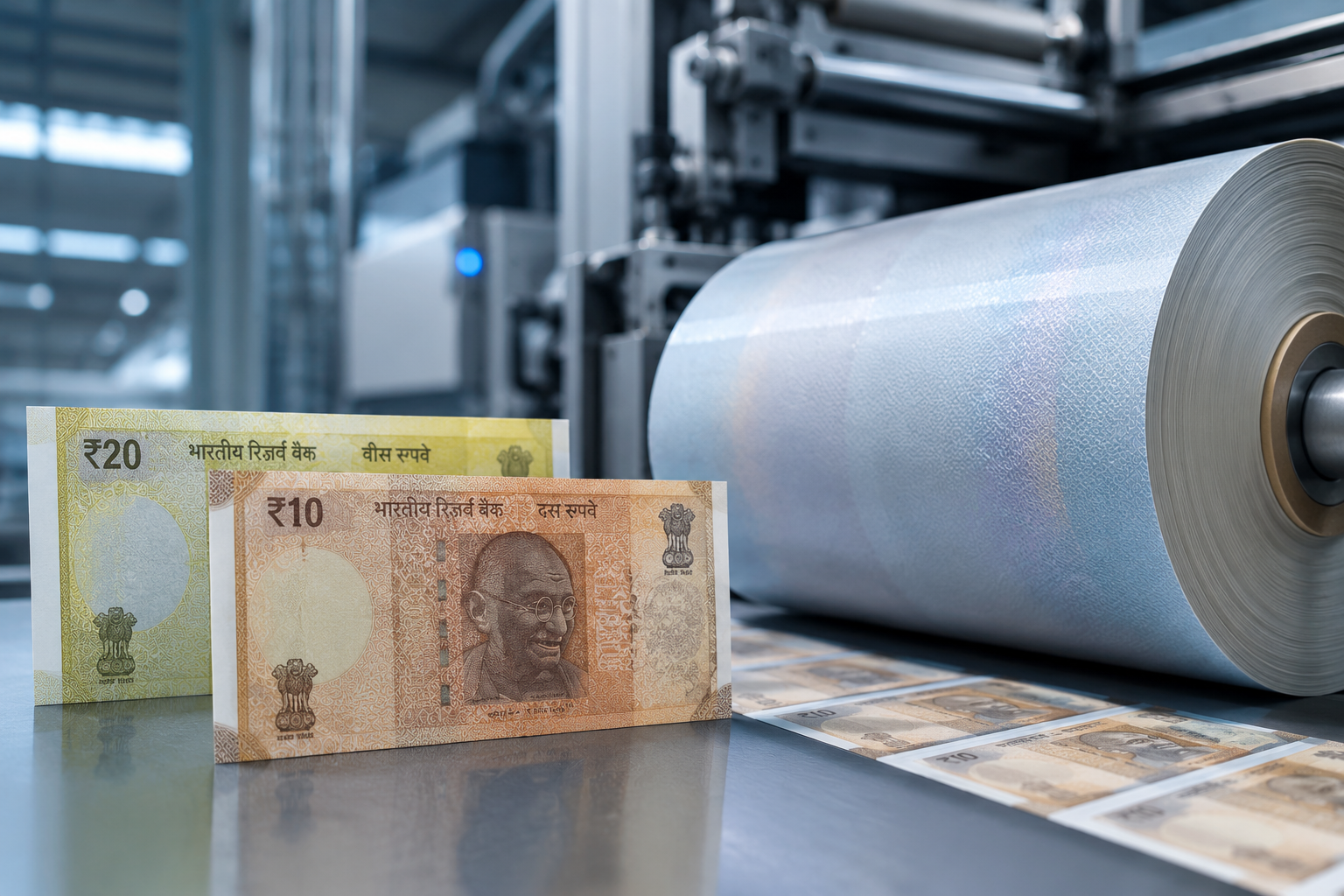
India’s currency management system is entering one of its most significant periods of change in over a decade. Between June and August 2026, the Reserve Bank of India’s currency-printing arm initiated a global procurement process for polymer banknote substrate, while the Government of India approved field trials covering two billion polymer banknotes across the INR 10 and INR 20 denominations.
Makreo Research has been tracking these developments as part of its Global Polymer Banknote Substrate Market and Forecast to 2031, which covers India within the broader Asia-Pacific market. Recent developments indicate that India is moving beyond preliminary consideration toward an active polymer banknote trial and procurement phase.
This shift could have implications beyond currency printing. For polymer substrate manufacturers, security printers, security-feature providers, and ink and film suppliers, India’s scale makes the country an important market to watch. This analysis examines what has changed in 2026, how India’s polymer banknote initiative could influence substrate demand, and what suppliers and decision-makers should consider as the market progresses toward potential wider adoption.
The Currency Demand Paradox: Why India Is Rethinking Banknote Substrate Now
India's payments story looks contradictory at first glance. UPI processed roughly 24,162 crore transactions worth close to ₹314 lakh crore in FY26, accounting for nearly 85 percent of retail digital payments nationwide, a scale few other economies can match. Yet over the same period currency in circulation did not shrink. It grew, rising close to 12 percent year on year to ₹41.23 trillion by the end of March 2026, and the currency-to-GDP ratio climbed to 12.1 percent from 11.7 percent a year earlier. That is still short of the post-demonetisation peak of 14.4 percent recorded in March 2021, but the direction of travel runs counter to a decade of digital-payments promotion, and it is the setting in which RBI is once again reconsidering plastic banknotes
That persistence of cash is exactly why substrate economics matter. RBI's own annual reports show secure currency-printing expenditure swinging from ₹5,101 crore in FY24 to ₹6,373 crore in FY25, before falling back nearly 25 percent to ₹4,875 crore in FY26 as printing requirements eased. The ₹500 note remains the value anchor of the system, accounting for 86 percent of the value of currency in circulation and over 7 billion pieces, 41 percent of total volume. But it is the lower denominations, ₹10 and ₹20, that wear out fastest under everyday handling and drive the most frequent reprinting. That is precisely where RBI is running its polymer trial first, and it is the strongest single argument for durability-led substrate economics winning out over the sticker price of polymer.
From Pilot to Procurement: India's Polymer Banknote Timeline in 2026
The pace of the last six months has been unusually fast for a currency-management decision, and unusually well documented in Parliament and at RBI's own press briefings.
-
June 5, 2026: The Governor tells reporters after the Monetary Policy Committee meeting that a polymer proposal is under consideration, at a preliminary stage, with no decision yet taken.
-
July 17 to 18, 2026: Bharatiya Reserve Bank Note Mudran Private Limited (BRBNMPL), RBI's wholly owned currency-printing subsidiary, issues a global Expression of Interest for 68,000 reams of opacified, security-featured polymer substrate, with a bid deadline of August 18. The move is also reported as BRBNMPL inviting global bids for polymer banknote substrate
-
July 27 to 28, 2026: The government confirms to the Lok Sabha, first in a written reply reported as allowing RBI to issue 2 billion pieces of ₹10 and ₹20 polymer banknotes, and then confirmed again through News on Air's official account of Minister of State for Finance Pankaj Chaudhary's Lok Sabha reply, that it has approved RBI's proposal under Section 25 of the RBI Act, 1934, to issue 1 billion pieces each of ₹10 and ₹20 polymer notes for field trials, with regular issuance to follow only after successful trials, a step also carried by Assam Tribune's coverage of the Centre clearing the trial
-
August 5, 2026: At the post-MPC briefing, RBI is targeting circulation at the beginning of the next fiscal year, effectively naming FY28 as the debut year, subject to how the notes perform under Indian climate and handling conditions, a timeline also flagged in reporting on RBI's plan to get India its first plastic notes next year
-
August 11, 2026: The same approval is reconfirmed to the Rajya Sabha by Finance Minister Nirmala Sitharaman, underscoring how closely Parliament is tracking the rollout.
This is not India's first attempt. A ₹10 polymer pilot ran in Kochi, Mysuru, Jaipur, Bhubaneswar, and Shimla in 2013 and 2014 and was quietly shelved when ATMs and cash-counting machines of that era struggled to read the notes. What is different this time is the infrastructure underneath the decision: currency-sorting and ATM systems have been substantially upgraded over the past decade, and unlike the earlier trial, the current tender arrives with an explicit national-security and indigenization framework attached, a point RBI's own account of India's currency history makes clear has never applied in quite this way before.
Inside the BRBNMPL Tender: What Global Substrate Suppliers Need to Know
The EoI is the first hard commercial signal in this cycle, and it repays a close reading. BRBNMPL's indicative requirement is 68,000 reams, roughly 34,000 reams for each of the two denominations, translating to the 1-billion-plus-1-billion note volumes Parliament has already approved: a face value close to ₹3,000 crore in notes for the pilot alone.
Eligibility is deliberately narrow. Bidders need at least three years of prior experience supplying security-featured polymer substrate to a central bank or banknote-printing organisation, government security clearance, and the demonstrated capacity to supply at least 20,400 reams, 30 percent of the indicative volume, on their own
The clause that will matter most to corporate development and compliance teams is the geopolitical firewall: bidders must isolate any China or Pakistan operations from the India contract, may not source raw materials for India's substrate from either country, and must commit not to re-supply India-specific substrate to any third country. BRBNMPL has also indicated that the 68,000-ream figure covers only immediate pilot needs; a larger, multi-denomination procurement is explicitly on the table if field trials succeed, and against a ₹41.23 lakh crore currency base, even a partial rollout represents one of the largest addressable substrate opportunities open anywhere in the world right now.
Where India Sits Relative to Global and Asia-Pacific Adoption Patterns
Roughly 60 countries have adopted polymer banknotes in some form, and full national conversions go back further than most assume: Australia in 1988, Canada in 2011, the United Kingdom in 2016. Set against that backdrop, India is not experimenting with an unproven material, it is catching up to established central-bank practice, and doing so at a scale, over 1.4 billion people and a ₹41 lakh crore currency base, that no other market entering this cycle can match
This is the trajectory Makreo Research has tracked in its Polymer Banknote Substrate Market and Forecast to 2031 report, which already positions India within its Asia-Pacific regional coverage. The events of the past six months are the clearest confirmation yet that India's segment of that forecast is moving from potential to procurement.
Primary interviews conducted for Makreo Research’s polymer substrate market study point to a supplier landscape that is concentrated but not closed. The largest players control the bulk of global revenue today, largely on the strength of long-standing central-bank relationships and integrated design-to-print capability rather than substrate technology alone. That reframes the competitive question for any supplier evaluating India: the opportunity is not to out-innovate incumbents in the abstract, it is to secure position in a market where those incumbent relationships do not yet exist.
The Security Technology Roadmap Central Banks Are Already Setting
RBI's own commentary points to transparent windows and enhanced anti-counterfeiting elements as the headline draw of polymer substrate, and the wider central-banking world shows where that roadmap runs next. Transparent windows remain the single hardest feature for counterfeiters to replicate, because transparency itself cannot be printed on paper.
Optically variable devices and colour-shifting foils, most visibly in the UK's layered window-and-hologram design, form the next tier. The Bank of Japan has pushed further still with micro-lens holography that creates moving three-dimensional images, Brazil has deployed anti-scanning layers specifically to defeat digitally scanned counterfeits, and the Bank of England has expanded tactile features for accessibility.
For suppliers positioning against India's tender, the near-term competitive edge sits with transparent-window and optically variable feature development, the capabilities the current EoI is built around. Anti-scanning layers and infrared, machine-level authentication represent the next wave BRBNMPL is likely to specify once the pilot scales, and that is where R&D and partnership decisions made now are likely to pay off across the FY28 to FY30 window.
The China Factor: Why India's Indigenization Clause Matters
India's tender did not write its China and Pakistan exclusion clauses in a vacuum. Several of India's neighbours already depend on China's state-owned banknote printer for their currency. As reporting on India's neighbours printing currency in China has documented, Nepal shifted its printing to the China Banknote Printing and Minting Corporation (CBPMC) after India declined to print notes featuring disputed border territory, and CBPMC has since won seven consecutive Nepali tenders worth close to $63 million for roughly 2.38 billion pieces of currency, including a $17 million order for 430 million pieces of Nepal's ₹1,000 note. CBPMC has also printed currency for Sri Lanka, Bangladesh, and Malaysia
Against that regional pattern, BRBNMPL's tender conditions read as a deliberate hedge: security clearance, operational separation from China and Pakistan, and a domestic-manufacturing signal that goes beyond a one-time purchase. For global substrate, ink, and film suppliers, the practical implication is that qualification hinges as much on supply-chain geography and compliance readiness as on product specification, and that capability-building or joint-venture routes into India's currency-paper ecosystem, alongside SPMCIL's existing security presses and mints and BRBNMPL's own printing works at Mysuru and Salboni, may carry more long-term value than a single tender award.
Adoption Barriers and the Public Communication Risk
Three structural barriers still stand between the current pilot and full-scale adoption, and they are consistent with what independent analysis of the RBI initiative has flagged. Polymer substrate costs meaningfully more to produce than paper, so the economics depend on durability savings compounding over several years, not the first print run. ATMs, note-sorting machines, and cash-handling infrastructure across banks and retailers would need recalibration wherever polymer volumes scale, a cost that sits outside RBI's own printing budget. And India's substrate supply chain currently depends on imported polypropylene film, precisely the dependency the tender's indigenization language is designed to unwind over time
A fourth barrier is less technical and more reputational, and it deserves more attention than it usually gets. The June 2026 misinformation episode, in which fabricated social media content claimed paper currency would be withdrawn by June 30, forced an official Press Information Bureau fact check within days and briefly created genuine public confusion, a dynamic captured in coverage asking whether a digital-first India really needs a plastic currency push in the first place. For an initiative moving on a compressed timeline, from a preliminary-stage comment in June to a signed tender and two parliamentary confirmations by mid-August, the lesson for every stakeholder in this ecosystem is that execution risk in India's polymer transition sits as much in public communication and trust management as it does in substrate chemistry.
How Makreo Research Supports Decision-Making Across India's Currency Ecosystem
Makreo Research and Consulting has tracked the global polymer banknote substrate market, including India’s position within it, through its Polymer Banknote Substrate Market and Forecast to 2031
India already forms part of the report’s Asia-Pacific coverage, while developments over the past six months, including the EoI, parliamentary approvals and the FY28 target, build on that analysis and bring the country’s near-term opportunity into sharper focus.
Businesses evaluating this evolving market can draw on Makreo Research’s consulting services for market sizing, demand forecasting, competitive benchmarking, country-level adoption analysis, regulatory assessment, market-entry strategy and capacity-expansion studies. Where decisions require direct validation from industry participants, suppliers, customers or other stakeholders, Makreo Research's market survey services provide primary evidence tailored to specific strategic and commercial questions.
Whether you are assessing India’s polymer banknote substrate opportunity, evaluating supplier or technology partnerships, planning capacity expansion, benchmarking competitors or considering entry into the Indian market, Makreo’s research, consulting and primary-survey capabilities can provide the evidence needed to support informed strategic decisions
Explore the Polymer Banknote Substrate Market and Forecast to 2031, or contact [email protected] to discuss your specific research requirements.
India Polymer Banknote Substrate Market: Key Questions Answered
How large is the current polymer banknote tender?
BRBNMPL's Expression of Interest covers 68,000 reams of polymer substrate, about 34,000 reams for each of the ₹10 and ₹20 denominations, supporting a pilot of 1 billion notes per denomination, roughly ₹3,000 crore in face value, with bids that closed on August 18, 2026.
Why is India moving on this now, given how far UPI has grown?
Because digital payments and cash have grown together, not apart. Currency in circulation rose to ₹41.23 trillion even as UPI processed over 24,000 crore transactions in FY26, and lower-denomination notes such as ₹10 and ₹20 wear out fastest under that continued cash demand, driving the durability case for a more resilient substrate.
When Will Polymer Banknotes Be Introduced in India?
RBI is targeting the beginning of FY28 for wider circulation, contingent on the ₹10 and ₹20 field trials performing successfully under Indian climate and cash-handling conditions. The BRBNMPL substrate tender closed on August 18, 2026, with vendor qualification and procurement expected to follow through the rest of 2026 and into 2027 ahead of that target.
Who Can Supply Polymer Substrate for India's Banknote Tender?
Eligibility is deliberately narrow. Bidders need at least three years of experience supplying security-featured polymer substrate to a central bank or banknote-printing organisation, government security clearance, and the capacity to independently supply at least 20,400 reams, 30 percent of the indicative 68,000-ream requirement.
What Security Features Will India's Polymer Banknotes Include?
RBI's public commentary points to transparent windows and enhanced anti-counterfeiting elements as the initial focus, consistent with the wider central-banking hierarchy where transparent windows and optically variable devices lead, followed by anti-scanning layers and machine-level infrared authentication as later-stage features.
Makreo Research and Consulting supports decision-makers across the currency management, secure printing, banknote substrate manufacturing, and central banking infrastructure sectors through a Complete Consulting & research approach combining market analytics, primary research, competitive benchmarking, currency-modernization and technology-adoption assessment, regulatory and policy review, demand forecasting, M&A assessment, and commercial feasibility analysis.
If you are evaluating a specific opportunity in India's polymer banknote substrate market, assessing currency modernization potential, planning market entry or capacity expansion, benchmarking competitors, or conducting a regulatory and commercial feasibility study, explore Makreo Research's Case Studies, including our published case study on polymer banknote market adoption and security technology, to understand how our in-depth research approach supports strategic and investment decisions across the currency, banknote substrate, and secure printing ecosystem.
India polymer banknote substrate market, India polymer banknote substrate market 2026, India polymer banknote market, RBI polymer banknotes, BRBNMPL polymer substrate tender, India ₹10 and ₹20 polymer note trial, 68,000 reams polymer substrate, India polymer banknote FY28 rollout, India polymer banknote market entry, India polymer banknote feasibility study, polymer banknote suppliers India, banknote substrate demand India, India currency modernisation, India security printing market, polymer banknote security features, transparent window banknotes, anti-counterfeiting technology, currency substrate localisation India, polymer banknote consulting services, polymer banknote market survey, Asia-Pacific polymer banknote market, Currency Technology, Security Printing, Market Entry Strategy, Polymer Substrate, Makreo Research