
From Partially Hydrogenated Oils to Palm Oil - A Public-Health Driven Food-System Transition | White Paper Part 5
India reduced trans fat intake from 4-6 g/day pre-2010 to 96% compliance by 2021. White paper Part 5 examines how palm oil replaced partially hydrogenated oils as a public health intervention.
Table of Contents
PART 5: FROM PARTIALLY HYDROGENATED OILS TO PALM OIL
5.1. Trans Fat Exposure in Indian Informal/Street Food Setups
5.1.1. Regulation, baseline survey and compliance
5.2. Why Partially Hydrogenated Oils had to be Removed?
5.3. Why Palm Oil Emerged as the Replacement?
Dietary fats are no longer viewed as a single class. Modern nutrition distinguishes four major groups:
-
Saturated fatty acids (SFA)
-
Monounsaturated fatty acids (MUFA)
-
Polyunsaturated fatty acids (PUFA)
-
Trans fatty acids (TFA).
Trans fats are formed when vegetable oils are partially hydrogenated for solidification. It is used to produce shortenings and margarines which are used in baked goods and as frying fats for deep fried snacks. These partially hydrogenated oils (PHOs) were once prized because they provided shelf life, aeration and plasticity. However, evidence mounted that trans fat raise LDL cholesterol, lower HDL cholesterol, promote inflammation and endothelial dysfunction, and are strongly associated with coronary heart disease (CHD). Epidemiological modelling showed that in 2010 the mean global trans fat intake was about 1.40% of total energy; intake varied fivefold across regions (0.6-2.9% E) and 28 fold across countries (0.2-6.5% E) [3].
In India, the PHO based vanaspati made trans fats ubiquitous (could contain up to 50-60% trans fat). Fat consumption averaged 20 g/day in rural areas and 30 g/day in urban areas; if 10% trans fat was allowed in vanaspati, eating 20-30 g/day would yield 0.9-1.35 % of energy from trans fat already above the World Health Organization (WHO) limit of 1% E [39][40]. Street snacks fried in vanaspati could contain 0.1-30 % trans fat, with jalebi, samosa and gulab-jamun occasionally comprising up to 50% trans fat by weight of total fat. Consequently, trans fat intake accounted for a substantial portion of CHD deaths in India.
This chapter examines why PHOs were removed from the food supply, the functional gap they left, how palm oil filled that gap, and what the transition means for public health. To provide historical context, we first review consumption patterns and market penetration of industrial trans fats and PHOs before detailing the drivers of their removal. We then explain why palm oil emerged as the replacement and summarise regulatory, clinical and policy interpretations. The chapter concludes with implications for industry, public health and future innovation.
Market penetration across sectors - Before PHO regulation:
- Packaged snacks and fried foods: savoury snacks (namkeen, mixtures, chips) were often fried in vanaspati, and fast food outlets used PHO rich shortenings.
- Baked goods and confectionery: biscuits, cookies, pastries and cream filled sweets commonly used PHO based bakery shortenings.
- Margarine, spreads and vanaspati: these products are almost 100 % fat and prior to regulation could contain 10-50% trans fat.
- Frozen and processed foods: ready to eat parathas, pastries and frozen snacks sometimes contained PHO based shortenings.
5.1. Trans Fat Exposure in Indian Informal/Street Food setups
Survey evidence from Indian street-food and informal eating-out studies, including the analytical work of Misra et al. (2009) and subsequent surveys commissioned by the Indian Council of Medical Research (ICMR) and other public-health researchers, has demonstrated substantial variability in trans fat exposure from commonly consumed snacks. These studies reported trans fat levels ranging from 0.1% to 30% of total fatty acids, with certain deep-fried snacks and traditional sweets prepared using partially hydrogenated fats (vanaspati) exhibiting trans fat contents approaching 50% of total fat [6][41].
The research focused on foods sold through informal retail formats, such as unlabelled transparent packaging and open containers-highlighting that ingredient opacity, repeated high-temperature frying, and the use of industrially modified fats, rather than the intrinsic properties of natural edible oils, were the primary drivers of adverse fat profiles. Importantly, the studies found comparable mean fat content across rural (28.8 g/100 g) and urban (29.6 g/100 g) settings, indicating that exposure patterns were linked to food processing and cooking practices rather than geography or socioeconomic classification. Fatty acid profiling of sampled frying media revealed elevated saturated fatty acids (25-69%) and trans fatty acids (0.1-30%), a compositional signature consistent with reused PHOs, and not with natural vegetable oils used in their unmodified form.
5.1.1. Regulation, Baseline Survey and Compliance
a) Global frameworks - The WHO’s REPLACE action package outlines six steps-review sources, promote replacements, legislate, assess and monitor, create awareness and enforce compliance, to help countries eliminate industrial trans fats while promoting healthier oils [42]. Policy frameworks view PHO removal as a process focused intervention rather than a blanket endorsement of any single fat.
b) National regulations - Many countries set a 2 g/100 g limit for industrial trans fats or ban PHOs altogether. Denmark implemented the first limit in 2003; Brazil and Singapore followed with bans in 2021 [42]; the European Union adopted a 2% limit in 2021; and the United States removed PHOs from the GRAS list in 2015 and prohibited in 2018. These policies reflect recognition that industrial trans fat has no known health benefits and limitation is recommended.
c) The Food Safety and Standards Authority of India (FSSAI) pursued a stepwise regulatory approach to eliminate industrial trans fats, reducing permissible trans fat levels in PHOs from 10 % in 2011 to 5 % in 2016 and further to 2 % in 2022, alongside the introduction of mandatory trans fat labelling and a “trans fat free” logo [9]. A nationwide baseline survey conducted in 2021 covering 6,245 packaged products found that only 3.14% exceeded the 2% trans fat limit, with nearly 90 % of these high-trans samples concentrated in oils, vanaspati and shortenings [43].
Economic surveys show, less than 0.4 % of sweets, fried snacks, bakery goods and frozen foods exceeded the limit, and overall compliance exceeded 96 % by 2021. Current regulations prohibit the manufacture and sale of PHOs, with enforcement efforts increasingly focused on small producers and street vendors to ensure sustained compliance.
Phased Elimination of Industrial Trans Fats in India: Evidence of Regulatory Impact:
-
Pre regulation phase (pre 2010): Trans fat intake in some Indian cities exceeded 4-6 g/day, vanaspati often contained up to 50 % trans fat, and there was limited public awareness.
-
Regulatory phase (2011-2021): FSSAI mandated labelling and reduced trans fat limits (10 % → 5 % → 2 %), prompting reformulation using palm oil and interesterified blends. Media coverage and advocacy increased awareness. By 2021 over 96 % of products met the 2 % limit.
-
Post regulation phase (2022 onwards): From 2022 India prohibits industrially produced trans fats above 2 %. Laboratory testing and market surveillance indicate that trans fats have largely disappeared from packaged foods, and vanaspati sales have plummeted. However, enforcement among small bakeries, sweet shops and street vendors remains a challenge.
-
Decline in vanaspati consumption: Economic surveys show that per capita vanaspati consumption fell from 0.36-1.08 kg per year in the 1990s to 0.03-0.05 kg per year by 2022-23 [44]. This decline reflects regulatory restrictions and consumer shifts to alternative oils.
5.2. Why PHOs Had to be Removed?
-
Primary source of industrial trans fats - PHOs were the major dietary source of industrial trans fats. They offered the functional qualities demanded by baked goods, confectionery and frying fats, but unlike ruminant trans fats, industrial trans fats provide no physiological benefit and exhibit strong atherogenic effects.
-
Evidence of harm - Mechanistic studies show that industrial trans fats induce endoplasmic reticulum stress and inflammation, activate sterol regulatory element binding protein 2 (SREBP2) and reroute fat storage to the liver. Controlled feeding trials confirm that diets rich in trans fats raise LDL cholesterol and depress HDL more than any other fat. Epidemiological estimates attribute a 23-27 % increase in CHD risk for every 2 % energy from trans fats, leading to hundreds of thousands of premature deaths annually.
-
Unacceptable health burden - Epidemiological modelling shows that in 2010 the mean global intake was 1.40 % of energy and that industrial trans fats were implicated in more than 500 000 CHD deaths each year [45].
-
Outdated technology and availability of alternatives - Partial hydrogenation emerged in the early twentieth century to produce vegetable-based solid fats to replace animal fats, but by the late twentieth century it was clear that PHOs caused more harm than good. Safer alternatives, such as interesterified fats, fully hydrogenated oils blended with soft oils and fractionated natural fats, became available.
Eliminating PHOs therefore targeted a unique and unnecessary risk factor. Unlike sugar or sodium, which are ubiquitous and physiologically essential at certain levels, industrial trans fats can be removed completely from the food supply without compromising functionality when appropriate replacements are used.
Clinical perspectives on removal: Clinicians interviewed for this white paper emphasised that the removal of PHOs was a process-specific intervention rather than a rejection of fats in general. Cardiologists consistently describe industrial trans fats as a distinct and avoidable dietary hazard; gastroenterologists stress that the concern relates primarily to processing and degradation pathways rather than to the mere presence of a particular edible oil; and clinicians characterise the removal of PHOs as an intervention that eliminates an exposure without any known physiological necessity.
5.3. Why palm oil emerged as the replacement?
Palm oil is naturally semi solid at room temperature because it contains roughly equal amounts of saturated and unsaturated fatty acids. Its semi-solid property mimic the functionality of PHOs without needing partial hydrogenation. Several attributes explain its dominance:
1. Structural compatibility - Fractionation produces two main fractions: palm olein (liquid) and palm stearin (solid). By blending these fractions, manufacturers can obtain specific melting points and textures. Palm stearin provides hardness, while palm olein supplies fluidity, allowing formulators to engineer shortenings, margarines and frying fats. Palm oil can be fractionated into mid fractions (e.g., palm mid stearin) for confectionery, and it can be interesterified with other oils to achieve specific melting profiles. This versatility allows palm oil to replace PHOs across a broad spectrum of products.
2. Resistance to oxidative degradation - Palm oil’s balanced saturated and monounsaturated fatty acid profile limits oxidation and thermal deterioration, enabling consistent performance in high-temperature cooking and baking.
3. Scale and availability - Palm oil has the highest oil yield per hectare among oil crops and is produced year round in tropical regions, ensuring a reliable global supply. After PHO bans, U.S. palm oil imports rose markedly and European manufacturers used palm fractions to replace PHOs, enabling “clean label” products free of PHOs.
4. Cost and non GMO status - Palm oil is less expensive than many alternative fats. Unlike high oleic or trait modified oils, palm oil is non genetically modified, making it attractive for global manufacturers.
Comparison with Other PHO Replacement Options
As the food industry moved away from PHOs, several alternative fat systems were considered, each offering benefits but also clear limitations.
Interesterified / restructured fats - produced by rearranging fatty acids in blends of fully hydrogenated fats and liquid oils, these are cooking fats that contain no trans fats; commonly used in margarines, bakery shortenings, and confectionery fillings as substitutes for PHOs. However, this process can increase saturated fats at the sn-2 position, the central fat-binding site that the body absorbs more easily, raising concerns about possible effects on cholesterol levels. These fats are also more expensive to produce and negatively perceived by consumers.
Fully hydrogenated oils (FHOs) also contain zero trans fats but are extremely hard and require blending with liquid oils to achieve usable textures; such blends often experience oil separation and poor mouthfeel, and unlike palm oil, FHOs do not naturally form a stable structure suitable for bakery and frying applications.
Coconut oil and cocoa butter are effective in specialised uses. Coconut oil in certain confectionery applications and cocoa butter in chocolate, but both are relatively expensive and constrained by supply, limiting their suitability as large-scale PHO replacements. In this context, palm oil has been incorporated as a trans fat free fat source with functional properties suitable for frying and structured food applications, without the need for chemical modification; its scalability, oxidative stability, and cost profile have supported its role in product reformulation across multiple food categories.
Table 15 : Advantages of Switching from PHOs to Palm Oil
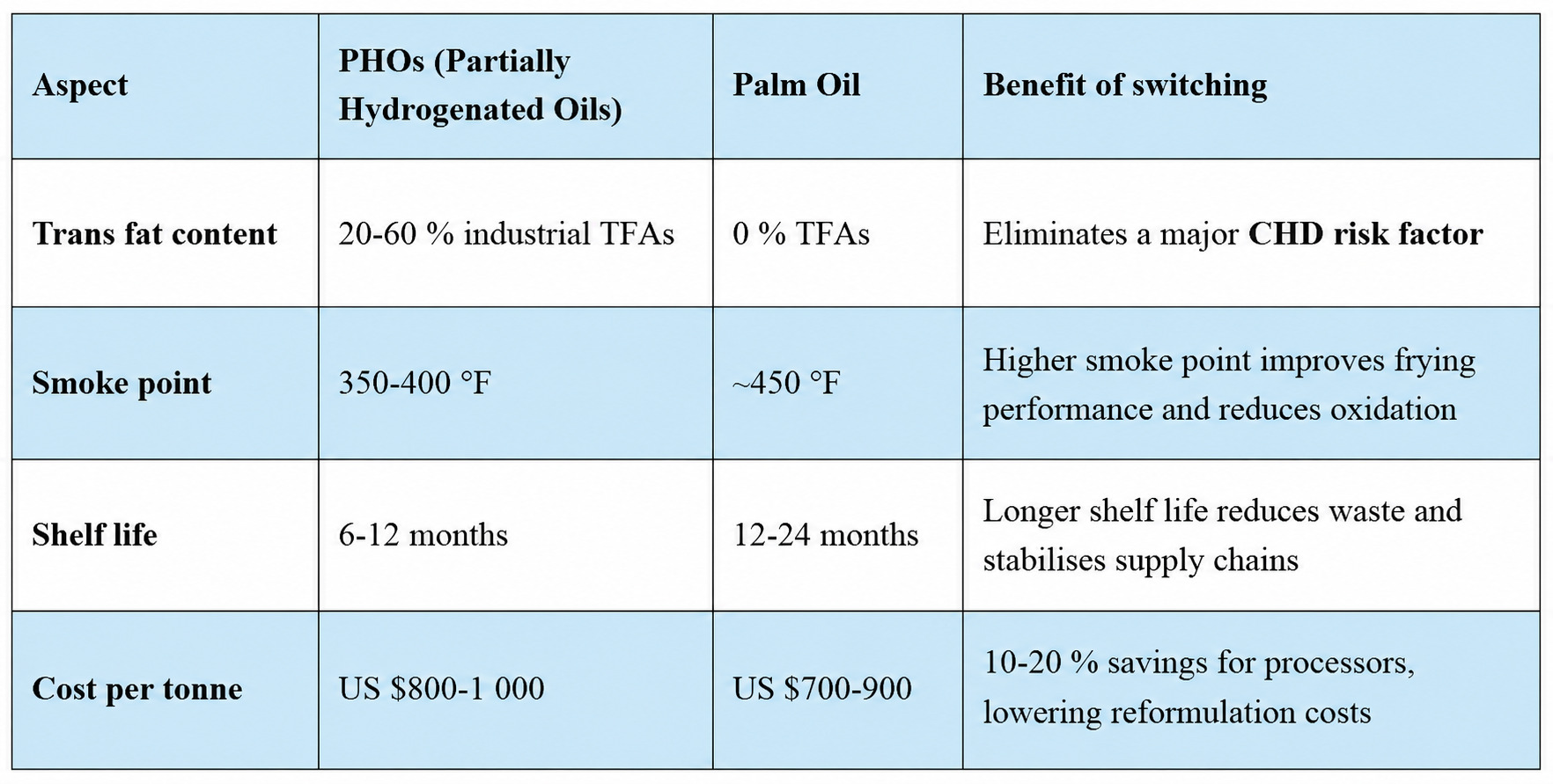
Source(s): WHO, FAO, FDA, MPOB, World Bank commodity data, and peer-reviewed food science literature.
Note: Values are indicative and may vary based on refining process, formulation, and market conditions.
This comparison underscores why palm oil became the workhorse of trans fat replacement projects: it eliminates trans fats, offers better frying stability, extends shelf life and is cost competitive. Clinicians and nutrition scientists emphasise that eliminating industrial trans fats is a risk reduction measure, not a nutritional endorsement of palm oil. Industrial trans fats raise LDL cholesterol, lower HDL, promote inflammation and have no physiological role. The American Heart Association and WHO recommend limiting total trans fat intake to <1 % of total energy (~2.2 g/day on a 2 000 kcal diet) [40].
Clinical perspectives on physiology and moderation: Neurologists note that industrial trans fats have no known physiological role, whereas naturally occurring dietary fats participate in membrane structure and fat soluble vitamin absorption; clinicians describe the substitution as a return from a biologically anomalous input to a physiologically recognisable category of dietary fats. Clinicians also stress that excess consumption of any fat, regardless of type, remains undesirable and that overall dietary pattern remains the primary determinant of metabolic risk.
Table 16: Clinical Outcomes when Substituting PHOs with Palm Oil
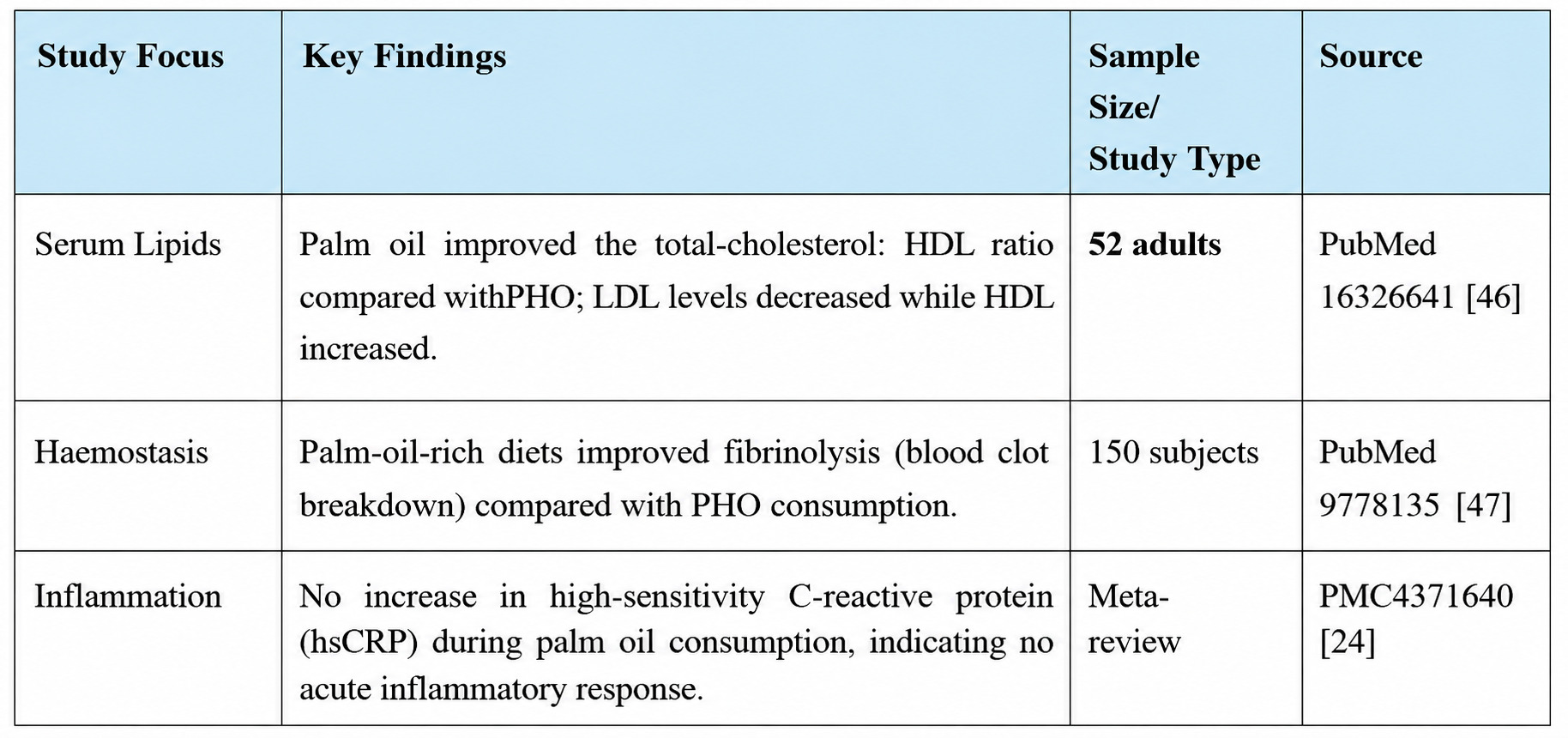 These studies indicate that replacing PHOs with palm oil leads to measurable positive effects on blood lipid profiles and haemostatic markers. While palm oil contains saturated fatty acids and should be consumed in moderation, it offers a naturally stable, trans fat free alternative to PHOs. Importantly, the substantial cardiovascular benefit arises from eliminating industrial trans fats, which are strongly associated with adverse cardiometabolic outcomes. In this context, palm oil serves as a more appropriate lipid source for food formulations, enabling the replacement of industrial trans fatty acids while maintaining functional and nutritional integrity.
Implications for public health and industry
Public health success and remaining risks - The elimination of PHOs represents a significant public health victory: it reduces cardiovascular risk without compromising the supply of functional fats. Industry data suggest that reformulation costs were modest and consumers accepted products made with palm oil and other alternatives. However, vigilance is needed. Regulatory agencies must continue to monitor formal and informal sectors to prevent illicit PHO use.
Consumer Awareness - The decline of trans fats should not lead to complacency about overall dietary quality. Public health messaging should emphasise balanced diets rich in healthy fats, fruits, vegetables and whole grains.
Inclusive Trans Fat Reduction Strategies - Despite substantial progress in trans fat reduction, residual exposure may persist within street food, and savoury eating-out environments, which collectively account for a very large chunk of daily food consumption in India, where cost sensitivities and limited access to reformulated inputs can slow the transition to trans fat free alternatives. Evidence indicates that targeted, enabling interventions, such as improving the affordability and availability of compliant cooking fats for street food vendors, providing technical guidance for oil substitution and recipe adjustment, and strengthening enforcement across informal and unorganised food markets, can significantly accelerate trans fat elimination across the population. Equally important are community engagement initiatives and culturally appropriate nutrition education campaigns, tailored to street-food contexts and local culinary practices, to ensure that regulatory efforts are inclusive, practical, and sustainable.
Concluding Observations
The global elimination of partially hydrogenated oils (PHOs) demonstrates the capacity of science-led regulation, clinical consensus, and food industry reformulation. Industrial trans fats, once a technological convenience, were conclusively identified as a major and avoidable contributor to cardiovascular disease. Phased regulatory action, initiated by Denmark and subsequently adopted worldwide-resulted in sustained reductions in trans fat intake, affirming the effectiveness of evidence-based public health policy.
In this context, various alternative fats and oils, including palm oil, were used in food reformulation to replace PHOs. This substitution was driven primarily by functional requirements such as stability, texture, and suitability for processing. India’s experience, from high historical exposure to trans fats to near-complete elimination-illustrates how regulatory clarity, reformulation by industry, and sustained advocacy can collectively manage population-level dietary risk. Importantly, the transition reflects reformulation strategies aimed at eliminating industrial trans fatty acids from the food supply.
Clinical Interpretation: What the Evidence Supports
Across cardiology, gastroenterology, and neurology, clinician perspectives converge on a consistent interpretation of the evidence:
-
No independent causal link has been established between palm oil consumption and cardiovascular, gastrointestinal, hepatic, or neurological disease when evaluated within balanced diets.
-
Clinical risk is driven by total fat intake, dietary patterns, and lifestyle factors, rather than by the identity of a single edible oil.
-
The health relevance of edible oils lies less in categorical labels (e.g., saturated vs unsaturated) and more in how oils are used-portion size, cooking temperature, reuse, and frequency of consumption.
From a clinical perspective, palm oil is considered one of several commonly used edible oils and is assessed within the broader context of dietary fat intake.
Food Science Perspective: Attributes That Are Often Overlooked
From a food science and lipid chemistry standpoint, several material attributes of palm oil remain underrepresented in public discourse:
1. Triglyceride Structure and Metabolic Behavior
Palm oil’s predominant saturated fatty acid, palmitic acid, is largely esterified at the sn-1 and sn-3 positions of the triglyceride molecule. This positional distribution limits the release of free palmitic acid during digestion, distinguishing palm oil metabolically from animal fats and industrial trans fats and undermining simplistic associations between saturation and atherogenic risk.
2. Thermal Degradation and Food-Safety Relevance
Thermal degradation and lipid breakdown are health-relevant considerations, not merely industrial concerns. Palm oil’s balanced fatty-acid composition and naturally occurring antioxidants (tocopherols and tocotrienols) limit heat-induced deterioration during high-temperature and repeated-use cooking. In food environments where deep frying and oil reuse are common, the formation of rancid and degraded lipid by-products represents a more immediate dietary risk than fatty acid category alone.
3. Micronutrient Context
In less-refined forms, palm oil contains carotenoids (pro-vitamin A) and tocotrienols (vitamin E isomer)-compounds absent or present only in trace amounts in many commonly used oils. In populations with persistent deficiencies of fat-soluble vitamins, this nutritional dimension merits contextual evaluation rather than omission from consideration.
Public Communication and Labeling: A Source of Distortion
A recurring concern across academic and technical stakeholders is the rise of ingredient-level signaling, particularly “No Palm Oil” claims, as a proxy for health. Such labeling does not necessarily reflect nutritional or safety differences and often obscures formulation trade-offs, including increased sodium, additives, or processing intensity. From a food science perspective, ingredient exclusion is not synonymous with nutritional improvement, and public understanding of food quality must extend beyond binary inclusion-exclusion narratives.
Systems Perspective: Food Security and Feasibility
Finally, from an agricultural and systems-nutrition standpoint, palm oil’s exceptionally high yield per hectare positions it as a structurally important component of edible oil security for densely populated countries such as India. No alternative oilseed currently matches palm oil’s productivity at scale.
Nutritional evaluation, therefore, cannot be detached from feasibility, affordability, and supply resilience. Oils that are nutritionally acceptable, functionally stable, and scalable must be assessed within the realities of population needs and food system constraints.
Final Synthesis
Taken together, the evidence reviewed in this white paper demonstrates that isolating palm oil as a primary dietary risk oversimplifies India’s nutritional and public health challenges. Health outcomes are shaped by dietary patterns, portion sizes, cooking practices, physical activity, and overall food quality, not by the presence or absence of a single ingredient.
A shift from ingredient-level demonization to context-driven, evidence-aligned evaluation is essential. Recognising palm oil as a scientifically legitimate, plant-based edible oil with distinct functional and nutritional attributes-governed by the same principles of moderation, quality, and responsible use that apply to all dietary fats-will support more coherent policy decisions, responsible industry practices, and meaningful public health outcomes in India.
References
[1] FAO/WHO Codex Alimentarius; USDA FoodData Central; Malaysian Palm Oil Board (MPOB); AOCS. Compiled and syn-thesized by Makreo Research. https://www.unicef.org/india/media/2646/file/CNNS-report.pdf
[2] ICMR–INDIAB Survey. (2025). Dietary profiles and associated metabolic risk factors in India. Nature Medicine. https://www.nature.com/articles/s41591-025-03949-4 [2]
[3] Global, regional, and national consumption levels of dietary fats and oils in 1990 and 2010. BMJ, 348, g2272. https://www.bmj.com/content/348/bmj.g2272
[4] Computed consumption mix → SEA / Business Standard, demand projections → NITI Aayog and verified from Business Standard publication.
https://www.business-standard.com/industry/agriculture/india-edible-oil-consumption-tripled-imports-health-obesity-palm-oil-125042100484_1.html
[5] Survey of per capita consumption of vegetable oil in India. https://scispace.com/pdf/survey-of-per-capita-consumption-of-vegetable-oil-in-india-1zuw0yop.pdf
[6] Jain, A., et al. (2024). Total Fat and Fatty Acid Profile Including TFA Content of Indian Fried Foods versus Oils Used for Frying. Journal of Food Science and Technology. https://link.springer.com/article/10.1007/s13197-024-05719-6
[7] ICMR National Institute of Nutrition. (2020). https://www.nin.res.in/nutrition2020/what_india_eats.pdf
[8] U.S. Food and Drug Administration. (2015). Final Determination Regarding Partially Hydrogenated Oils. Federal Register. https://www.federalregister.gov/documents/2015/06/17/2015-14883/final-determination-regarding-partially-hydrogenated-oils
[9] Sundram, K., et al. (2003). Palm Fruit Chemistry and Nutrition. Asia Pacific Journal of Clinical Nutrition. http://apjcn.nhri.org.tw/server/APJCN/12/3/355.pdf
[10] Sun, Y., et al. (2015). Meta-Analysis of Clinical Trials. Journal of Nutrition. https://www.sciencedirect.com/science/article/pii/S0022316622087958
[11] Ismail, S.R., et. al. (2018). Systematic review of palm oil consumption and the risk of cardiovascular disease. PLoS One. https://pmc.ncbi.nlm.nih.gov/articles/PMC5831100/
[12] Badrul Hisham, M.D., et al. (2020). A systematic review and meta-analysis. Asia Pacific Journal of Clinical Nutrition. https://apjcn.qdu.edu.cn/11_2020-0171_523_536.pdf
[13] FAO. (2010). Fats and Fatty Acids in Human Nutrition. https://www.fao.org/fileadmin/user_upload/nutrition/docs/requirements/fatsandfattacidsreport.pdf?utm_source=chatgpt.com
[14] Odia, O.J., et al. (2015). Palm oil and the heart: A review. World Journal of Cardiology. https://pmc.ncbi.nlm.nih.gov/articles/PMC4365303/
[15] Tee, V.P., et al. (2012). Olive oil and palm oil: the myths and the facts. Palm Oil Developments. https://palmoilis.mpob.gov.my/publications/POD/pod56-voon.pdf
[16] Rastogi, T., et al. (2004). Diet and risk of ischemic heart disease in India. The American Journal of Clinical Nutrition. https://ajcn.nutrition.org/article/S0002-9165(22)03890-4/fulltext?utm_source=chatgpt.com
[17] Ramesh, B., et al. (2007). Effect of Dietary Substitution of Groundnut Oil on Blood Glucose. The Yale Journal of Biolo-gy and Medicine. https://pmc.ncbi.nlm.nih.gov/articles/PMC1942175/
[18] Graña, S.Á., et al. (2025). Behavioiur of sunflower (Helianthus annuus L.). Food Chemistry Advances. https://www.sciencedirect.com/science/article/pii/S2772753X25000152
[19] Mahmud, N., et al. (2023). A review of different frying oils and oleogels as alternative frying media for fat-uptake re-duction in deep-fat fried foods. Heliyon. https://www.sciencedirect.com/science/article/pii/S240584402308708X
[20] Rajanaidu, N. (1994). Q’ Seeds – Quality Oil Palm Planting. In: Palm Oil Development, 20. Palm Oil Research Institute of Malaysia. https://palmoilis.mpob.gov.my/publications/POD/pod20-1.pdf
[21] Malaysian Sustainable Palm Oil (MSPO). (2022). MSPO Standards (MS 2530:2022; MSPO 2.0). https://mspo.org.my/standards/
[22] Yurchenko, S. and Saealle, N. (2025). Oxidative stability and fatty acid profile of vegetable oils. Food. https://www.sciencedirect.com/science/article/pii/S2772275925000425?utm_source
[23] Johnson, S., et al. (2009). Fatty acids profile of edible oils and fats in India. Centre for Science and Environment, New Delhi. https://cdn.cseindia.org/userfiles/fatty_acids_profile.pdf?utm_source
[24] May, C.Y. and Nesaretnam, K (2014). Research advancements in palm oil nutrition. European Journal of Lipid Science and Technology. https://onlinelibrary.wiley.com/doi/epdf/10.1002/ejlt.201400076
[25] Nagendran, B., et al. (2000). Characteristics of red palm oil, a carotene-and vitamin E–rich refined oil for food uses. Food and Nutrition Bulletin. https://journals.sagepub.com/doi/epdf/10.1177/156482650002100213
[26] MalaysiaPalmoils.com. (n.d.). Specifications of RBD Palm Olein CP6 (Super Olein). https://malaysiapalmoils.com/
[27] Ariyan Corporation. (n.d.). Standard Specification of CP6. https://www.ariyancorp.com/wp-content/uploads/2022/10/Standard-Specification-Of-CP6.pdf
[28] USHA Oil. (n.d.). RBD Palm Olein CP6 / Super Olein – Technical Overview. https://www.ushaoil.com/wp-content/uploads/2021/08/RBD-Palm-Olein-CP6.pdf
[29] Lužaić, R., et al. (2025). Deep-Frying Performance of Palm Olein and Sunflower Oil Variants. Processes. https://doi.org/10.3390/pr13103285
[30] Lim, J., et al. (2014). Influence of Deep Frying Using Various Vegetable Oils on Acrylamide Formation. Journal of Food Science. https://pubmed.ncbi.nlm.nih.gov/24344977/
[31] Kuek, S., et al. (2020). Contribution of Lipids toward Acrylamide Formation during Intermittent Frying. Food Chemistry. https://www.sciencedirect.com/science/article/abs/pii/S0956713520303467
[32] Ahmad, A., et al. (2021). Selection of Vegetable Oils and Frying Cycles Influencing Acrylamide Formation. https://pmc.ncbi.nlm.nih.gov/articles/PMC7912009/
[33] Malaysian Palm Oil Board (MPOB). (2021). Evidence on FFB Grading and Delivery to Mills within 24 Hours (POEB 136). https://palmoilis.mpob.gov.my/publications/POEB/poeb136.pdf
[34] Ramli, N., et al. (2020). Sustainable Palm Oil: The Role of Screening and Advanced Technologies. https://pmc.ncbi.nlm.nih.gov/articles/PMC7356346/
[35] Tan, C., et al. (2023). Free Fatty Acid Formation Points in Palm Oil Processing and Storage. Agriculture (MDPI). https://www.mdpi.com/2077-0472/13/5/957
[36] Oey, S., et al. (2019). Mitigation Strategies for Reduction of 2- and 3-MCPD & Glycidyl Esters in Edible Oils. Comprehensive Reviews in Food Science and Food Safety. https://ift.onlinelibrary.wiley.com/doi/10.1111/1541-4337.12415
[37] Ong, L., et al. (2025). Mitigation of 3-MCPD Esters and Glycidyl Esters during Palm Oil Refining. Food Research International. https://www.sciencedirect.com/science/article/pii/S096399692500033X
[38] Malaysian Palm Oil Board (MPOB). Mitigation Procedures for Reducing 3-MCPD Esters and Glycidyl Esters (POD 57). https://palmoilis.mpob.gov.my/publications/POD/pod57-siew.pdf
[39] Food Safety and Standards Authority of India (FSSAI). (2009). Regulation of Trans Fatty Acids in Partially Hydrogenated Vegetable Oils. https://www.fssai.gov.in/upload/uploadfiles/files/Regulation_Trans_Fat_09_10_2018.pdf
[40] American Heart Association & World Health Organization. Guidelines on Trans Fat Intake. https://www.heart.org/en/healthy-living/healthy-eating/eat-smart/fats/trans-fat
[41] Maindola, A. (2019). FSSAI Aiming to Reduce Hydrogenated Trans Fats in Indian Food to 2%. Food & Beverage News. https://www.fnbnews.com/Top-News/fssai-aims-to-reduce-hydrogenated-trans-fats-in-indian-food-to-2-57293
[42] World Health Organization. REPLACE Action Package: Eliminating Industrially Produced Trans-Fatty Acids. https://www.who.int/teams/nutrition-and-food-safety/replace-transfat
[43] Food Safety and Standards Authority of India (FSSAI). (2021). PAN-India Survey Results on Trans-Fat in Different Food Categories (Press Release). https://www.fssai.gov.in/upload/media/FSSAI_News_TransFat_17Dec21.pdf
[44] NITI Aayog. (2024). Pathways and Strategy for Accelerating Growth in Edible Oils towards Atmanirbharta. Government of India. https://www.niti.gov.in/sites/default/files/2024-01/Edible-Oil-Strategy-Report.pdf
[45] Steele, L., et al. (2024). Ending Trans Fat: The First-Ever Global Elimination Program for a Noncommunicable Disease Risk Factor. JACC: Global Health. https://www.jacc.org/doi/10.1016/j.jaccgh.2023.10.006
[46] Pedersen, J.I., et al. (2005). Palm oil versus hydrogenated soybean oil: effects on serum lipids and plasma haemostatic variables. Asia Pacific journal of clinical nutrition. https://apjcn.qdu.edu.cn/14_4_19.pdf
[47] Müller, H., et al. (1998). Replacement of partially hydrogenated soybean oil by palm oil in margarine without unfavorable effects on serum lipoproteins. Lipids. https://link.springer.com/article/10.1007/s11745-998-0284-9
Trans Fat in India, Partially Hydrogenated Oils Health Risk, Why Were PHOs Banned in India, FSSAI Trans Fat Rules India, Vanaspati Trans Fat Content India, How Much Trans Fat Did Vanaspati Contain, Trans Fat and Heart Disease India, Industrial Trans Fat Cardiovascular Risk, Why Did India Ban Partially Hydrogenated Oils, Palm Oil as Trans Fat Replacement, Is Palm Oil Trans Fat Free, Palm Oil vs Partially Hydrogenated Oils, Palm Oil Frying Performance India, Palm Oil Shelf Life vs PHO, Edible Oil Reformulation India, WHO Trans Fat Elimination Policy, How India Reduced Trans Fat in Food, Palm Oil in Indian Food Industry, Trans Fat Free Cooking Oil India, Public Health Impact of Trans Fat Removal India