
Brazil EV Charging Market - 25,000 Charging Points and a Half-Million EV Fleet Redefine the Infrastructure Race
Explore Brazil’s EV charging market in 2026, with 25,429 charging points, a 505,806-vehicle plug-in fleet, fast-charger growth, BESS regulation, and investment trends.
For most of the last decade, Brazil's electric vehicle story was a story about cars sold, not infrastructure built. That changed through the first half of 2026. As dealership lots filled with Chinese-branded electric and plug-in hybrid models and legacy automakers began shipping their own locally built alternatives, the country's charging network stopped being an afterthought and became the constraint everyone is now racing to solve. Wait times of one to two hours at capacity stations in major cities, a national grid straining to absorb new demand, and a first-ever federal storage auction scheduled for December 2026 all point to the same conclusion: Brazil's EV charging market has entered the phase where infrastructure, not vehicle sales, decides who wins the next five years of Latin America's largest EV economy.
Brazil EV Charging Network Reaches 25,429 Points
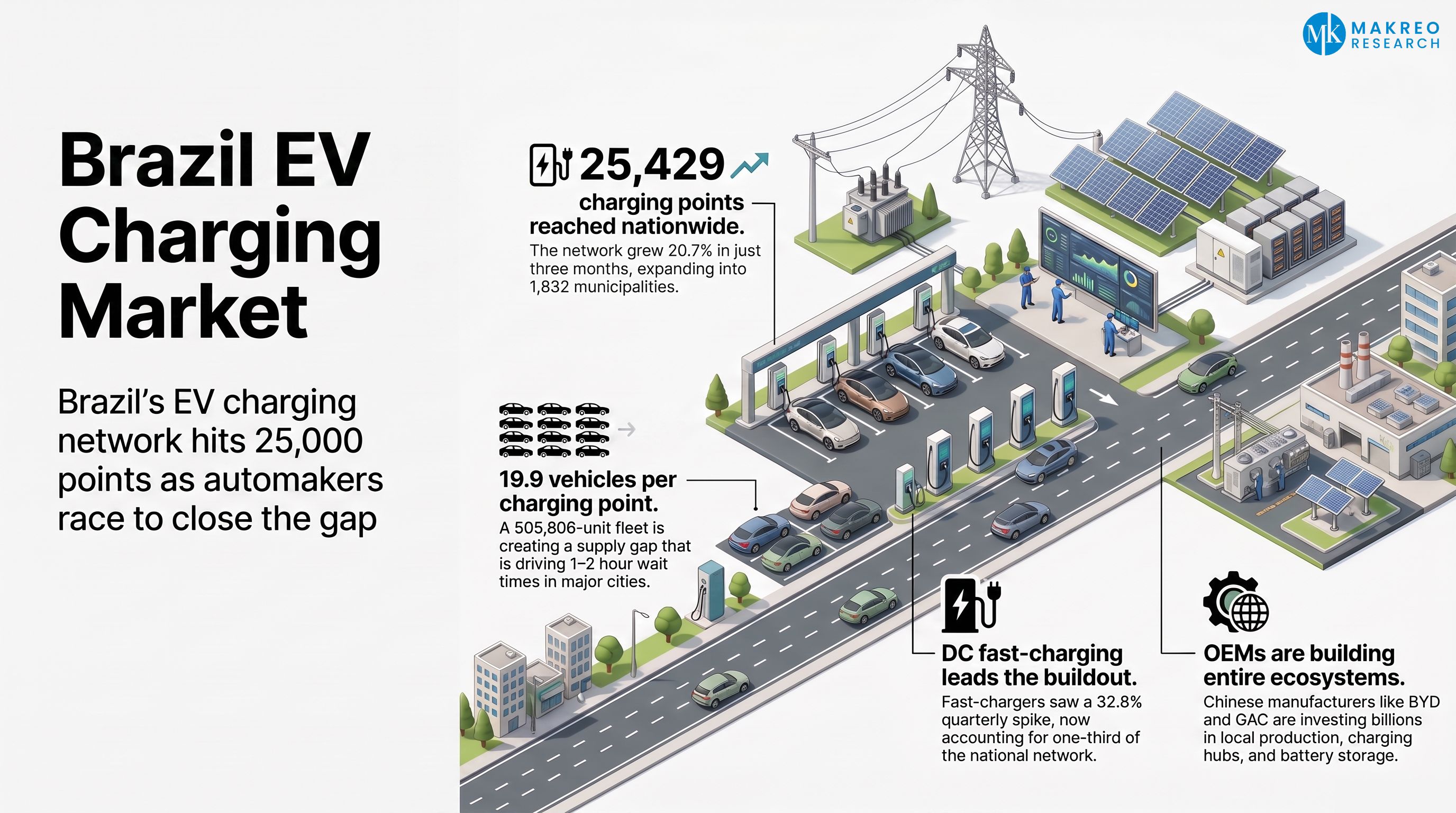
According to a joint study by the Brazilian Electric Vehicle Association (ABVE) and electric mobility platform Tupi, the national public and semi-public charging network reached 25,429 points in May 2026, a 20.7 percent jump from the 21,060 points recorded in February. That expansion is running in parallel with a plug-in fleet that now totals 505,806 units, split between 266,752 plug-in hybrids (52.7 percent) and 239,054 fully electric vehicles (47.3 percent) that depend entirely on public or private charging.
The resulting ratio, roughly 19.9 vehicles for every charging point, captures both the pace of adoption and the scale of the buildout still required to keep up with it. Fast DC charging is leading that buildout: DC units grew from 6,479 to 8,601 in a single quarter, a 32.8 percent spike that now puts fast chargers at 33.8 percent of the national network, up from 30.8 percent previously. Slower AC charging also rebounded, rising 15.4 percent, a recovery tied directly to São Paulo's Law 18,403/2026, which guarantees condominium owners the right to install home chargers in their private parking spaces without board approval. Davi Bertoncello, Tupi's executive director, summed up the shift: Brazil has left the testing phase and entered the scaling phase.
Growth is not evenly spread. The North region posted the steepest gains, up 31.1 percent overall with a 51 percent surge in fast chargers, while the Southeast still holds the largest absolute base at 11,079 public chargers. The network now reaches 1,832 municipalities, an 11.1 percent increase since February. ABVE projects 2026 will close as Brazil's strongest year for electromobility yet, with total electrified sales potentially surpassing 300,000 units.
Grid Strain Is Forcing a Reckoning With Battery Storage
Charger counts only tell half the story. Brazil's hydropower-heavy grid is already struggling to absorb the solar and wind capacity coming online, leading to curtailment and financial losses for renewable generators during peak production hours. That structural problem is precisely why battery energy storage systems have moved from a side conversation to a central one in the EV charging debate.
In June 2026, Brazil’s power regulator, Aneel, approved a long-awaited regulatory framework for energy storage systems. The framework provides greater clarity on grid connections and allows battery storage projects to participate in the country’s first planned capacity reserve auction, expected before the end of 2026.
Key provisions include:
-
Standalone storage systems dispatched centrally by the National System Operator will pay network charges only as power generators.
-
Independently operated storage systems will be required to contract grid capacity separately for charging and discharging.
Fabio Lima, executive director of the Brazilian Energy Storage Association, described the completed framework as a major milestone that provides greater regulatory certainty ahead of the planned battery auction.
BYD is already responding to this improved policy environment.
-
The company is preparing to invest up to R$500 million, or approximately US$98 million, in a new battery energy storage production line for Brazil’s national grid.
-
This investment would be additional to BYD’s existing R$5.5 billion commitment to its Camaçari vehicle manufacturing complex in Bahia.
-
BYD is expected to decide whether to expand its existing Manaus battery facility or establish a new production site.
-
The investment forms part of the company’s broader objective of achieving 50% local content by 2027.
The implication for EV charging operators is significant. As grid-scale battery storage and EV charging infrastructure expand together, both sectors will increasingly depend on the same investment capital, regulatory framework, grid connections, and, in some cases, shared locations.
Chinese Automakers Are Exporting an Ecosystem, Not Just a Car
The defining shift in 2026 is that Chinese automakers in Brazil are no longer separating vehicle sales from charging infrastructure investment.
Key developments include:
-
GAC Group partnered with local charging operator GreenV and mobility platform 99 to deploy 242 fast-charging stations by 2030. The initiative forms part of a broader US$1.3 billion investment that also includes a new vehicle assembly plant in Catalão, Goiás.
-
GreenV brings operational scale to the partnership, with more than 15,000 charging stations tracked and over 600 active charging units deployed across Brazil.
-
BYD partnered with Raízen Power to develop 600 DC charging sites nationwide, strengthening the link between vehicle sales, energy supply, and charging availability.
-
Great Wall Motor has also indicated plans to invest in local charging networks to improve coverage across its priority cities.
The Brazilian government is actively encouraging this shift. In January 2026, Minister of Mines and Energy Alexandre Silveira publicly invited Chinese automakers to invest directly in the country’s charging infrastructure, highlighting the strategic importance of charger availability to Brazil’s wider EV transition.
The urgency is already visible in major cities, where charging stations frequently operate near full capacity and drivers may face waiting times of one to two hours. Limited grid capacity is also becoming a significant barrier to deploying new chargers quickly enough.
Ride-hailing fleets are adding further pressure to the network:
-
The electrification alliance involving 99, Raízen, Movida, and BYD doubled its target to 20,000 electrified vehicles connected to the 99 platform by the end of 2026 after exceeding its original goal.
-
EV import tariffs are scheduled to rise to 35% by mid-2026, giving automakers a stronger incentive to localise both vehicle production and the charging ecosystem supporting it.
Together, these developments show that Chinese automakers are pursuing a broader ecosystem strategy in Brazil, combining local manufacturing, fleet partnerships, energy infrastructure, and charging-network expansion.
Policy Is Catching Up, Slowly
Three regulatory threads are moving simultaneously, and each has direct implications for anyone planning to enter this market. Aneel's Public Consultation CP42/2025, open through March 2026, is revising the rules for connecting EV chargers to the distribution grid, with proposals covering flexible connection contracts, clearer cost-allocation models, and mandatory availability maps for grid connection points, changes driven by EPE forecasts of sharply rising EV-related electricity demand over the next decade.
Separately, Aneel approved Brazil's first regulatory sandbox involving vehicle-to-grid technology in February 2026, granted to utility Equatorial Alagoas for a project integrating distributed solar generation, battery storage, and EV charging under a single experimental tariff structure. Private operators are testing similar ground: Eon Grid opened a smart mobility hub in São Paulo built around an initial R$15 million investment, piloting V2G and storage integration while targeting 2,000 fast chargers nationally by mid-2026. Layered on top of these technical reforms, the government is reportedly evaluating a dedicated electromobility unit within the Ministry of Mines and Energy to coordinate policy, regulation, and investment stimulus across charging infrastructure, a signal that Brazil is preparing to manage this sector as a distinct policy priority rather than a subset of the broader energy transition.
A Market Still Forming Its Competitive Map
Brazil's charging ecosystem today mixes energy incumbents, automaker-backed networks, and independent operators, without a single dominant player. Market intelligence from the U.S. International Trade Administration names Raízen Power, which operates under the Shell Recharge brand, alongside EDP Brasil, CPFL Energia, and major utilities including Eletrobras, Enel, Neoenergia, and Equatorial Energia as anchor players, with emerging operators Zletric and VoltBras also building out fast-charging footprints. The same source pegs Brazil's EV charging market at roughly US$36.7 million in 2024, projected to reach US$119.3 million by 2030 at a 22 percent compound annual growth rate, with broader EV infrastructure spend estimated to reach US$189 million by 2033.
Regionally, Brazil leads Latin America on both EV sales volume and charging infrastructure scale, ahead of Mexico, Chile, and Colombia, according to a first-half 2026 regional review from Latam Mobility. That leadership position, paired with a fragmented operator landscape and a regulatory environment still being finalized, is exactly the combination that tends to reward early, well-informed market entrants and penalize those relying on secondary data alone.
How Makreo Research Delivers Brazil EV Charging Insight
Auction timelines, corridor site economics, OEM partnership terms, and state-level regulations such as São Paulo's condominium charging law are moving faster than most companies' internal market intelligence can track. Decisions on where to site a charging corridor, which automaker or energy partner to align with, and how to price against an incumbent like Raízen Power or a fast-scaling entrant like GreenV depend on data that is rarely available in public reporting alone.
Makreo Research and Consulting delivers exactly this kind of integrated, data-backed framework, combining market analytics, primary research, and policy assessment to guide clients through market entry and expansion decisions across the energy and utilities landscape. Our custom research and market survey capabilities are designed to support decision-makers across the full range of functions this market now touches:
-
Corporate Strategy and Market Entry Planning: market sizing, demand forecasting, and scenario modeling to evaluate whether and how to enter Brazil's charging ecosystem.
-
Business Development and Strategic Partnerships: due diligence and structured evaluation of potential automaker, utility, and platform partnerships, informed by stakeholder interviews with operators and OEM representatives.
-
Charging Network Expansion and Site Feasibility: location assessment and corridor analysis that combine traffic, grid-capacity, and demand data to identify viable charging sites.
-
Product Development and Charging Technology: competitor benchmarking across DC fast charging, AC, and V2G-capable hardware to inform product and technology roadmaps.
-
Energy Procurement and Grid Integration: policy assessment of Aneel's evolving connection rules and storage framework to support procurement and interconnection strategy.
-
Operations, Infrastructure, and Asset Management: pricing analysis and utilization benchmarking to optimize uptime, tariffs, and asset performance across a charging network.
-
Automotive OEM and Fleet Electrification Strategy: fleet and customer surveys that quantify charging behavior, range anxiety, and adoption barriers among Brazilian EV owners and fleet operators.
-
Retail, Real Estate, and Destination Charging: demand forecasting and site feasibility studies for chargers at malls, hotels, and other destination locations.
-
Sales, Marketing, and Customer Adoption: primary consumer research to shape pricing, messaging, and loyalty programs aimed at EV buyers and charging-network subscribers.
-
Government Affairs, Policy, and Regulatory Compliance: structured tracking and interpretation of Aneel consultations, state-level laws, and the upcoming federal storage auction.
-
Investment, Project Finance, and M&A: competitor benchmarking and market assessment to support valuation, financing, and acquisition decisions across the charging and storage value chain.
Every engagement draws on primary research, including stakeholder interviews, customer and fleet surveys, competitor benchmarking, pricing analysis, location assessment, and demand forecasting, delivered through our Custom Research and Market Survey services.
How Makreo Research Has Proven This Approach Before
This kind of ground-truth research is not new territory for us. When a leading automotive manufacturer needed to evaluate entering India's electric commercial vehicle segment, the real barrier wasn't market size, it was whether distributors would stock the vehicles, whether financiers would treat them as bankable assets, and where total cost of ownership actually turned in the client's favor. Makreo Research answered those questions through 500 distributor interviews, financier and fleet-operator conversations, and India-specific TCO modeling, turning a fast-moving, incentive-driven market into a clear entry roadmap. The same primary-research discipline, ground-level stakeholder access instead of desk research alone, is exactly what Brazil's charging and storage market calls for today. See how we approached India's Electric Commercial Vehicle Market Entry and Feasibility Study.
Frequently Asked Questions
How many EV charging points does Brazil have in 2026?
Brazil's public and semi-public EV charging network reached 25,429 points in May 2026, according to a joint ABVE-Tupi study, up 20.7 percent from 21,060 points in February 2026. DC fast chargers account for 33.8 percent of that total and are growing faster than any other segment, while the network now reaches 1,832 municipalities nationwide.
What is causing the gap between EV sales and charging infrastructure in Brazil?
The gap exists because Brazil's plug-in vehicle fleet, now 505,806 units, is scaling faster than fixed charging infrastructure and grid capacity can follow, producing a ratio of roughly 19.9 vehicles per charging point. In major cities this shows up as one- to two-hour wait times at busy stations, while insufficient grid capacity limits how quickly new chargers can be added.
Are Chinese automakers building charging infrastructure in Brazil, or only selling cars?
Yes, Chinese automakers are actively building charging infrastructure alongside vehicle sales, treating the ecosystem as core to market share. BYD has partnered with Raízen Power to deploy 600 DC charging sites, GAC has partnered with GreenV and 99 to build 242 fast chargers by 2030, and Great Wall Motor is separately investing in local charging networks.
Having conducted the Global Battery Energy Storage System (BESS) Market and Forecast to 2031 study, Makreo Research and Consulting is equally positioned to support organizations evaluating specific insights in BESS or looking to conduct a dedicated Brazil EV Charging Market Entry and Feasibility Study. To discuss either mandate, reach out to us at [email protected], or Contact us.
Brazil EV charging market, Brazil EV charging market 2026, Brazil electric vehicle charging infrastructure, Brazil EV charging market entry, Brazil EV charging feasibility study, Brazil DC fast charging network, Brazil BESS market, Chinese automakers Brazil charging network, Brazil EV charging investment, Brazil EV fleet electrification, Brazil market entry and expansion strategy energy utilities, EV Charging Infrastructure, Battery Energy Storage, Electric Vehicles, Market Entry Strategy, Energy and Utilities, Latin America EV Market, Makreo Research