China Retail Industry Market Size and Forecast 2028 - Analysis of Online and Offline Retail Trends, Second Edition
Overview
Executive Summary
China retail industry is home to significant retail behemoths like Alibaba, Taobao, Tmall, etc. Retailers and building owners in China are currently evaluating new market niches and growing demand opportunities in order to create novel scenarios that maximize value. Additionally, as there are more online Chinese consumers, the physical and digital worlds are fusing more and more, which is facilitating the creation of vast data sets that span all age groups.
Expanding Middle Class and Changing Consumer Habits in the Dynamic China Retail Market
As China grows to become the second-largest economy in the world, the number of people in the middle class is growing. In China now, the middle class numbers over 300 million people. More than 500 million people are expected to be part of China's new middle class by 2025. In China, the "new middle class" has changed how people shop. Today, this group is more inclined to spend money on spiritual purchases; their consumption habits differ by city, and they are interested in eco-friendly, healthy goods, services, and products.
Premiumization and Shifting Consumer Lifestyles are driving growth in China's Retail Market Size
With the changing consumer lifestyle, demand for premium products is rising. Due to this, retailers are trying to convince customers to buy more expensive products by giving a proposition with better value through cross-selling and upselling the product, which has been one of the factors contributing to the expansion of the retail market in China. The rising consumer awareness of food safety and health issues is one of the causes that has favored premiumization. This has increased consumer demand for high-end organic food goods, which increases demand for the retail industry in China.
Challenges and Resilience Amidst COVID-19: Impact on Supply Chains in China Retail Market
Moreover, with the implementation of COVID-19, the China retail industry is facing challenges in the supply chain. Companies are experiencing workforce and labor shortages as a result of the recent increase in virus spread in 2022. In general, the recovery from the pandemic has been made harder for many industries due to a lack of skilled workers. The supply of consumer goods to the worldwide market was restricted as a result of the continuous case surge, which has been a significant contributor to labor shortages. This had an unavoidable detrimental impact on businesses and consumers for a long period of time. Major logistics hiccups have caused an accumulation of items in storage and had a negative impact on global supply chains.
Investment in Cities and Shifting Priorities: A Driving Force in the China Retail Industry Market
With the rapidly growing economy and considerable domestic market, many businesses have already changed their operational priorities from serving the needs of the 80 million residents of China's top-tier cities and the more than 300 million middle-class consumers they serve to fiercely competing with Chinese and foreign rivals in the country's lower-tier cities and counties, particularly in its eastern region.
Dominance of Online Retail Channel and Future Outlook for the China Retail Market
China is home to the world's largest e-commerce market, with more than half of the global e-commerce transactions taking place in the country. The continuously expanding online retail sector has emerged as a key factor influencing growth, employment, and consumption. China's retail sales are predicted to experience a modest recovery in 2023 owing to rising consumption of food, beverages, and electronics; however, this recovery is predicted to be less robust than it was in 2021 due to a lower consumer outlook for employment and household income, which is dependent on China's pandemic-related policies. By 2030, it is expected that China's private expenditures will have more than doubled. However, because of the government's "dynamic Zero-COVID" strategy, COVID flare-ups will continue to weaken consumer confidence until 2025.
Future Outlook
Moreover, many foreign-invested firms are attempting to reorient their positions in the country's new development structure, emphasizing their long-term confidence in functioning in China, with the result that the nation's retail industry will experience positive growth as China pushes forward with industrial innovation, expands domestic market demand, and makes it easier for the movement of domestic and international markets.
Scope of the Study
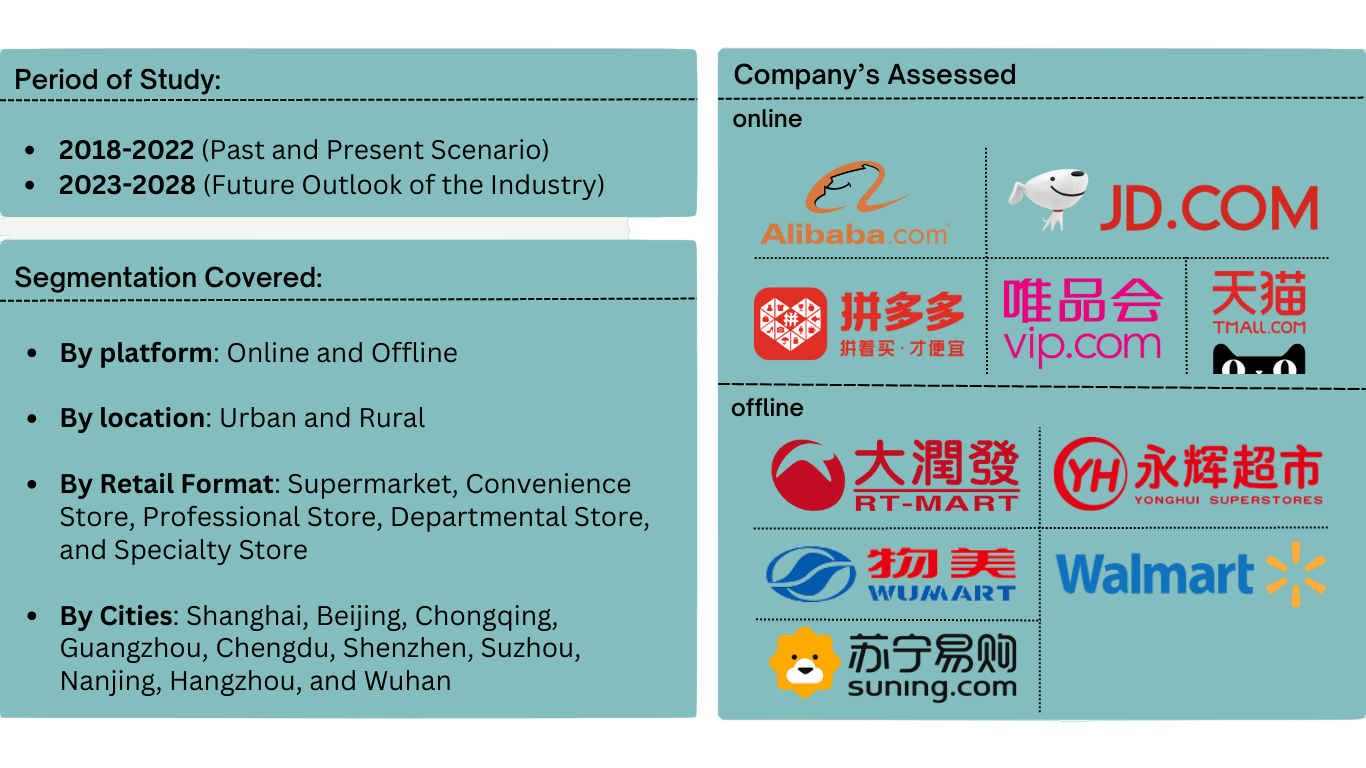
Makreo research has published a study on Retail Market titled, “China Retail Industry Forecast 2028: Analysis of Online and Offline Retail Trends - Second Edition”. Market assessment has been carried out using qualitative and quantitative methods and have combined the impact of macroeconomic and microeconomic scenarios. The market has witnessed many shifts in recent past after the COVID-19 outburst that given a suggest push in the market therefore, we have studied the impact of pre-COVID and post-COVID scenario. Future outlook has been assessed keeping various influencing factors into consideration and also to assess the expected opportunities in the market.
-
How is the China retail market adapting to the COVID-19-driven economic downturn?
-
What is the current situation of the industry, and at what pace has the retail market's revenue increased in the past?
-
What are the main driving forces that have historically given the Chinese retail business a boost?
-
What is the expected revenue of China retail market by 2028?
-
Who are the major players in the retail market, and how these players are contributing to the industry?
-
How rapidly is the Chinese e-commerce and online retail market expanding?
-
How China retail market is segmented by retail format?
-
Which sector leads in terms of producing the greatest demand for the retail market in China?
-
How did the retail industry in China respond to new COVID-19 variant-driven movement restrictions?
-
How the Chinese economy has performed in the past and what is the future expected growth outlook?
Looking for a Section from Report? Start your Partial Purchase Request
Table of Contents
- Report Synopsis
- Country Overview: CHINA
- 1.Research Methodology
- 1.1.Objectives of the Study
- 1.2.Research Process
- 1.3.Data Collection Methods
- 1.4.Analytical Framework
- 2.China Retail Market: EPTD Analysis (Economic, Political, Technological & Demographic Factors)
- 2.1.Country Overview: EPTD Analysis
- 2.2.EPTD Analysis: China Economy Overview
- 2.3.EPTD Analysis: China Political Overview
- 2.4.EPTD Analysis: China Technological Overview
- 2.5.EPTD Analysis: China Demographic Overview
- 3.China Trade Facts: Imports and Exports Performance
- 3.1.China Trade Performance
- 3.2.China Monthly Trade Performance, 2022
- 3.3.China Trade Performance: Export Facts
- 3.4.China Trade Performance: Import Facts
- 3.5.China Trade Performance: Trade Surplus
- 4.China Retail Market: Past and Present Analysis
- 4.1.China Retail Market Structure
- 4.2.China Retail Market: An Overview
- 4.2.1.China Consumer Goods Performance: Impact of COVID-19
- 4.2.2.Challenges in Retail Supply Chain
- 4.2.3.China Retail Market Snapshot
- 4.2.4.China Consumer Goods Performance 2022
- 4.3.China Retail Market Analysis By Revenue: Past and Present Performance
- 5.China Retail Market Segmentation: by Platform, by Location, by Retail Format, by Cities
- 5.1.China Retail Market: By Platform (Online vs Offline)
- 5.2.China Retail Market: By Location (Urban vs Rural)
- 5.3.China Retail Market: By Retail Format (Supermarket, Convenience Store, Professional Store, Departmental Store, Specialty Store)
- 5.4.China Retail Market: By Cities
- 5.4.1.Cities in China Attracting Business 2022
- 5.4.2.China Retail Market: Shanghai
- 5.4.3.Beijing Retail Market Performance
- 5.4.4.Chongqing Retail Market Performance
- 5.4.5.Guangzhou Retail Market Performance
- 6.China Online Retail Market Outlook
- 6.1.China Digital Key Facts
- 6.2.China Online Retail Industry Performance: Impact of COVID-19
- 6.3.China Online Retail Market Analysis By Revenue: Past and Present Performance
- 6.4.E-commerce Market Performance
- 6.4.1.E-commerce Growth opportunity in China
- 6.4.2.Cross-border E-Commerce (CBEC) Market Performance
- 7.China Automobile Retail Market
- 7.1.China Automobile Market: Performance in 2022
- 7.2.Passenger Car Retail Sales Performance
- 8.China Apparel and Textile Retail Market
- 8.1.Performance of China Textile and Apparel Industry
- 8.2.China Retail Sales of Textiles and Garments
- 9.China Electronics Retail Market
- 9.1.China Consumer Electronics Market: Smartphone
- 9.2.China Consumer Retail Electronics Market
- 10.China Pharmaceutical Retail Market
- 10.1.China Pharmaceutical Retail Market
- 11.China Retail Market: Future Outlook
- 11.1.China Retail Market Analysis By Revenue: Future Outlook
- 11.2.China Retail Market: Future Outlook By Platform (Online vs Offline)
- 11.3.China Retail Market Future Outlook by Cities
- 11.3.1.Top Cities with Great Development Potential
- 11.3.2.Factors to Overcome Supply Chain Disruption
- 11.3.3.Factors to Drive Future Growth of China Retail Market
- 11.3.4.Increasing Investments in China to Drive Retail Industry
- 12.China Retail Industry: Trends and Development
- 12.1.Recent Trends and Developments
- 12.2.China Retail Market: Challenges
- 13.China Retail Industry: Macro-Economic Factors
- 14.China Retail Market: Competitive Landscape
- 14.1.China Retail Market: Mergers and Acquisitions, Deals and Alliances
- 14.2.China Retail Market: Funding Timeline
- 14.3.China Retail Market: Online Company Profiles
- 14.3.1.Company Profile: JD.Com
- 14.3.2.Company Profile: Alibaba
- 14.3.3.Company Profile: Pinduoduo
- 14.3.4.Company Profile: Vipshop Holdings Limited
- 14.3.5.Company Profile: TMALL
- 14.4.China Retail Market: Offline Retail Company Profiles
- 14.4.1.Company Profile: RT Mart & Suning
- 14.4.2.Company Profile: Yonghui Superstores
- 14.4.3.Company Profile: Wumart Group
- 14.4.4.Company Profile: Walmart
Related Reports - Consumer Products & Retail