
Misconceptions About Palm Oil and Health Among Indian Consumers | White Paper Part 2
Explore evidence-based insights on palm oil health misconceptions in India, covering saturated fats, trans fats, heart health and clinician perspectives.
Table of Contents
PART 2: MISCONCEPTIONS ABOUT PALM OIL AND HEALTH AMONG INDIAN CONSUMERS
2.1 Framing the Issue: A Discrepancy Between Evidence and Public Perception
2.1.1. The Perception That “Palm Oil Is Uniquely Unhealthy”
2.2 The Oversimplification of Saturated Fat
2.2.1. The Conflation of Palm Oil with Trans Fats
2.3 The Assumption of a Direct Causal Link with Cardiovascular Disease
2.4 The View That “Palm Oil Has No Nutritional Relevance”
2.5 Concerns Regarding Digestive and Liver Health
2.6 The Interpretive Limits of “No Palm Oil” Labels
2.7 Reframing Palm Oil Debate: Context, Communication, and Public Health Reality
2.1. Framing the Issue: A Discrepancy Between Evidence and Public Perception
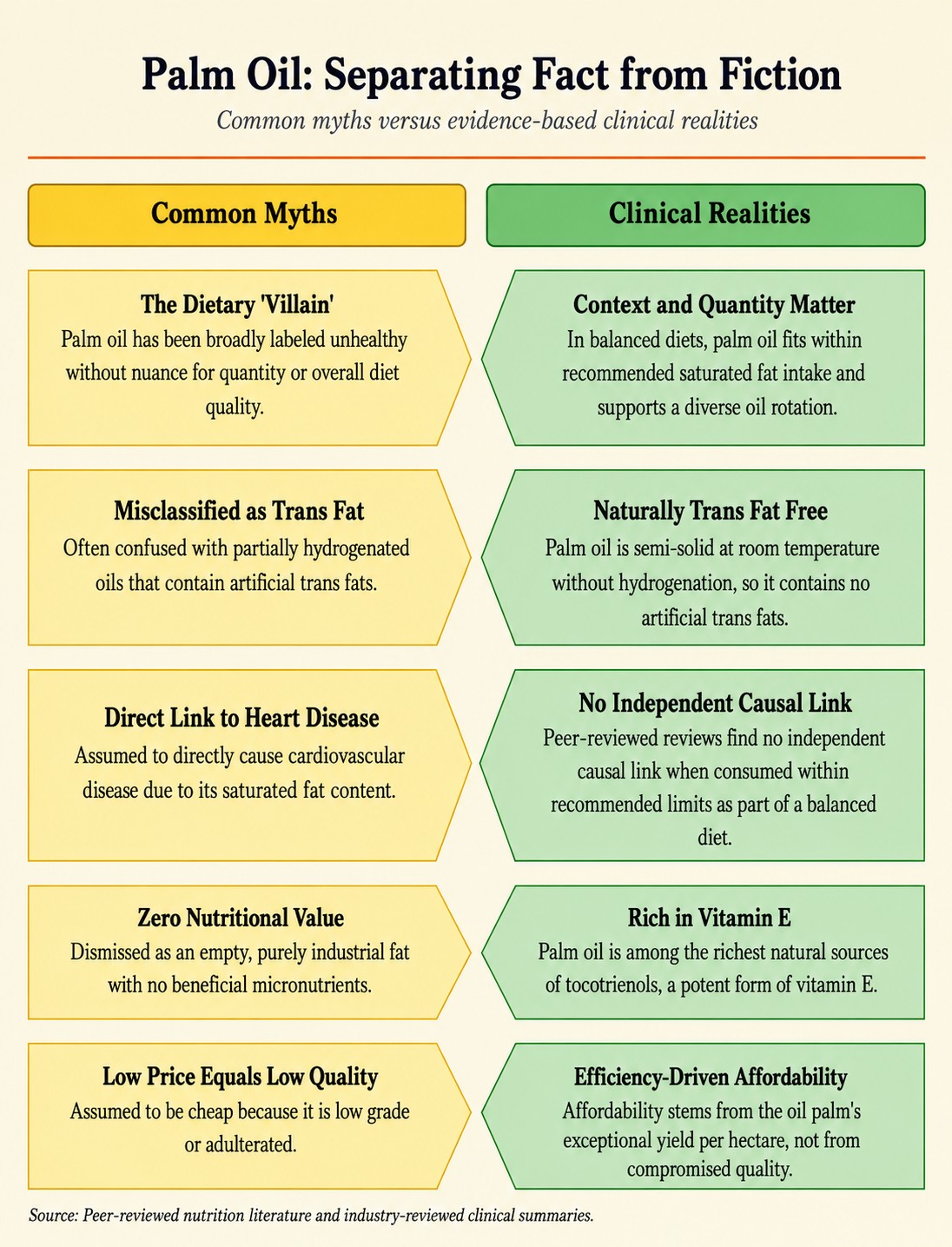
A review of the academic literature and scientific evidence reviewed for this paper, together with the perspectives of clinicians interviewed, indicates that public discourse on palm oil in India is shaped more by perception, simplified messaging, and marketing narratives than by clearly established evidence of harm. Over time, palm oil has increasingly been discussed not merely as one edible oil among many, but as a symbolic marker of “unhealthy” industrial processed food, a shift that appears to have been reinforced by product positioning and the growing visibility of “No Palm Oil” labels on packaged foods.
It is also important to note that palm oil is among the most widely used edible oils both globally and in India. In the Indian context, it is extensively present not only in household cooking, but also across packaged foods, bakery and confectionery products, and in the HoReCa sector. Because of these wide applications and daily consumption across socioeconomic groups and dietary settings, public perceptions about palm oil carry population-level implications. Misunderstandings or oversimplified narratives about its health effects therefore do not remain confined to niche consumer choices but influence dietary behavior at scale.
Clinician interviews further indicate that understanding of palm oil is not uniform even within the medical community. In routine practice, both physicians and patients are influenced by prevailing public narratives in addition to, and sometimes in place of, structured nutritional reasoning. This divergence between scientific nuance and public communication provides the context in which many of the misconceptions discussed in this section have emerged.
Clinician Perspective from Interviews
-
Cardiologists repeatedly described palm oil as “one of the most misunderstood edible oils” in contemporary clinical practice.
-
Several clinicians noted that misinformation persists even within the medical community due to gaps in nutrition-focused training, uneven integration of emerging evidence, and limited dissemination of India-specific clinical data.
2.1.1. The Perception That “Palm Oil Is Uniquely Unhealthy”
A widely held belief is that palm oil is fundamentally more unhealthy than other commonly used cooking oils. This perception is typically linked to its saturated fat content and its widespread use in packaged and commercially prepared foods.
However, the comparative fatty acid profiles reviewed in the scientific literature place palm oil within the mid-range of fats commonly consumed in the Indian diet. Oils such as coconut oil and ghee contain higher proportions of saturated fat yet are not always discussed with equivalent concern. Clinicians interviewed for this project consistently report that, in clinical practice, no single oil is regarded as uniquely unhealthy in isolation. Adverse effects are more commonly associated with excessive intake of fats in general, particularly in the context of an overall imbalanced diet.
Based on the academic literature and available scientific evidence, palm oil possesses nutritional characteristics that align with other widely accepted edible oils and can be appropriately evaluated within the broader context of balanced dietary patterns. Its health implications depend primarily on the quantity consumed, the frequency of intake, and the overall composition of the diet.
Table 4: Comparative Analysis of Saturated Fat Contribution Across Common Foods in India
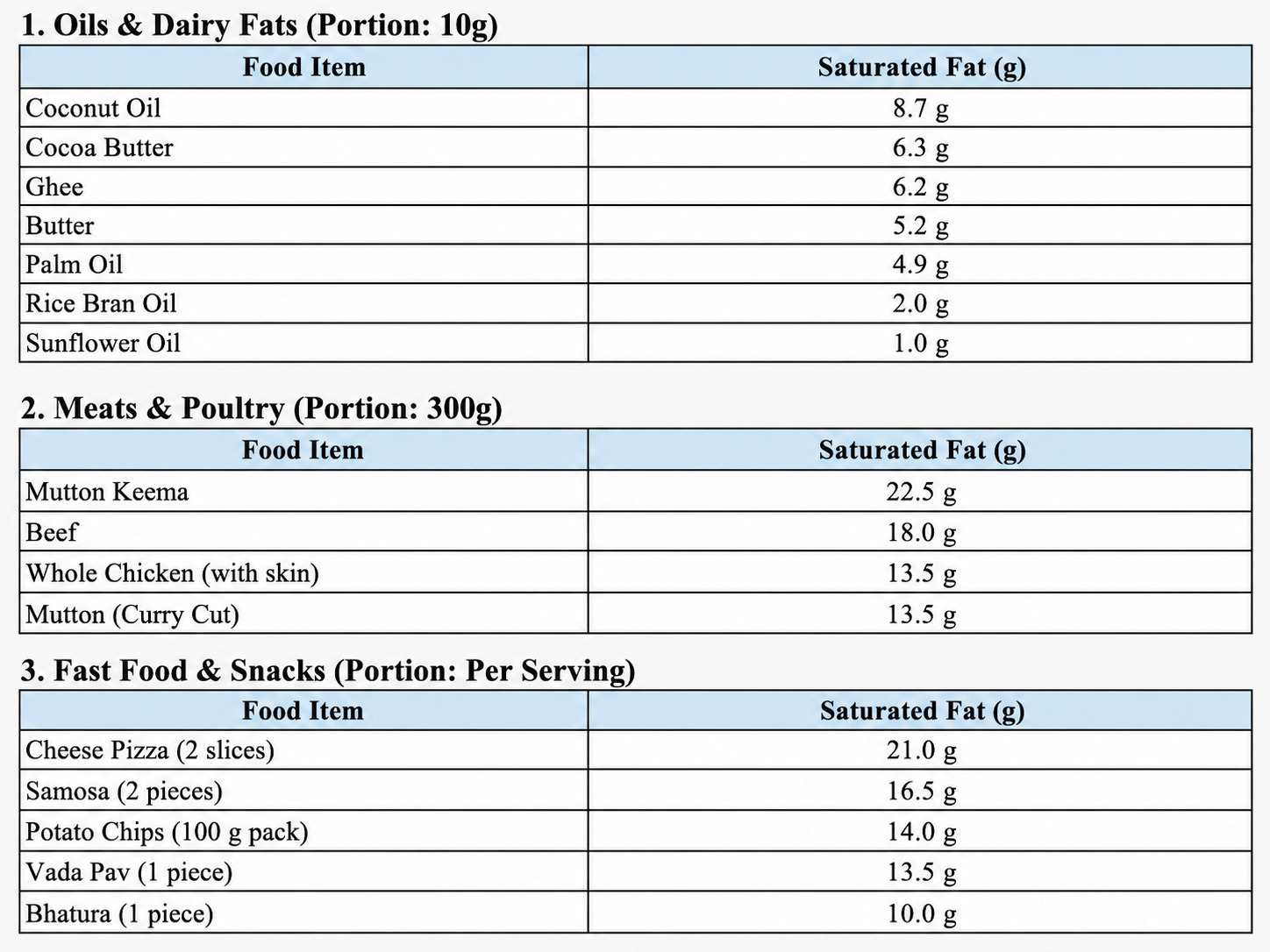 Note: Data represents saturated fat (g) per specified portion size. Variances in ranges are averaged for visualization.
Source: ICMR National Institute of Nutrition [7]
Clinician Perspective from Interviews
-
Cardiologists affirmed that palm oil does not present greater health risks when compared with other commonly consumed cooking oils.
-
Excess consumption of any oil including olive oil or ghee was emphasized as the principal concern rather than oil type.
2.2. The Oversimplification of Saturated Fat
Public communication around dietary fats is frequently reduced to a simplified message that treats saturated fat as uniformly unhealthy. This has contributed to the widespread assumption that any food containing saturated fat is intrinsically unhealthy, regardless of overall composition or dietary context.
The scientific literature reviewed indicates a more differentiated picture. Palm oil’s main saturated fatty acid, palmitic acid, does not behave in the same manner as animal-based saturated fats and industrial trans fats, and reported changes in lipid markers are often mixed, with effects observed in both LDL and HDL cholesterol. Clinicians emphasize that fat is a biologically essential macronutrient, required for normal physiological functions including cell membrane structure and the absorption of fat-soluble vitamins.
Taken together, the academic literature and scientific evidence reviewed support the view that the primary determinant of risk is not the mere presence of saturated fat, but total intake, overall dietary balance, and the pattern of consumption. Saturated fat is generally advised to be limited, but its presence alone does not render a food intrinsically unhealthy.
Clinician Perspective from Interviews
-
Clinicians emphasised that palmitic acid does not exhibit the same atherogenic profile as industrial trans fats.
-
Saturated fats were consistently described as requiring moderation, not elimination.
2.2.1. The Conflation of Palm Oil with Trans Fats
Palm oil is frequently and incorrectly grouped together with trans fats. This appears to reflect historical associations between solid or semi-solid cooking fats and partially hydrogenated oils used in commercial food production.
The scientific literature reviewed indicates that palm oil is naturally free of trans fats and has been used in many settings as a replacement for partially hydrogenated oils following regulatory restrictions on industrial trans fats [8].
Clinicians consistently distinguish between the risks associated with trans fats and those associated with naturally occurring saturated fats, noting that the adverse health effects of trans fats are more clearly and consistently documented.
Based on the academic literature and scientific evidence reviewed, it is not appropriate to treat palm oil and trans fats as equivalent categories.
Clinician Perspective from Interviews
-
Cardiologists uniformly identified trans fats, not palm oil, as the most clearly established dietary risk factor for cardiovascular disease.
-
Palm oil’s thermal stability was cited as a reason it has been used to reduce harmful compounds formation during high-temperature cooking.
2.3. The Assumption of a Direct Causal Link with Cardiovascular Disease
A particularly prominent belief in public discourse is that palm oil consumption is a direct cause of cardiovascular disease. This reflects a broader tendency to focus on individual ingredients rather than on overall dietary patterns and lifestyle factors.
The scientific literature reviewed reports mixed and largely neutral findings with respect to clinical cardiovascular outcomes, even where modest changes in lipid markers are observed. Clinicians interviewed uniformly state that, in routine practice, they do not observe a clear and isolatable causal relationship between palm oil consumption and cardiovascular disease.
The available academic literature and scientific evidence reviewed, together with clinical experience, indicate that cardiovascular risk is shaped by a complex interaction of total caloric intake, overall macronutrient balance, physical activity, and broader lifestyle factors, rather than by any single cooking oil.
Clinician Perspective from Interviews
-
None of the cardiologists interviewed identified palm oil as an independent causal factor for heart disease.
-
Salt intake, sugar consumption, sedentary behavior, and excess calories were consistently identified as dominant risk drivers.
2.4. The View That “Palm Oil Has No Nutritional Relevance”
Palm oil is sometimes characterised as a purely industrial fat without nutritional value. This view appears to be influenced by the fact that most consumers encounter palm oil primarily in refined or highly processed food products.
The scientific literature and clinician interviews reviewed indicate that certain forms of palm oil, particularly red palm oil, contain tocotrienols and carotenoids with antioxidant properties and provitamin A activity [9]. At the same time, clinicians acknowledge that awareness of these attributes is not uniform among either healthcare professionals or the general public.
It is therefore more accurate, based on the academic literature and scientific evidence reviewed, to show that not all palm oil products have the same nutritional values. While conventional refined palm oil primarily serves functional roles in cooking and food preparation, less-refined form (red palm oil) may retains additional micronutrients and thus demonstrate greater nutritional relevance in specific contexts.
Clinician Perspective from Interviews
-
Tocotrienols were repeatedly highlighted by cardiologists as a distinct and under-recognised nutritional attribute of palm oil.
-
Beta-carotene content in red palm oil was discussed in relation to addressing vitamin A deficiency and public health nutrition.
2.5. Concerns Regarding Digestive and Liver Health
Palm oil is sometimes implicated in digestives issues or the increasing prevalence of fatty liver disease. These concerns have developed alongside broader changes in dietary habits and the rising consumption of food prepared outside the home.
Gastroenterologists interviewed reported that they have not observed any consistent gastrointestinal intolerance or specific conditions directly linked to palm oil. Instead, issues such as fatty liver disease, bloating, and other digestive symptoms are described as multifactorial, and more closely associated with overall diet composition, excess calorie intake, and lifestyle factors.
Based on the academic literature and scientific evidence reviewed, there is no clear clinical basis for singling out palm oil as a unique or independent cause of gastrointestinal or liver disease.
2.6. The Interpretive Limits of “No Palm Oil” Labels
The increasing use of “No Palm Oil” labels on packaged foods has created a simple interpretive shortcut for consumers, suggesting that the absence of palm oil automatically implies a healthier product.
Clinicians emphasize that the more relevant question is what replaces palm oil in such formulations. Substitutions may involve other fats, higher levels of sodium and sugar, or greater degrees of processing, each of which carries its own potential health implications. As reflected in the academic literature and scientific evidence reviewed, without transparent comparison, the label itself cannot be considered a reliable indicator of nutritional quality.
Clinician Perspective from Interviews
-
“No palm oil” claims were described as marketing cues rather than evidence-based health indicators.
-
Increased sodium exposure was highlighted as a potentially greater cardiovascular concern.
2.7. Reframing Palm Oil Debate: Context, Communication, and Public Health Reality
“Evidence suggests that palm oil can be safely included in the diet when consumed in moderation within a balanced nutritional framework. At the same time, public narratives about dietary fats have often progressed more quickly than the scientific consensus.” - Clinician Perspective
1. Health Outcomes Are Driven by Overall Diets, Not Single Ingredients
Evidence from the scientific literature and clinician perspectives consistently indicates that India’s growing burden of obesity, diabetes, and metabolic disorders is largely linked to overall dietary patterns rather than the inclusion of any one cooking oil. Excess total calorie intake, high consumption of refined and ultra-processed foods, inadequate physical activity, and imbalanced macronutrient profiles emerge as the dominant contributors to adverse metabolic health outcomes.
Isolating palm oil as a primary dietary risk factor risks oversimplifying a complex nutritional landscape and diverts attention from these far more influential and systemic determinants of population health, as reflected in the academic and clinical evidence reviewed.
2. Nutrition Knowledge Gaps Shape Public and Professional Perceptions
Several clinicians acknowledge that nutrition education remains under-represented in both undergraduate medical curricula and continuing medical education programs. This gap contributes to inconsistencies in dietary advice and creates space for simplified, emotive, or commercially driven narratives to disproportionately influence both healthcare professionals and the general public.
Strengthening evidence-based nutrition education and improving clinical communication are therefore critical steps toward more accurate dietary guidance and informed public discourse.
3. A Balanced Public Health View on Palm Oil’s Functional Role
From a practical public health perspective, the scientific literature reviewed highlights that palm oil’s oxidative stability and cooking performance make it a widely used and functional dietary fat. When appropriately regulated, it may also serve as a potential vehicle for the fortification of fat-soluble vitamins, particularly in populations at risk of micronutrient deficiencies.
Such applications, however, must be guided by robust scientific evidence, regulatory oversight, and long-term evaluation to ensure meaningful public health benefits.
The discussion continues in Part 3 "Not All Saturated Fats Are Equal - Moving Beyond a Simplified Nutritional Category | White Paper Part 3"
Palm Oil Misconceptions India, Palm Oil and Cardiovascular Disease, Palm Oil Trans Fat Comparison, Saturated Fat Health Risk India, Palm Oil Dietary Villain Myth, No Palm Oil Label Health Claims, Palm Oil Digestive Health Evidence, Palm Oil Liver Health India, Palm Oil LDL HDL Cholesterol, Palmitic Acid Cardiovascular Risk, Palm Oil Saturated Fat India, Clinical Evidence Palm Oil India, Cardiologist Perspective Palm Oil, Gastroenterologist Palm Oil Review, Nutrition Misconceptions India, Evidence Based Dietary Fat India, Palm Oil Public Health India, Indian Clinician Dietary Advice