
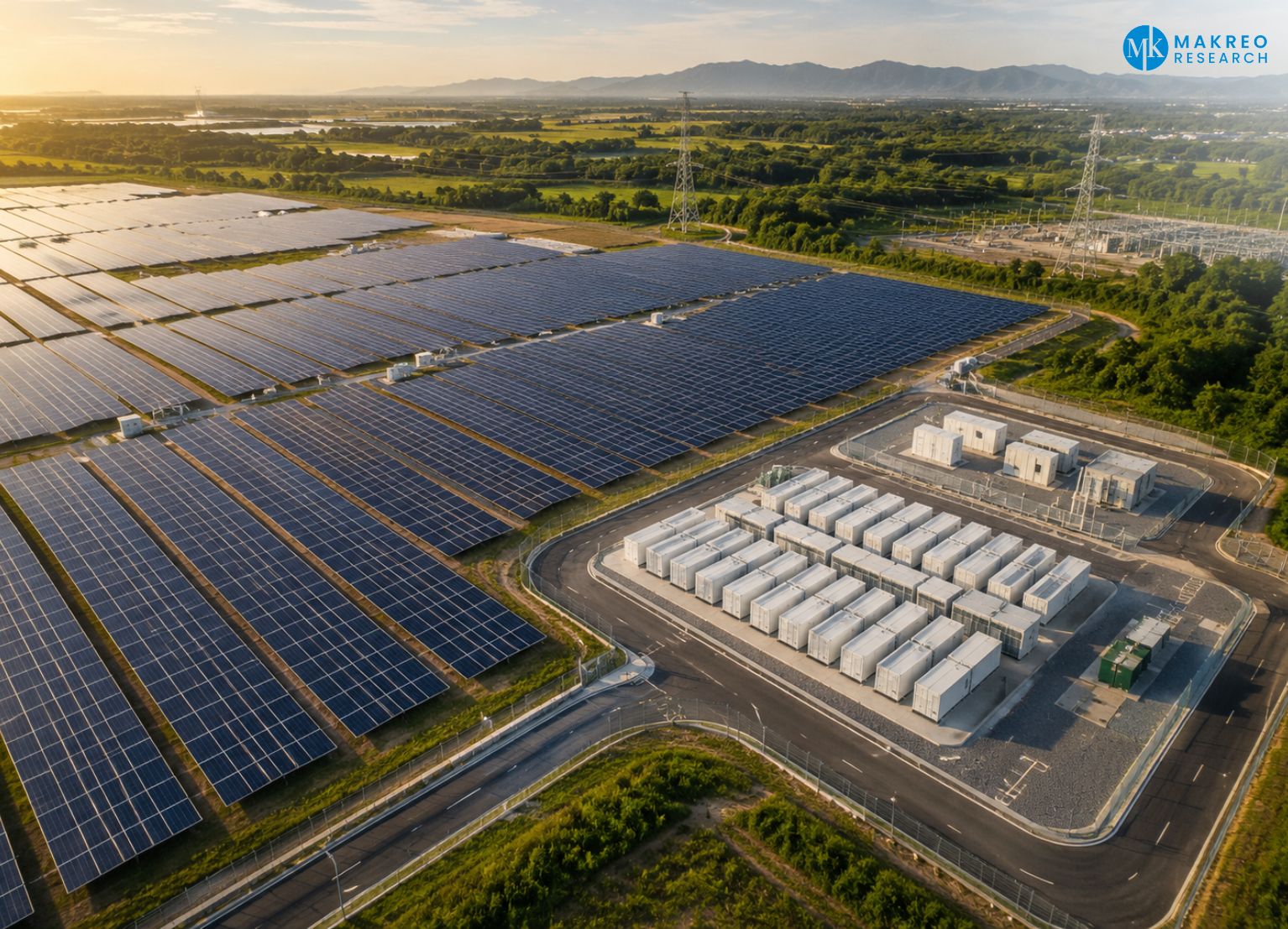
Malaysia Solar Energy Market 2026: Capacity Crosses 5.7 GW as LSS6's Mandatory Battery Storage Mandate Reshapes Investment
Malaysia solar capacity hits 5.7 GW as LSS6 mandates battery storage for all new projects. See what's driving growth, policy shifts, and investment risk in 2026.
Malaysia's Solar Energy Market Enters a New Phase as Capacity Surpasses 5.7 GW
Malaysia's solar energy market closed 2025 at 5,777 MW of cumulative installed capacity, up from 4,329 MW the year before, a jump of roughly 1.4 GW in a single year according to figures from the International Energy Agency's Photovoltaic Power Systems Programme (IEA-PVPS). That single statistic captures more than a year of strong deployment. It marks the moment Malaysia's solar story shifted from "how much capacity can we add" to "how much of that capacity can the grid actually absorb and dispatch reliably." With the government now set to launch the country's largest ever solar tender, Large Scale Solar 6 (LSS6), carrying a 2,000 MW allocation and a first of its kind mandatory battery storage requirement, that shift is no longer a talking point. It is policy.
For developers, financiers, equipment suppliers, and corporate offtakers tracking Southeast Asia's clean energy buildout, Malaysia in 2026 looks less like an emerging solar market and more like a market entering its consolidation phase, where bankability, grid integration, and storage economics start to matter as much as panel prices. Makreo Research and Consulting's latest study, Malaysia Solar Energy Market and Forecast to 2031, analyzes this market by application (utility, residential, commercial), system type (ground mounted, rooftop, floating), connection type (on grid, off grid), and geography, tracking the capacity, pricing, and policy shifts that are now defining where capital will flow through the rest of the decade.
A Record Year of Deployment, Driven by Three Overlapping Schemes
The 1.4 GW added in 2025 was not the product of a single program. IEA-PVPS data shows Malaysia's growth has come through three parallel channels: the Large Scale Solar (LSS) auction program, which had deployed 2,648 MW by the end of 2025; the earlier feed in tariff scheme, which contributed 345 MW before its 2016 closure; and the three rounds of net energy metering (NEM), which together deployed 2,747 MW of rooftop and distributed solar across residential, commercial, industrial, and government buildings before the scheme concluded in June 2025. Together these three channels account for roughly 5,740 MW, with the remaining gap to the 5,777 MW headline figure made up of solar capacity installed outside these government schemes, including off grid systems.
That last figure is worth sitting with. Distributed solar under NEM alone now accounts for nearly as much installed capacity as the entire utility scale LSS program, a sign that Malaysia's rooftop segment has matured well beyond pilot scale. Industry estimates put rooftop concentration heavily in industrial states such as Selangor, Johor, Kedah, and Pulau Pinang, where commercial electricity tariffs make self consumption solar increasingly competitive against grid power.
Energy analysts at Ember told pv magazine that the LSS program, the third NEM round, and high commercial tariffs were the three key drivers behind 2025's growth, with commercial and industrial demand in particular pulling solar deployment forward as businesses sought to hedge against rising power costs.
LSS6 Arrives With a Different Rulebook - Storage Is No Longer Optional
The headline development for 2026 is LSS6. Malaysia's Deputy Prime Minister and Minister of Energy Transition and Water Transformation, Datuk Seri Fadillah Yusof, confirmed at the Energy Transition Conference 2026 that the new 2,000 MW tender round will require all participating solar projects to be paired with battery energy storage systems. "This is one of the areas we are focusing on. Under LSS6, solar projects must be paired with battery storage," he told reporters, framing the move as essential to grid stability as renewable penetration climbs.
This is a structural change, not a cosmetic one. Every previous LSS round awarded capacity on a price competitive basis without a storage obligation. LSS6 folds storage costs directly into project economics from day one, and early industry estimates point to a meaningfully different cost and opportunity picture:
-
Construction costs: expected to rise to roughly MYR 3 million to MYR 3.5 million per MW, up from MYR 2 million to MYR 3.5 million per MW for solar only projects under earlier rounds
-
EPCC opportunity: the total contract value tied to LSS6 is estimated at MYR 6 billion to MYR 7 billion
-
Floating solar allocation: expected to be larger than in prior rounds, given Malaysia's land constraints and an estimated floating solar PV resource potential of around 16.5 GW
The mandatory storage requirement sits inside a broader push under the My Battery Energy Storage System (MyBeST) initiative, which targets 400 MW of battery capacity and 1,600 MWh of storage across four projects in Peninsular Malaysia, alongside a separately flagged 2,000 MW phased BESS rollout. An initial 100 MW project has already been commissioned, with a further 400 MW under development. Recent agreements, including one between Mikro MSC Bhd and Hong Kong Cospower Technology Co Ltd for utility scale BESS projects, point to growing international interest in supplying Malaysia's storage buildout. The government has also outlined a roughly RM43 billion grid modernization plan through Tenaga Nasional Berhad (TNB), positioning grid and storage investment as the connective tissue between rising solar capacity and a stable national power system.
NEM's Replacement, Solar ATAP, Removes the Quota Ceiling
On the distributed generation side, January 1, 2026 marked the formal launch of the Solar Accelerated Transition Action Programme (ATAP), replacing NEM as the rooftop solar incentive structure for residential and commercial customers. The shift matters because ATAP removes the quota constraints that had begun limiting NEM uptake in its final rounds, while allowing larger system sizes for non domestic users, up to 100 percent of maximum demand.
The trade off is in how exports are treated. Where NEM offered rolling one to one credit, ATAP settles excess generation within the same billing period without carryover, and offers no separate export tariff benefit, placing a much sharper premium on system sizing and self consumption optimization. Energy analysts covering the market told pv magazine that ATAP's easier approval process should still expand rooftop adoption through 2026, even as it pushes commercial buyers toward designing systems closer to their actual load profile rather than maximizing export volume.
Corporate Renewable Procurement Gains Momentum Across Malaysia
Perhaps the most significant change in Malaysia's solar demand base over the past year has come from outside the traditional utility and household segments entirely: data centres. The Corporate Renewable Energy Supply Scheme (CRESS), which allows large energy consumers to procure renewable power directly from developers via the grid, had reached 1.3 GW of uptake as of mid-2025, according to TNB, including a 50 MW, 21 year agreement to supply data centre operator DayOne.
The clearest signal of this shift came in December 2025, when TotalEnergies and Google signed a 21 year Power Purchase Agreement for 1 TWh of renewable power over the agreement's term, generated by the Citra Energies solar plant in Kedah, a facility with 20 MW of capacity, structured under the earlier Corporate Green Power Programme (CGPP) framework rather than CRESS itself. The project, awarded to TotalEnergies and local partner MK Land in 2023, entered construction in early 2026 and will help power Google's data centre operations in Malaysia. It follows a similar arrangement TotalEnergies struck with Google in the United States months earlier, underlining how Malaysia is being slotted into the same global corporate procurement playbook used in more mature renewable markets.
That said, data centre demand is also introducing new friction into Malaysia's solar financing landscape. At the same Energy Transition Conference, Malakoff Corporation Berhad, the country's largest independent power producer, flagged a growing mismatch between the long tenures clean energy assets require and the shorter, more flexible contract terms that data centre operators prefer, typically seven to fifteen years against the 20 to 25 year horizons capital markets are comfortable financing. TNB's chief new energy officer noted that module price volatility, with photovoltaic module costs rising by as much as 30 percent within a few months earlier this year, is compounding the challenge of bringing projects to financial close on predictable terms. In February 2026, Prime Minister Anwar Ibrahim also announced that the government will restrict the entry of new data centres unrelated to AI workloads, citing the sector's outsized draw on energy and water resources, a move that could reshape the pace and composition of future corporate PPA demand.
Strategic Outlook - Where Malaysia's Solar Energy Market Is Headed Through 2031
Taken together, these developments point to a market entering a more demanding, and more durable, phase of growth. Malaysia's solar energy sector is moving into a stage where grid reliability, energy storage integration, and corporate renewable procurement are becoming as important as capacity additions themselves. The introduction of LSS6's mandatory battery energy storage requirement signals a structural shift in how utility scale solar projects will be developed, financed, and operated in the years ahead.
For developers and EPC contractors, success will increasingly depend on the ability to integrate solar generation, battery storage, financing solutions, and grid compliance into a unified project offering rather than separate workstreams. For corporate energy buyers and data centre operators, mechanisms such as CRESS and CGPP continue to create pathways for renewable energy procurement, although evolving system access charges and contract structures remain points that buyers and developers are still working through.
Opportunities are also expanding across floating solar, battery energy storage systems, and grid modernization initiatives as Malaysia advances its broader energy transition agenda. Under the National Energy Transition Roadmap (NETR), the country has outlined long term renewable energy capacity targets that, if met, would require sustained investment from technology providers, infrastructure financiers, and clean energy developers over the next several years.
At the same time, the concerns raised earlier around project bankability, capital costs, grid readiness, and long term offtake agreements are already reshaping how investment decisions get made. As renewable penetration increases, stakeholders are placing greater emphasis on project economics, energy storage capabilities, and the ability to deliver reliable power to end users, not just on adding capacity for its own sake.
Looking ahead to 2031, Malaysia's solar market is likely to be defined less by how much capacity gets installed and more by how effectively that capacity is integrated into a resilient, flexible, and increasingly decarbonized power system.
How Makreo Research Supports Decision Making in Malaysia's Solar Market
Makreo Research and Consulting's Malaysia Solar Energy Market and Forecast to 2031 report tracks capacity growth, segmentation by application and system type, pricing and cost composition, government policy impact, and competitive positioning among leading players such as Solarvest Holdings Berhad, Plus Xnergy, Samaiden Group, ITRAMAS, and First Solar Malaysia, among others. The full study is available through our report store for organizations evaluating entry, expansion, or competitive positioning in this market.
For organizations seeking deeper insights beyond syndicated research, Makreo Research and Consulting delivers custom market research and market survey solutions designed to support critical business decisions across market entry, growth strategy, investment evaluation, customer intelligence, competitive benchmarking, technology assessment, and regulatory analysis. Our tailored research engagements help stakeholders identify opportunities, assess risks, understand evolving market dynamics, and develop data-driven strategies in rapidly changing industries such as renewable energy and energy storage.
To discuss how a custom research or market survey could support your Malaysia solar strategy, contact us at [email protected].
Frequently Asked Questions
What is Malaysia's current installed solar capacity?
Malaysia's cumulative installed solar capacity reached 5,777 MW by the end of 2025, up from 4,329 MW in 2024, according to figures from the International Energy Agency's Photovoltaic Power Systems Programme (IEA-PVPS).
What is LSS6 and why does it require battery storage?
LSS6 is Malaysia's sixth and largest Large Scale Solar tender round, allocating 2,000 MW of utility scale solar capacity. Unlike earlier rounds, it mandates that all awarded projects include battery energy storage systems (BESS) to support grid stability as renewable penetration increases.
How is data centre demand affecting Malaysia's solar market?
Data centre operators are increasingly procuring renewable power through schemes such as CRESS and CGPP, illustrated by TotalEnergies' 21 year, 1 TWh power purchase agreement with Google signed in December 2025, though tenure mismatches between long term project financing and shorter corporate offtake preferences remain a live concern for developers.
Malaysia solar energy market, Malaysia solar energy market 2026, Malaysia solar capacity, Malaysia solar power, LSS6, Large Scale Solar 6, Large Scale Solar Malaysia, Malaysia battery energy storage, Malaysia BESS, mandatory battery storage solar, Solar ATAP Malaysia, Net Energy Metering Malaysia, NEM Malaysia, Malaysia rooftop solar, Malaysia utility scale solar, Malaysia floating solar, Corporate Renewable Energy Supply Scheme, CRESS Malaysia, Corporate Green Power Programme, CGPP Malaysia, Malaysia renewable energy market, National Energy Transition Roadmap, NETR Malaysia, Malaysia solar PV market, Malaysia solar investment, Malaysia solar policy, Malaysia data centre renewable energy, TotalEnergies Google Malaysia solar, Malaysia clean energy market, Malaysia solar market forecast 2031, Malaysia EPCC solar, Tenaga Nasional Berhad solar, TNB renewable energy, Malaysia solar tender, IEA-PVPS Malaysia, Malaysia solar market research report, Makreo Research Malaysia solar