
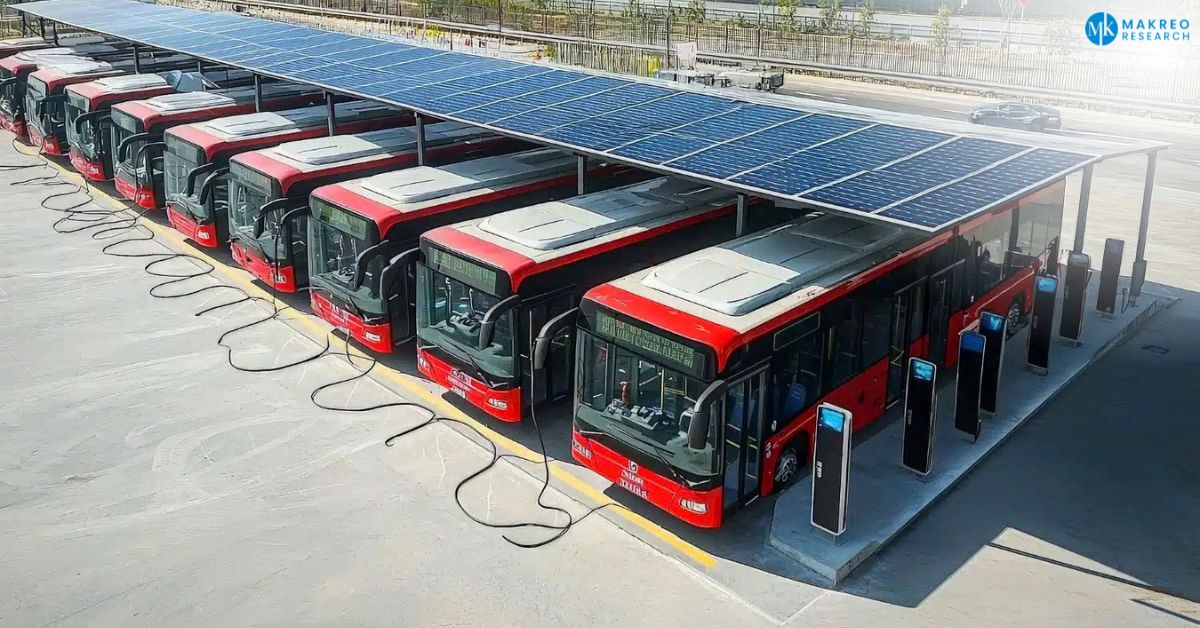
Indonesia Electric Commercial Vehicle Market - Jakarta Targets 10,000+ Electric Buses by 2030 as Local Assembly and Mining Expand
Makreo Research analyses Indonesia's electric commercial vehicle market with Jakarta targeting 10,000+ e-buses by 2030, local assembly expanding and mining fleets supporting e-truck adoption.
Indonesia's electric commercial vehicle market is moving beyond pilot deployments as local assembly, public transport electrification and mining demand begin to create the foundations for early-scale adoption. The opening of an electric commercial vehicle assembly plant in Magelang in April 2026, with installed capacity of up to 10,000 electric buses, marked an important step towards domestic eBus and eTruck production. Since then, Jakarta has strengthened its electric bus ambitions, charging infrastructure for heavy vehicles has begun to take shape, and the government has been studying incentives linked to local content.
Makreo Research and Consulting projects Indonesia's electric commercial vehicle market to grow at a 16.67% CAGR between 2027 and 2032. This proprietary forecast reflects the market's transition from isolated deployments towards a more structured phase of localisation, procurement and fleet planning, with electric buses and mining applications emerging as the strongest near-term areas of adoption.
For OEMs, fleet operators, mining contractors, logistics providers, utilities and investors, the key question is no longer whether commercial vehicle electrification can gain traction in Indonesia, but where adoption will scale first, what will drive it, and at what economics. Developments across public transport, mining, charging infrastructure and TKDN policy suggest that the market is building its foundations, although high upfront vehicle costs, charging constraints and financing remain critical barriers to wider deployment.
Why Is Indonesia's Electric Commercial Vehicle Market Moving Towards Early-Scale Adoption?
The scale of the opportunity is matched by the scale of the gap. Official data place Indonesia's electric vehicle population at around 341,000 units, or 0.2% of a vehicle parc of almost 174 million. Commercial vehicles represent a small share of that base: the country's electric truck population stood at only 273 units in mid-2026, while Makreo Research estimates that 798 electric buses were in operation nationwide as of March 2026.
The structure of the logistics industry explains much of this lag. According to Makreo Research that land transport remains largely volume-driven, vehicle lifetimes can exceed 15 years, and some operators continue to run fleets that are up to 40 years old. Access to subsidised diesel further weakens the economic incentive to switch, which reinforces the position of established brands such as Hino and Mitsubishi Fuso in conventional trucking.
The environmental case for change is nevertheless substantial. Industry estimates indicate that more than six million trucks generate around 30% of Indonesia's land transport emissions, placing heavy commercial vehicles firmly on the national policy agenda.
Public Transport Electrification - Jakarta Anchors Electric Bus Demand
Public transport remains the most visible and policy-backed segment of Indonesia's eCV market. TransJakarta's roadmap targets 50% fleet electrification by 2027 and full electrification by 2030, equivalent to up to 10,047 vehicles. In August 2026, Governor Pramono reaffirmed the 2030 horizon, stating that Jakarta aims to operate more than 10,000 electric buses by that date. Earlier statements had referenced 2029; the August 2026 commitment is the most recent stated target.
The fiscal argument supports this trajectory. TransJakarta estimates that each electric bus can save up to Rp302 million a year in fuel subsidy, with cumulative savings over a 5.5-year operating period of around Rp3.9 billion, broadly the price of a 12-metre electric bus. For bus OEMs, body builders and battery suppliers, Jakarta's procurement schedule represents the most predictable source of eBus demand in the country, and President Prabowo's call for regional governments to purchase domestically produced buses points to demand beyond the capital.
Electric Truck Economics - Total Cost of Ownership Remains the Deciding Factor
Electric trucks face a steeper adoption curve. Industry estimates show that fuel accounts for 30% to 35% of truck transport costs, yet electric trucks remain two to three times more expensive to purchase. Industry analysis presented in July 2026 estimates energy cost per 100 km at Rp113,000 for a truck running on subsidised biodiesel, compared with about Rp72,000 for an electric truck. The operating saving is clear; the upfront capital requirement is the barrier.
The Ministry of Industry has acknowledged that most electric trucks in Indonesia are still imported, that the battery represents 30% to 50% of an electric truck's cost of ownership, and that current EV incentives do not yet extend to trucks. Policy research estimates that tax exemptions comparable to those for passenger EVs could reduce truck TCO by 36% to 40%. Leasing and rental models, which shift spending from capital to operating expenditure, are emerging as a practical route to early adoption.
Mining and Industrial Fleets - The Strongest Near-Term Opportunity for eCV Adoption
Makreo Research's primary insights identify mining and off-road applications as the most attractive near-term segment. Mining operators cannot use subsidised diesel, which leaves their fuel costs almost five times higher than those of subsidised users, and their fleets operate on predictable, dedicated routes that simplify charging. Because fuel is among the largest operating costs in mining, the savings from electrification are proportionally greater than in conventional logistics.
Recent developments support this view. As of July 2026, PLN supplies power to a Kalimantan mining company operating 150 electric trucks and 23 electric excavators, and is in discussions with nine further mining companies. At Mining Indonesia 2026, GM Tractors exhibited XCMG electric and hybrid heavy equipment, while GM Mobil showcased electric trucks for mining, construction and logistics. Tighter coal production quotas (RKAB) have, however, weighed on heavy-equipment demand, so EV investment cases in coal mining must be tested against output volatility, whereas nickel and mineral processing regions offer a more expansionary backdrop.
Competitive Landscape - Chinese, Japanese and Local OEMs Reposition
The competitive structure of Indonesia's eCV market differs markedly from that of its conventional truck market. Makreo Research's interviews indicate that Japanese brands hold an 80% to 90% share of conventional commercial vehicles, supported by long-established distribution and service networks. In electric vehicles, however, Chinese OEMs are viewed as significantly ahead in technology, and several critical components are still imported from China.
Local manufacturers are positioning themselves between these two groups. VKTR's Magelang plant combines completely knocked-down assembly with a rising local content roadmap, while the consolidation of Hino and Mitsubishi Fuso under ARCHION, in which Daimler Truck and Toyota each plan to hold a 25% stake, gives the Japanese incumbents a larger platform for zero-emission development. For new entrants, the decisive factors are likely to be local assembly partnerships, after-sales capability and compliance with domestic content rules rather than vehicle technology alone.
Is Indonesia's EV Charging Infrastructure Ready for Electric Commercial Vehicles?
Public charging is expanding quickly, but it was built for passenger cars rather than trucks. By June 2026, Indonesia had 5,016 public charging units (SPKLU) at 3,132 locations, up from 4,655 at the end of 2025. Charging consumption in the first half of 2026 reached 62.4 million kWh, exceeding the 48.5 million kWh recorded for the whole of 2025, and the national target is 62,918 SPKLU units by 2030. Utilisation is also rising: charging transactions during the Lebaran period of March 2026 reached 303,234, against 73,161 a year earlier.
Heavy vehicles need more power and more space. A prototype electric truck charging station is planned at the KM 88 rest area on the Cipularang toll road. For now, commercial operators rely mainly on depot charging and private infrastructure, as the logistics and mining deployments show. Electric truck charging in Indonesia is a depot-first market, and corridor charging remains at prototype stage.
Charging Infrastructure and TKDN Policy - The Two Levers That Will Determine Scale
Charging infrastructure has expanded rapidly, but primarily for passenger vehicles. By mid-2026, Indonesia's public network had reached around 5,000 four-wheel charging units across more than 3,100 locations. Most existing stations, however, cannot serve trucks because of limited space or power capacity, and 27 high-utilisation logistics locations across Java and Sumatra have been identified as suited to dedicated truck charging. The Cipularang pilot is therefore an important first step towards corridor-based heavy-vehicle infrastructure.
Policy is converging on local content. Under Indonesia's battery electric vehicle roadmap, the minimum TKDN requirement is 40% until 2026, rising to 60% for 2027 to 2029 and 80% from 2030. The government's study of incentives linked to TKDN levels suggests that future support will reward deeper localisation rather than assembly alone. Indonesia's nickel and aluminium resources, together with its expanding smelter and battery manufacturing base, give the country a structural advantage in meeting these thresholds.
Indonesia Electric Commercial Vehicle Market Outlook to 2032
Makreo Research projects Indonesia's electric commercial vehicle market to grow at a 16.67% CAGR between 2027 and 2032, with 2026 as the base year. The outlook considers developments in electric bus deployment, logistics and industrial applications, mining fleet electrification, charging infrastructure and Indonesia's domestic EV ecosystem.
The report segments the market by vehicle type, including eLCV, eHDV and eBus; OEM origin, covering Chinese, Japanese, local and European manufacturers; application, including public transport, mining, logistics and industrial uses; and geography, covering Java, Sumatra, Kalimantan and Sulawesi. Makreo's analysis indicates that eBuses and eTrucks are currently seeing faster deployment than eLCVs, where adoption remains at an early stage. The study also examines market scenarios, with 49 figures and tables and profiles of seven companies.
Makreo expects growth to vary across applications. Government-backed bus fleet programmes and captive mining operations are identified as the leading areas for near-term adoption, while broader electric truck deployment in conventional logistics is likely to depend on improvements in purchase economics, financing and charging infrastructure.
How Makreo Research Supports Decision-Making Across Indonesia's eCV Ecosystem
Public information shows what has been announced. It rarely shows what fleet buyers will pay, which routes suit electric trucks, or which partners can meet TKDN on time. Makreo Research and Consulting closes that gap through:
-
Market entry assessment
-
Market sizing and regional opportunity assessment across Java, Sumatra, Kalimantan and Sulawesi
-
Competitive benchmarking
-
OEM and local partner screening
-
Total cost of ownership (TCO) research
-
Charging infrastructure assessment
-
Customer perception research
Our market surveys and consulting services include structured surveys of fleet operators, logistics companies and mining contractors, and primary interviews with procurement heads, financiers and regulators. This evidence reveals purchase triggers, acceptable payback periods, charging needs and financing preferences that desk research cannot establish.
Explore the Indonesia Electric Commercial Vehicle Market and Forecast to 2032, or contact Makreo Research to discuss your research requirements.
Key Questions Answered
How fast is the Indonesia electric commercial vehicle market expected to grow?
Makreo Research projects the Indonesia electric commercial vehicle market to grow at a 16.67% CAGR between 2027 and 2032, with 2026 as the base year.
Which segment is leading eCV adoption in Indonesia?
Electric buses lead adoption, anchored by TransJakarta's fleet of 500 electric buses and Jakarta's target of more than 10,000 by 2030. Mining is the strongest near-term opportunity for electric trucks.
What is driving electric commercial vehicle adoption in Indonesia?
The main drivers are local assembly capacity, public transport electrification targets, rising diesel costs and supply concerns, green financing and TKDN-linked industrial policy. Operating-cost savings in early mining and logistics deployments are strengthening the business case
Why are electric trucks slow to gain traction in Indonesian logistics?
Electric trucks cost two to three times more than diesel trucks, incentives do not yet cover them, subsidised diesel narrows the savings, and most public chargers cannot accommodate heavy vehicles.
Makreo Research and Consulting supports decision-makers across the commercial vehicle, mining, logistics, charging and battery sectors. Explore Makreo Research's Case Studies to see how its research approach supports strategic and investment decisions
Indonesia electric commercial vehicle market, Indonesia eCV market 2026, Indonesia electric bus market, Indonesia electric truck market, Indonesia eLCV market, TransJakarta electric buses, VKTR Magelang plant, Indonesia TKDN electric vehicles, electric truck charging Indonesia, mining fleet electrification Indonesia, Indonesia EV incentives, ARCHION Hino Mitsubishi Fuso, eCV market entry Indonesia, eCV consulting services, eCV market survey, Makreo Research