
India’s Athletic Footwear Market Nears USD 6.2 Billion as Sneakers Become Everyday Lifestyle Essentials
India’s athletic footwear market nears USD 6.2 billion as sneakers become lifestyle essentials. Explore growth drivers, brands, pricing bands, consumers, and manufacturing trends.
India’s athletic footwear market is no longer confined to sports or performance-driven use cases. Sneakers have moved decisively into everyday life,worn to offices, social gatherings, travel, and semi-formal settings, signalling a structural shift from utility-led consumption to lifestyle, comfort, and self-expression.
This evolution reflects a broader change in how Indian consumers engage with footwear. Athletic shoes are no longer purchased only for running or training; they are increasingly chosen as default daily wear. The result is a category that now sits at the intersection of fashion, fitness, and identity, rather than performance alone.
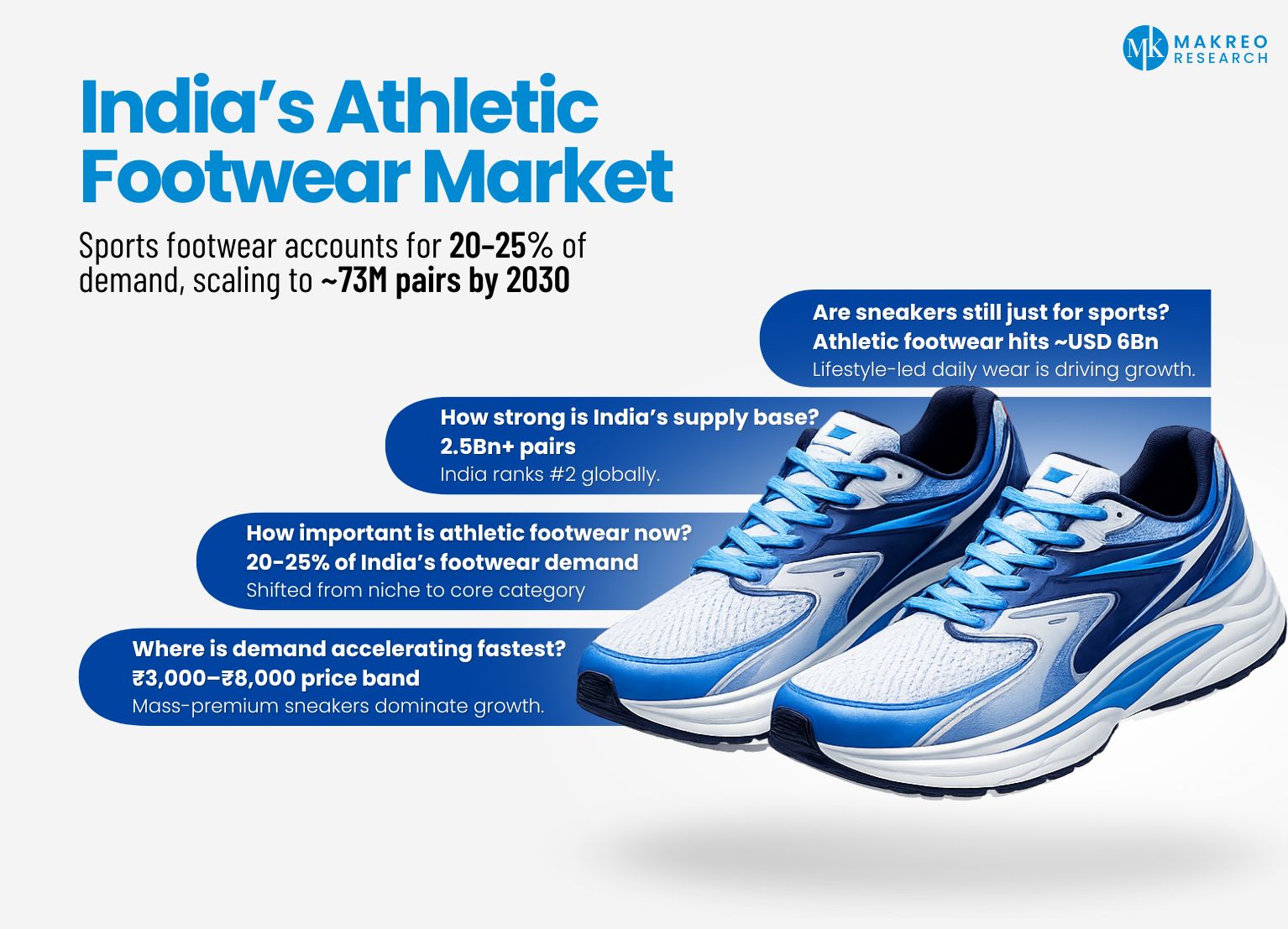
This behavioural shift is supported by scale. India is the world’s second-largest footwear producer, manufacturing over 2.5 billion pairs annually. Established manufacturing hubs such as Tamil Nadu anchor global supply chains, while emerging clusters in Uttar Pradesh and Bihar are expanding capacity across athletic and casual footwear categories.
According to Makreo Research’s synthesis of industry data and market signals, demand patterns are evolving rapidly. Men’s footwear accounts for ~58% of total demand, followed by women at ~30% and children at ~12%. Casual and athletic footwear are among the fastest-growing segments, supported by workplace casualisation, rising fitness participation, and lifestyle-led purchasing behaviour.
India’s Athletic Footwear Market Evolves Beyond Sportswear
For decades, athletic footwear consumption in India followed a narrow definition. Sports shoes were worn strictly for exercise, while formal and casual footwear dominated daily use. Beyond performance, athletic footwear carried limited cultural relevance.
Over the past decade, however, four structural forces have reshaped this dynamic:
rapid urbanisation, casualisation of workplaces, changing social environments, and social media transforming sneakers into visible lifestyle markers. Athletic sneakers are now worn across work, travel, and social settings, repositioning them as symbols of individuality rather than specialised gear.
This shift is clearly reflected in market size. India’s athletic sneaker segment was valued at ~USD 3.9 billion in FY2024 and is projected to approach USD 6.2 billion by the end of the decade. Athletic footwear now contributes nearly 20–25% of India’s total footwear market, confirming its transition from a niche category to a core consumption segment.
The Pricing Structure Redefining India’s Athletic Sneaker Market
Historically, India’s athletic sneaker market has been split between two extremes. On one end are premium international brands priced between ₹10,000–₹20,000, catering to a narrow, urban consumer base. On the other are low-cost, largely unbranded products priced around ₹1,000, which continue to drive the bulk of volume.
This left a clear and underserved gap in the middle.
The ₹3,000–₹8,000 price band has emerged as a strategic whitespace, where consumers seek design, comfort, durability, and aspiration without paying global brand premiums. This segment has become the fastest-growing pocket of India’s athletic sneaker market and is reshaping competitive dynamics.
Homegrown Brands Are Powering India’s Athletic Footwear Expansion
Growth in India’s athletic footwear market is being driven less by global premium labels and more by domestic brands that dominate the mass-premium ₹3,000–₹8,000 segment. This band effectively bridges the gap between expensive imports and India’s fragmented, low-cost unorganised market, which still accounts for nearly 90% of total footwear volumes.
Established Domestic Players
-
Bata India: With an estimated 15–20% share of India’s organised footwear market and a retail network of 1,600+ stores, Bata is expanding its athletic and sneaker portfolio while retaining mass affordability and distribution strength.
-
Liberty Shoes: Exporting to 25+ countries, Liberty maintains a diversified presence across school, formal, casual, and select athletic categories. Its positioning remains anchored in durability and value pricing.
-
Relaxo Footwears (Sparx, Flite, Bahamas): Among India’s largest footwear players by volume, Relaxo leverages 50,000+ retail touchpoints nationwide. Sparx anchors its sporty sneaker offerings, while Flite and Bahamas focus on everyday comfort-led consumption.
-
CHK: Founded in 2024, CHK operates an end-to-end design-to-manufacturing model from a 40,000 sq. ft. facility in Tamil Nadu. Its products are engineered for Indian usage conditions and priced between ₹4,000–₹8,000. The brand has reported early traction of ~₹1 lakh in daily sales within months of launch, highlighting demand for India-first sneaker propositions.
International Brands Deepen Commitment to India’s Athletic Footwear Market
India’s athletic footwear opportunity is also drawing deeper commitment from global brands, driven by premiumisation and rising lifestyle-led demand. International players are expanding retail footprints, strengthening localisation, and investing in experiential engagement to capture long-term growth.
ASICS: ASICS currently operates 111 stores in India and targets 200 stores by 2026. It recently opened its largest India flagship at Connaught Place, Delhi, reinforcing its premium positioning. Nearly 75% of ASICS products in India are priced above ₹12,000, and the brand reported 37% revenue growth to ₹345 crore, driven by performance and athleisure demand.
New Balance: New Balance has more than doubled its India store count in the past year, adding multiple locations across Bengaluru. Its strategy focuses on experiential retail, community runs, and fitness-led engagement. Globally, the brand reported USD 7.8 billion in sales in 2024, supporting its long-term expansion plans in India.
India’s Athletic Footwear Consumer Base Is Broadening
India’s athletic footwear market is no longer driven solely by metro youth or sport-specific usage. Demand is widening across age groups, city tiers, and daily use cases, reshaping how brands approach product design, pricing, and distribution.
Gen Z and millennials (18–35 years) remain primary demand drivers, prioritising comfort, self-expression, and social-media-led fashion adoption. Homegrown brands priced between ₹3,000–₹5,500 report repeat purchase rates of 20–30%, signalling early brand loyalty in a segment previously dominated by price-led buying.
Geographic expansion is accelerating beyond metros. Tier-2 and Tier-3 cities are contributing a rising share of athletic footwear demand as consumers transition from sandals and unbranded shoes to organised brands offering aspirational yet functional products.
Women consumers are emerging as a key growth lever, driven by preferences for design differentiation, customisation, and all-day comfort. Collectively, these shifts are repositioning India’s athletic footwear from a youth-centric category to a multi-demographic lifestyle market.
Why Manufacturing Capability Is the Next Inflection Point
Despite strong demand momentum, manufacturing capability remains a structural constraint in India’s athletic footwear market. Sports footwear already accounts for 20–25% of total footwear demand, with volumes projected to reach ~73 million pairs annually by 2030.
Meeting this scale will require deeper backend integration across materials, tooling, and specialised sneaker components. Industry participants continue to highlight gaps in material availability, minimum order quantities, and sneaker-specific inputs, factors that increase import dependence and slow speed-to-market.
As a result, brands investing in in-house or vertically integrated manufacturing are gaining structural advantages, despite higher capital intensity. Over the long term, success in India’s athletic footwear market will be shaped less by storytelling and more by supply-chain resilience, cost control, and manufacturing sophistication.
India’s Athletic Footwear Market Is Now a Strategy Market, Not a Volume Play
India’s athletic footwear market has entered a phase where growth is no longer driven by availability or affordability alone. The next decade will be shaped by brand depth, manufacturing control, comfort engineering, and cultural relevance.
For years, India was the factory floor for global sneaker brands.
Today, it is becoming a brand-building market in its own right, where local players compete not just on price, but on design language, fit-for-India performance, and lifestyle positioning.
The opportunity is substantial, but uneven. While demand momentum is clear, not all brands will scale sustainably. Winners will be those who can:
-
Balance aspiration with affordability in the ₹3,000–₹8,000 band
-
Build repeat consumption beyond first-time sneaker buyers
-
Secure manufacturing resilience as volumes move toward 70+ million pairs annually
-
Translate cultural relevance into long-term brand equity, not short-term hype
In this market, intuition-led expansion is increasingly risky. Execution decisions now require data-backed clarity.
How Makreo Research Drives Winning Strategies in India’s Athletic Footwear Market
Makreo Research works closely with sneaker brands, athletic footwear manufacturers, retailers, investors, and PE-backed platforms to help them navigate India’s rapidly evolving footwear landscape.
Our work in the India athletic and lifestyle footwear ecosystem focuses on decision-critical questions, such as:
-
Which price bands and product attributes drive repeat purchase versus one-time trial?
-
How does consumer preference differ across metros, Tier-2, and emerging cities?
-
What manufacturing and sourcing strategies best support scale without margin erosion?
-
How are homegrown brands outperforming global players in select segments, and why?
-
Which channels (D2C, marketplaces, offline retail) are driving profitable growth today?
Our Custom Research Capabilities Include:
-
Consumer and intercept surveys across city tiers, age cohorts, and usage occasions
-
Brand perception, pricing elasticity, and purchase driver analysis
-
Mystery shopping and retail audits across organised and unorganised formats
-
Competitive benchmarking across assortment, pricing, drops, and promotions
-
City- and region-level demand mapping for expansion planning
-
Manufacturing and supply-chain assessment for scalability and cost optimisation
Our research is custom-built, not templated, designed around your category focus, growth stage, and strategic objectives.
The Question Is No Longer If India’s Athletic Footwear Market Will Grow
The Question Is Who Will Build Enduring Brands
Whether you are:
-
A global athletic footwear brand accelerating India expansion
-
A homegrown sneaker brand scaling beyond early traction
-
A retailer optimising category performance
-
Or an investor evaluating India’s next consumer growth wave
For tailored market intelligence and strategic research support in India’s athletic footwear market, contact us at [email protected].
India athletic footwear market, India sneaker market, Athletic footwear market India, India sports footwear market, Sneakers market in India, India footwear industry, Athletic shoes market India, India lifestyle footwear market, India sneaker industry growth, India athletic footwear trends, Sports shoes market in India, Indian sneaker brands, Footwear market size India, Athletic footwear demand India, Casual and athletic footwear India, India footwear manufacturing industry, Organized footwear market India, Footwear consumption trends India, Sneakers price range in India, Mid-range sneaker market India, Bata athletic footwear, Relaxo Sparx sneakers, Liberty Shoes India, CHK sneakers India, ASICS India stores, New Balance India expansion, Sneaker consumption trends India, Gen Z sneaker trends India, Millennial footwear preferences India, Women athletic footwear India, Tier 2 Tier 3 city footwear demand, Lifestyle sneakers India, Everyday sneakers India, Athletic footwear market research India, Sneaker industry analysis India, Footwear consumer insights India, Sports footwear industry report, India footwear demand analysis, Retail footwear market India