
India Higher Education Market 2026: NEP 2020, Foreign University Campuses, and Online Degrees Reshape a 155-Million-Student Opportunity
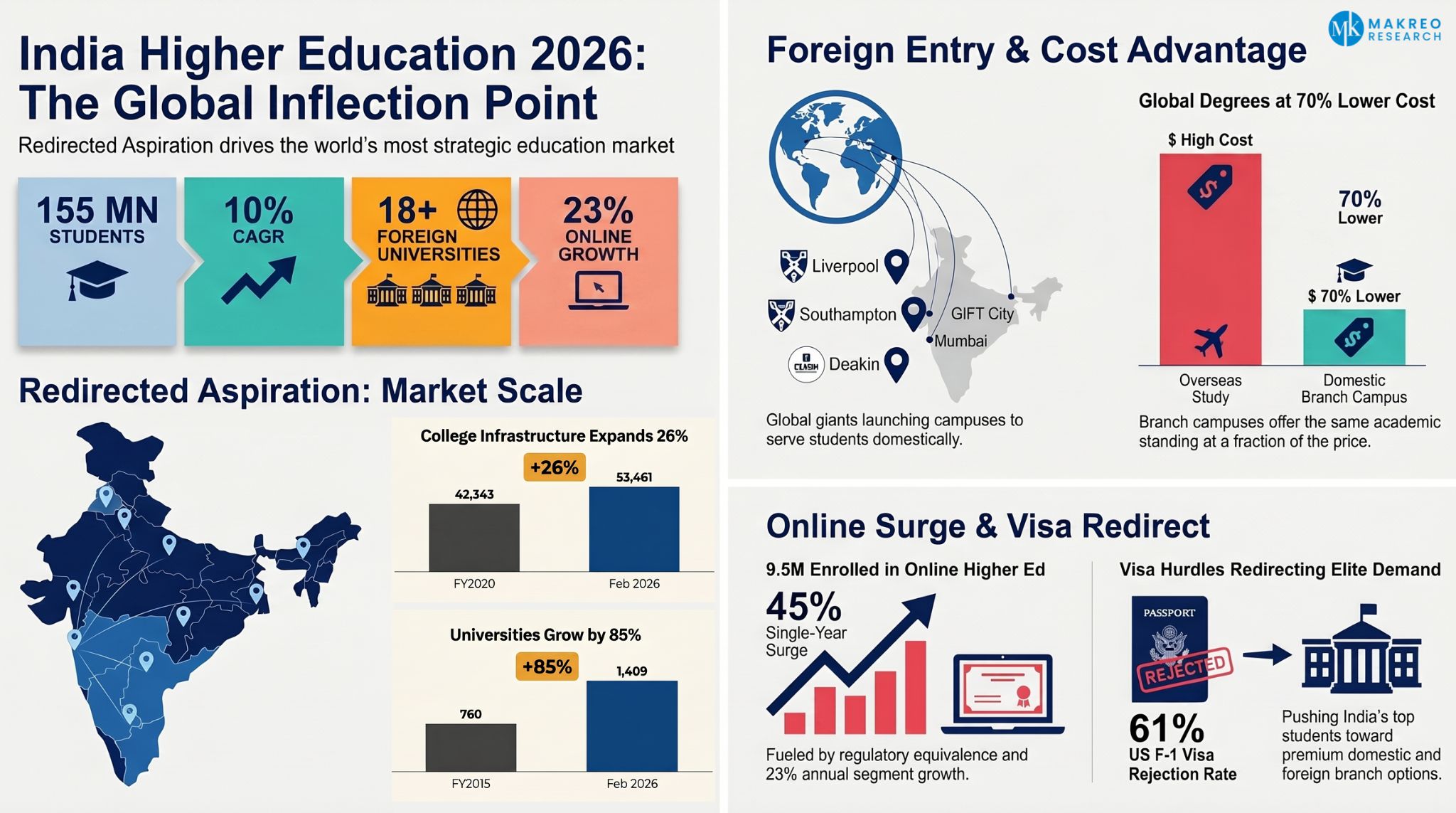
India's higher education market grows at 10% CAGR. 18 foreign universities enter in 2026, online enrolments hit 9.5M.
For years, India’s higher education story was mainly framed around outbound student mobility. Indian students aspired to study in the US, UK, Canada and Australia, while domestic institutions competed largely within state, city and entrance-exam ecosystems. That picture is changing quickly. India is now being positioned as both a source market and a destination market: foreign universities are building local campuses, online degrees are gaining acceptance, and students are increasingly evaluating global credentials without necessarily leaving the country.
This shift matters because it is structural, not seasonal. According to Makreo Research’s India Higher Education Market and Forecast (FY2021-FY2030), the sector’s growth is being shaped by private institution expansion, digital delivery, foreign university collaboration models, student demographic depth and India’s policy push to internationalise higher education. Public sources and recent industry developments indicate the same direction: India is becoming one of the most strategically important higher education markets globally, not only because of its population scale, but because regulation, affordability and delivery models are moving at the same time.
India Higher Education Market Size and Scale: What the Numbers Actually Mean
India is now one of the world’s most strategically important higher education growth markets, supported by a large student-age population, expanding institutional capacity, and policy-led reform under NEP 2020. According to BusinessWorld’s coverage report, India has nearly 155 million people in the 18-23 age group, making it one of the largest higher education demand pools globally.
For institutions and investors, the opportunity is not evenly distributed. Metropolitan cities remain attractive for foreign campuses and premium programmes, but Tier-2 and Tier-3 cities are becoming equally important for online degrees, hybrid learning, skill-linked programmes and affordable private higher education. This creates a segmented opportunity: premium global education in major urban clusters, scalable online and blended programmes outside metros, and employability-led curricula across both.
Makreo Research’s report tracks this market through academic level, student origin, foreign collaboration models and competitive dynamics. This segmentation is essential because undergraduate demand, postgraduate upskilling, doctoral research, diploma programmes and online certificates are not growing for the same reasons. Each requires a different pricing model, student acquisition strategy, faculty approach and regulatory lens.
NEP 2020 and UGC Regulations: The Policy Shift Behind Foreign University Entry
India’s foreign university expansion is not only driven by student demand. It is also the result of a clearer regulatory framework under NEP 2020. The UGC Foreign Higher Educational Institutions Regulations 2023 created a formal pathway for eligible foreign universities to set up campuses in India, offer programmes, and award qualifications with UGC approval.
The regulation allows globally recognised institutions, including those ranked in the top 500 globally or by subject, to establish branch campuses in India. This moved the market beyond informal collaborations and twinning arrangements toward a structured foreign campus model with academic autonomy and degree-awarding authority.
The UGC Recognition and Equivalence Regulations 2025 further strengthened student confidence by confirming that degrees from approved foreign campuses in India are equivalent to corresponding Indian qualifications. This matters for employability, higher studies, government job eligibility, PSU roles, and long-term credential value.
For students, foreign campuses in India now offer a more credible alternative to overseas education. For universities and private institutions, this creates a new competitive category where academic recognition, industry integration, placement outcomes, faculty depth, campus experience, and affordability will matter more than degree availability alone.
Foreign Universities in India 2026: From Announcement Phase to Operating Phase
Who Is Operational Now
Three foreign universities are fully operational as of April 2026. Deakin University (GIFT City, Gujarat) held its inaugural graduation ceremony in March 2026 — the first globally recognised Australian degree awarded entirely on Indian soil. The University of Wollongong is also operational at GIFT City. The University of Southampton launched in Gurugram, Haryana, with its first cohort including students from India, the UAE, and Nepal.
The August 2026 Wave
Fourteen universities hold formal UGC approval or Letters of Intent, with the largest group opening in August-September 2026:
-
University of Liverpool, Bengaluru: Admissions open for August 2026 across Business Management, Accounting and Finance, Computer Science, Biomedical Sciences, and Game Design. Industry partnerships with Wipro, Dream11, and AstraZeneca in place at launch. Five-year enrolment target: 5,000+ students.
-
University of Aberdeen, Powai (Mumbai): Teaching from September 2026 in Business Management, Computing Science, Data Science, Economics, Artificial Intelligence (PG), and MBA.
-
University of Bristol, Mumbai: Applications open for 2026 across Data Science, Economics, Finance and Investment, Immersive Arts, and Financial Technology.
-
University of York, Mumbai: Undergraduate and postgraduate programmes from the 2026/27 academic year.
-
Birkbeck, University of London, Bengaluru: Launched April 14, 2026, offering Business Management, Business Analytics, and International Business Management.
-
Illinois Institute of Technology, Mumbai: First US university to receive UGC approval. Inaugural cohort of approximately 300 students. Fees at approximately one-third of Chicago campus rates.
-
University of New South Wales (UNSW), Bengaluru: Launching August 2026, offering Business, Computer Science, and Data Science. UNSW has held a global top-20 ranking for two consecutive years.
-
Queen's University Belfast, GIFT City: First Russell Group university to open in India.
-
Coventry University, GIFT City: First UK university approved for the GIFT City zone. Enrolling for 2026 in International Business Management and Business and Finance.
-
Victoria University (Melbourne), Delhi NCR: UGC approval received; campus launch expected 2027 in Business, IT, Data Science, and Cybersecurity.
The Cost Proposition That Is Changing Student Decisions
Studying at a University of Southampton Gurugram campus costs approximately 60-70% less than attending the UK home campus. Illinois Tech Mumbai fees are roughly one-third of Chicago campus rates. Degrees from these campuses carry the same academic standing as the home institution and, under UGC Equivalence Regulations 2025, hold full Indian credential recognition. For students weighing this against a 61% US F-1 visa rejection probability, the calculus has shifted considerably.
India Online Higher Education: From Alternative Route to Mainstream Access Channel
Online higher education in India is no longer a pandemic-era substitute. It has become a mainstream access channel for working professionals, young learners outside metro cities, exam-focused students and learners seeking flexibility. Education Economic Times has described online degrees as moving from the margins to the mainstream, while India Today’s BestColleges coverage notes that India’s online learning market is set to expand strongly through FY2028, supported by young learners, digital access and government initiatives.
The real change is credential acceptance. UGC-recognised online degrees have improved trust, while digital public platforms and institutional online programmes have expanded access beyond physical campuses. The Hindu’s coverage of online higher education highlights the role of UGC regulations and market trends in making online programmes more credible for students and employers.
For universities, online higher education is not simply a distribution channel. It is a product strategy. Institutions need to decide which programmes can be delivered fully online, which require blended delivery, where internships or assessments must remain physical, and how student support will be structured. EdTech providers need to prove learning outcomes, retention, employability and compliance rather than relying only on learner acquisition.
AI, Hybrid Learning and Skills: The Next Layer of Competition
AI is becoming a defining layer of higher education delivery. Entrepreneur India’s 2026 education business trends point to AI-led learning, hybrid models and skill-centred programmes as high-growth themes. These trends are visible across universities, EdTech firms and corporate learning programmes, where demand is moving toward personalised learning, adaptive assessments, job-linked microcredentials, language localisation and analytics-driven student support.
The opportunity is significant, but it is not automatic. AI in higher education will be judged on quality, not novelty. Institutions will need to show whether AI tools improve completion rates, placement readiness, faculty productivity and student engagement. EdTech platforms will need to demonstrate credible outcomes and data privacy standards. Investors will increasingly distinguish between AI as a feature and AI as a measurable learning advantage.
Hybrid learning is likely to become the practical middle path. Students may want the flexibility of online modules, but many still value campus interaction, peer learning, labs, internships and placement support. The winning model in India may therefore be neither fully physical nor fully online, but a structured combination of digital access and institutional credibility.
Student Mobility Is Rebalancing: India as Source, Destination and Retention Market
Global student mobility is changing. Economic Times reported that international student numbers are projected to reach 8.5 million by 2030, while also noting that the combined market share of the traditional big four destinations is expected to decline as students explore alternative destinations. For India, this creates two simultaneous shifts: Indian students continue to look abroad, but India itself is also becoming more relevant as a regional education destination.
Indian Express coverage of QS Global Student Flows indicated that India could see an annual rise in foreign students, supported by affordability, English-language education and policy reforms. This matters because inbound student growth can improve campus diversity, international partnerships, research linkages and India’s soft power in education.
At the same time, visa tightening and rising costs in traditional destinations are making domestic alternatives more attractive. Foreign campuses in India, joint degrees, dual degrees, online global certifications and Indian institutions with international partnerships can capture part of the demand that earlier moved almost entirely overseas. This does not mean outbound education will disappear. It means the decision set has widened.
Quality Signals Are Improving, but Trust Will Decide the Market
India’s global academic visibility is improving. A PIB release on QS World University Rankings 2026 stated that India had 54 universities in the rankings, making it the fourth most represented country globally that year. The latest QS World University Rankings 2027 coverage shows India’s representation remains strong, with IIT Delhi emerging as the top-ranked Indian institution and 52 Indian institutions included.
Rankings are only one part of the trust equation. Students and employers also evaluate placement outcomes, faculty quality, practical learning, international exposure, research depth, alumni outcomes and affordability. As more foreign campuses and online degrees enter the market, the biggest challenge will be preventing confusion between approved, equivalent, credible programmes and unapproved or low-quality offerings.
This makes regulatory clarity and student communication extremely important. Institutions must clearly explain approval status, degree equivalence, programme structure, fees, placement support and progression pathways. In a more crowded market, transparency will become a competitive advantage.
Strategic Implications for Stakeholders in India’s Higher Education Market
For foreign universities, India is no longer only a recruitment market. It is a campus, partnership and long-term brand market. The right approach depends on programme fit, city selection, pricing, regulatory readiness, faculty model and employer partnership depth.
For private universities, the competitive benchmark is rising. Domestic institutions will need to strengthen global collaborations, digital readiness, interdisciplinary programmes, applied research, student outcomes and industry engagement to compete with foreign campuses and premium online degree options.
For EdTech platforms, the market is shifting from growth-at-any-cost to credibility-at-scale. Programmes that align with recognised degrees, employability outcomes, professional upskilling and measurable learning improvement are better positioned than generic course libraries.
For investors, the opportunity lies in segment-level clarity. Campus infrastructure, online degrees, AI learning tools, student financing, international pathway programmes and employability services are very different investment themes. Each requires separate demand validation and competitive benchmarking.
How Makreo Research Supports Decision-Making in India’s Higher Education Market
India’s higher education market is large, but headline growth is not enough for strategic decisions. A foreign university evaluating a Bengaluru campus needs different intelligence than an EdTech company assessing online MBA demand in Tier-2 cities, or an investor benchmarking private university expansion across states. Makreo Research supports this specificity through custom market research, market surveys and strategic consulting.
Makreo Research can assist teams exploring market entry, institutional expansion, new programme development, student demand assessment, competitive benchmarking, international collaborations, EdTech adoption, investment planning and regulatory strategy in India’s higher education sector.
Our custom research and market survey solutions are relevant for Strategy and Corporate Planning, Academic Planning, Admissions, Sales and Marketing, Product, Finance, Operations, and Policy/Regulatory teams. Research methods can include student and parent surveys, institution-level interviews, employer demand mapping, fee benchmarking, competitive landscape analysis, city-level feasibility studies and regulatory impact assessment.
For decision-makers, the value is practical clarity: which programmes have demand, which locations can support growth, which student segments are addressable, which competitors are best positioned, and which regulatory or operational risks must be solved before expansion.
Makreo Research’s India Higher Education Market Size, Share, Trends and Forecast (FY'2021-FY'2030) provides a structured view of the sector across academic levels, competition, foreign university collaboration models and student demographics. The report covers market evolution, NEP 2020 implications, private and public institution dynamics, digital education adoption, student mobility, foreign university pathways and the strategic outlook through FY2030.
The study is designed for universities, EdTech platforms, investors, policymakers, education service providers and consulting teams evaluating India’s higher education opportunity with a need for current, segment-level intelligence rather than generic market commentary.
Frequently Asked Questions
Which foreign universities are open in India in 2026?
Three are fully operational: Deakin University (GIFT City, Gujarat), University of Wollongong (GIFT City, Gujarat), and University of Southampton (Gurugram, Haryana). The largest August 2026 wave adds University of Liverpool (Bengaluru), Illinois Institute of Technology (Mumbai), UNSW Sydney (Bengaluru), University of Bristol (Mumbai), University of Aberdeen (Mumbai), University of York (Mumbai), Birkbeck University of London (Bengaluru), and Queen's University Belfast (GIFT City). Degrees from all UGC-approved campuses are fully equivalent to Indian degrees under UGC Equivalence Regulations 2025.
What is driving online degree enrolment growth in India?
UGC's Online Education framework gave online degrees full regulatory equivalence with campus degrees, making them valid for government jobs, PSU employment, and PhD admission. Enrolments in UGC-governed online programmes reached 9.5 million, a 45% single-year increase. Growth is concentrated among working professionals and students in Tier-2 and Tier-3 cities - segments underserved by physical campus infrastructure. The online market is projected to triple by FY2028.
How is AI being used in India's higher education sector?
AI is entering from three directions: government policy (Rs. 100 crore Centre of Excellence in AI for Education; YUVA AI for All targeting 10 lakh learners), institutional curriculum (Coursera's collaboration with 18 Indian universities, including IITs and IIMs, produced 2.6 million generative AI enrolments by August 2025 - the highest globally), and EdTech platforms (personalised learning paths, vernacular-language instruction, and automated assessments). AI/ML platforms captured 31% of global edtech investment in 2025.
India Higher Education Market, Higher Education Market India, NEP 2020, Foreign Universities in India, Foreign University Campuses India, Online Higher Education India, Online Degrees India, India EdTech Market, AI in Education India, Private Universities India, Higher Education Investment India, Student Enrollment India, Higher Education Market Forecast, Education Market Research, Custom Market Research, India Higher Education Outlook, India Higher Education Forecast 2030, Foreign Universities Entering India, Online Degrees Reshaping Higher Education, Future of Higher Education India, Higher Education Investment Opportunities India, India Education Industry Trends, University Expansion Strategy India, Higher Education Competitive Benchmarking, Student Demand Assessment India