
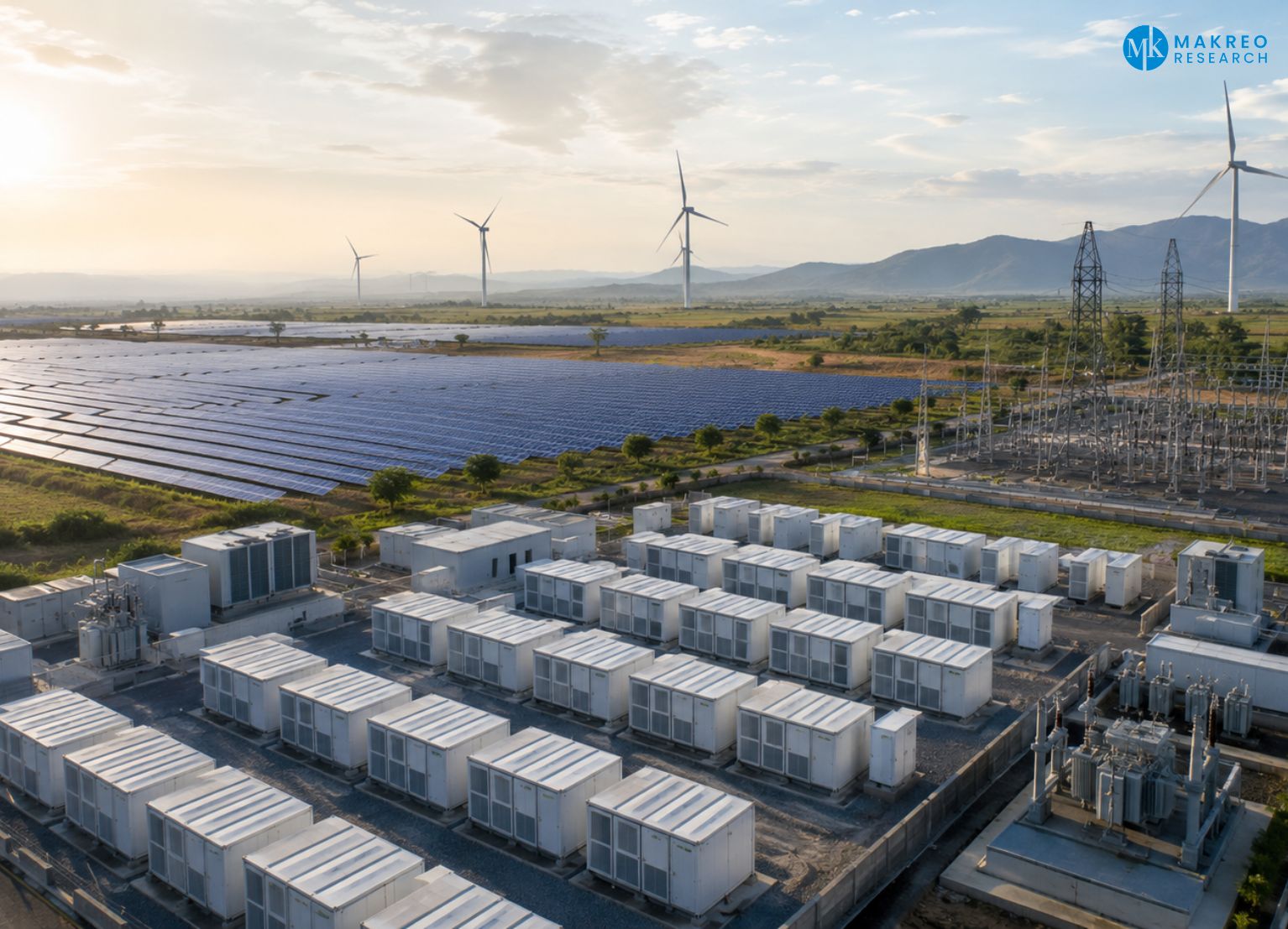
India BESS Market Enters an Execution-Led Growth Phase, Estimated at USD 348.40 Million in 2026 and Set for Rapid Growth Through 2032
India's BESS market enters an execution-led growth phase, reaching USD 348.40 million in 2026 as the project pipeline scales past 92 GWh.
India’s battery energy storage market has reached an important transition point. For several years, the sector was primarily shaped by government tenders, policy initiatives, proposed manufacturing facilities, and projects awaiting financial closure. In 2026, the market began moving toward execution as utility-scale projects entered operation, standalone storage procurement expanded, and merchant BESS models gained greater attention.
According to Makreo Research and Consulting’s India Battery Energy Storage System Market and Forecast to 2032, the market is estimated to reach USD 348.40 million in 2026 and is projected to expand at a CAGR of 29.05% from 2026 to 2032. The study evaluates the market across utility, commercial and industrial, and residential applications, alongside battery type, storage system, connection type, energy capacity, ownership model, component, and geography.
The report further highlights that India’s BESS project pipeline increased from approximately 19 GWh in 2024 to 92 GWh in 2026, representing an addition of around 74 GWh within two years. Commissioned capacity stood at approximately 0.8 GWh in January 2026, while nearly 5 GWh of projects were expected to become operational by the end of the year.
This widening pipeline reflects a market moving beyond tender announcements toward commercial deployment. Future growth will be supported by renewable-energy integration, peak-demand management, grid-modernisation initiatives, standalone and hybrid storage procurement, commercial and industrial adoption, and domestic battery-manufacturing investments.
India BESS Market Highlights
-
The India BESS market is estimated at USD 348.40 million in 2026.
-
Market revenue is projected to grow at a 29.05% CAGR from 2026 to 2032.
-
The BESS project pipeline expanded from approximately 19 GWh in 2024 to 92 GWh in 2026.
-
Commissioned BESS capacity stood at approximately 0.8 GWh in January 2026, with nearly 5 GWh expected to become operational by the end of 2026.
-
India’s national storage objective of meeting around 4% of electricity demand by 2030 translates into an estimated 200–250 GWh of grid-scale storage capacity.
-
Merchant-market participation, co-location incentives, grid modernisation, and indigenous battery-cell development could further accelerate adoption.
India BESS Market Demand Outlook to 2032
India’s BESS demand outlook is being shaped by the rapid expansion of renewable generation and the increasing requirement for flexible power capacity. Higher solar and wind penetration creates a growing need to store surplus electricity, manage evening demand ramps, reduce renewable curtailment, and maintain grid reliability.
The national objective of meeting approximately 4% of electricity demand through energy storage by 2030 represents an estimated requirement of 200–250 GWh of grid-scale storage capacity. This creates a substantial expansion opportunity compared with the current operational base and project-development pipeline.
Demand is expected to emerge across multiple applications rather than utility-scale procurement alone. Front-of-the-meter systems will support renewable integration, peak management, frequency regulation, and grid balancing, while behind-the-meter systems will help commercial, industrial, and residential users improve backup reliability, manage peak electricity costs, and optimise on-site renewable generation.
The pace of market expansion will depend on project commissioning, tariff viability, transmission readiness, financing availability, storage obligations, domestic manufacturing progress, and the commercial development of merchant and ancillary-service revenue models.
India BESS Tender Pipeline Shifts Toward Execution
India’s cumulative tendered energy-storage capacity increased from approximately 6.8 GW in 2018 to 90.7 GW by 2025. Standalone storage represented more than 71% of the capacity tendered during 2025, with standalone BESS accounting for around 60% of the total.
Approximately 10.4 GW of standalone BESS capacity was allocated in 2025. Two-hour, two-cycle systems accounted for 57% of allocated capacity, reflecting their suitability for morning and evening peak demand. Four-hour configurations also gained momentum as utilities sought longer-duration support for evening ramps and firm renewable-power supply.
Tender activity remained strong in the first half of 2026, with around 47 GWh of new energy-storage tenders issued and the wider project pipeline reaching approximately 260 GWh.
Renewable Watch’s tracking through May 2026 identified:
- More than 29,000 MWh of standalone BESS capacity under bidding
- Over 35,000 MWh awarded
- More than 2,000 MWh under construction
- Over 4,700 MWh operational
- Around 5,300 MWh cancelled
In the firm and dispatchable renewable energy and renewable-plus-storage segments, more than 4,500 MW remained under bidding, over 17,000 MW had been awarded, approximately 9,400 MW was under construction, and nearly 2,800 MW had been cancelled.
The gap between awarded and operational capacity highlights the importance of financial closure, battery procurement, grid connectivity, tariff viability, safety compliance, and developer experience. As noted by a senior industry representative, India’s BESS market is shifting from aggressive tendering toward execution-led expansion, with future progress increasingly measured by projects commissioned on schedule rather than capacity announced.
India BESS Tariff Trends and Project Viability
The sharp decline in standalone BESS tariffs during 2025 expanded procurement but raised concerns about project bankability. The lowest discovered tariff for a two-hour system fell to approximately INR 1.48 lakh per MW per month, well below the indicative viability benchmark of around INR 2.3 lakh per MW per month.
Between 2022 and 2025, BESS tariffs declined by more than 71%, compared with an estimated 36% reduction in battery-pack prices. As a result, nearly 75% of the two-hour capacity allocated in 2025 falls within an at-risk tariff category, with several projects priced below realistic development and operating costs. The participation of new entrants without an established standalone BESS execution record has added to concerns around financial closure and timely commissioning.
Tariffs began correcting upward in early 2026. CESC and PSPCL auctions discovered prices of approximately INR 3.26–3.44 lakh per MW per month, nearly double the 2025 low. Solar-plus-storage tariffs also recovered from around INR 2.70 per kWh to above INR 3.10 per kWh in subsequent auctions.
The correction reflects higher battery and component costs, raw-material volatility, currency exposure, supply-chain risks, and changing Chinese export policies. It may also improve project quality by allowing developers to account more realistically for financing, degradation, replacement reserves, safety systems, and long-term operating expenses.
State-Wise India BESS Market Deployment
India’s BESS pipeline is concentrated in states with strong renewable-energy capacity, active procurement programmes, suitable land availability, and rising peak-power management requirements.
-
Rajasthan leads the tracked project pipeline with an estimated 13% share, supported by its large solar base, available project sites, interstate transmission connectivity, and participation in standalone and merchant BESS projects.
-
Gujarat accounts for approximately 9% of the pipeline, driven by utility-led tenders, industrial electricity demand, expanding renewable capacity, and the development of the Khavda renewable-energy complex.
-
Andhra Pradesh represents around 5% of the tracked pipeline, followed by Maharashtra at 4%.
-
Bihar and Uttar Pradesh each account for approximately 3%, while Kerala and Tamil Nadu contribute around 2% each.
State-level project viability will vary depending on discom credit quality, grid congestion, renewable curtailment, transmission availability, industrial demand, land costs, tariff structures, and approval timelines.
Lithium-Ion Dominance and Emerging Battery Technologies
Lithium-ion remains the dominant technology in India’s BESS market due to its commercial availability, modular design, high efficiency, and suitability for two-to-four-hour storage applications. However, India’s limited domestic cell-manufacturing capacity continues to create import dependence and exposure to currency, supply-chain, and raw-material risks.
This is increasing interest in alternative technologies such as sodium-ion and flow batteries. Sodium-ion may be suitable where material availability and cost stability are prioritised, while flow batteries could support selected long-duration storage applications.
Technology adoption will increasingly depend on storage duration, cycling requirements, safety, lifecycle cost, operating conditions, and domestic supply availability. At the same time, advanced battery-management systems, thermal control, fire suppression, predictive maintenance, and AI-enabled energy-management platforms are becoming essential procurement requirements.
India BESS Manufacturing and Policy Support
Government support remains important to improving the commercial viability of battery storage and strengthening domestic manufacturing.
India’s viability gap funding framework covers approximately 43.2 GWh of BESS capacity, backed by an estimated outlay of around INR 91 billion. The Advanced Chemistry Cell Production Linked Incentive programme has a budget of approximately INR 181 billion and targets 50 GWh of domestic manufacturing capacity.
The Union Budget 2026–27 also extended customs-duty support to capital goods used in lithium-ion cell manufacturing for BESS, supporting greater localisation of the battery supply chain.
Additional measures include transmission-charge waivers, storage procurement obligations, safety standards, and regulatory recognition of storage as a distinct grid asset. Industry stakeholders are still seeking faster VGF disbursement, GST rationalisation, stronger support for domestic components, and clearer merchant-market revenue mechanisms.
The next phase will depend on whether these policies translate into financially closed projects, operational manufacturing facilities, and commercially sustainable storage assets.
India BESS Competitive Landscape and Investment Activity
India’s BESS market is attracting participation from renewable-energy developers, utilities, EPC firms, battery manufacturers, system integrators, and technology providers.
-
Adani Green Energy has established a leading operating position through the commissioning of 3.37 GWh at Khavda. ACME Solar has expanded its storage footprint in Rajasthan, while IndiGrid has commissioned a 360 MWh project in Gujarat. Juniper Green Energy has entered the merchant storage segment, demonstrating increasing developer interest in market-linked BESS revenues.
-
Hindustan Power secured approximately 750 MWh of storage projects during 2025 across multiple central and state procurement programmes. The projects included solar-plus-storage and standalone BESS configurations, demonstrating how mid-sized developers are building diversified storage portfolios.
-
Jupiter Electric Mobility signed agreements covering approximately 110 MWh of utility-scale and commercial and industrial BESS projects. The company’s battery and BESS orderbook crossed INR 150 crore, with a higher orderbook target for FY2026-27.
-
Swelect Energy Systems is also expanding its presence in the commercial and industrial storage segment, reflecting broader market interest beyond utility-scale procurement.
These developments indicate that competition is therefore moving beyond central-government tenders into system integration, EPC delivery, container manufacturing, merchant BESS, C&I solutions, energy-management software, fire safety, battery analytics, and long-term asset management.
India BESS Market Outlook to 2032
India’s battery energy storage market has moved into an execution-led phase, supported by rising installed capacity, merchant storage projects, improving tariff discovery, and broader participation from utilities, developers, manufacturers, and industrial users.
The opportunity, however, will vary significantly by state, application, storage duration, battery technology, procurement model, grid connectivity, and revenue structure. Commercial success will depend on project bankability, reliable technology, safety compliance, realistic tariff assumptions, and the ability to move projects from award to commissioning.
Makreo Research and Consulting’s India Battery Energy Storage System Market and Forecast to 2032 provides a structured assessment of market size, segmentation, technology trends, state-level opportunities, policy developments, competitive positioning, and future demand.
For companies evaluating market entry, manufacturing, technology positioning, partnerships, investment, or tender participation, the key question is no longer whether the market will expand, but where sustainable opportunities will emerge and which capabilities will be required to capture them.
Explore our Energy and Utilities Industry research and request sample reports for detailed insights into market growth, competitive landscapes, pricing trends, and emerging opportunities.
To discuss how custom research or a market survey could support your India BESS market strategy, contact us at [email protected].
India BESS Market, India Battery Energy Storage System Market, India BESS Market Size, India BESS Market Forecast, India BESS Market Report, India BESS Market Growth, India BESS Market Trends, India BESS Market Analysis, India BESS Market Outlook, India Energy Storage Market, India Battery Storage Market, India BESS Project Pipeline, India BESS Tender Pipeline, India BESS Tenders 2026, India Standalone BESS Market, India BESS Tariff Trends, India BESS Project Viability, India BESS Competitive Landscape, India BESS Companies, BESS Manufacturers in India, India BESS System Integrators, India BESS Manufacturing Market, India Lithium-Ion Battery Manufacturing, India BESS Policy, India BESS Viability Gap Funding, India BESS Investment Opportunities, India BESS Market Entry Strategy, India BESS Growth Opportunity Assessment, India Utility-Scale Battery Storage Market, India Commercial and Industrial BESS Market