
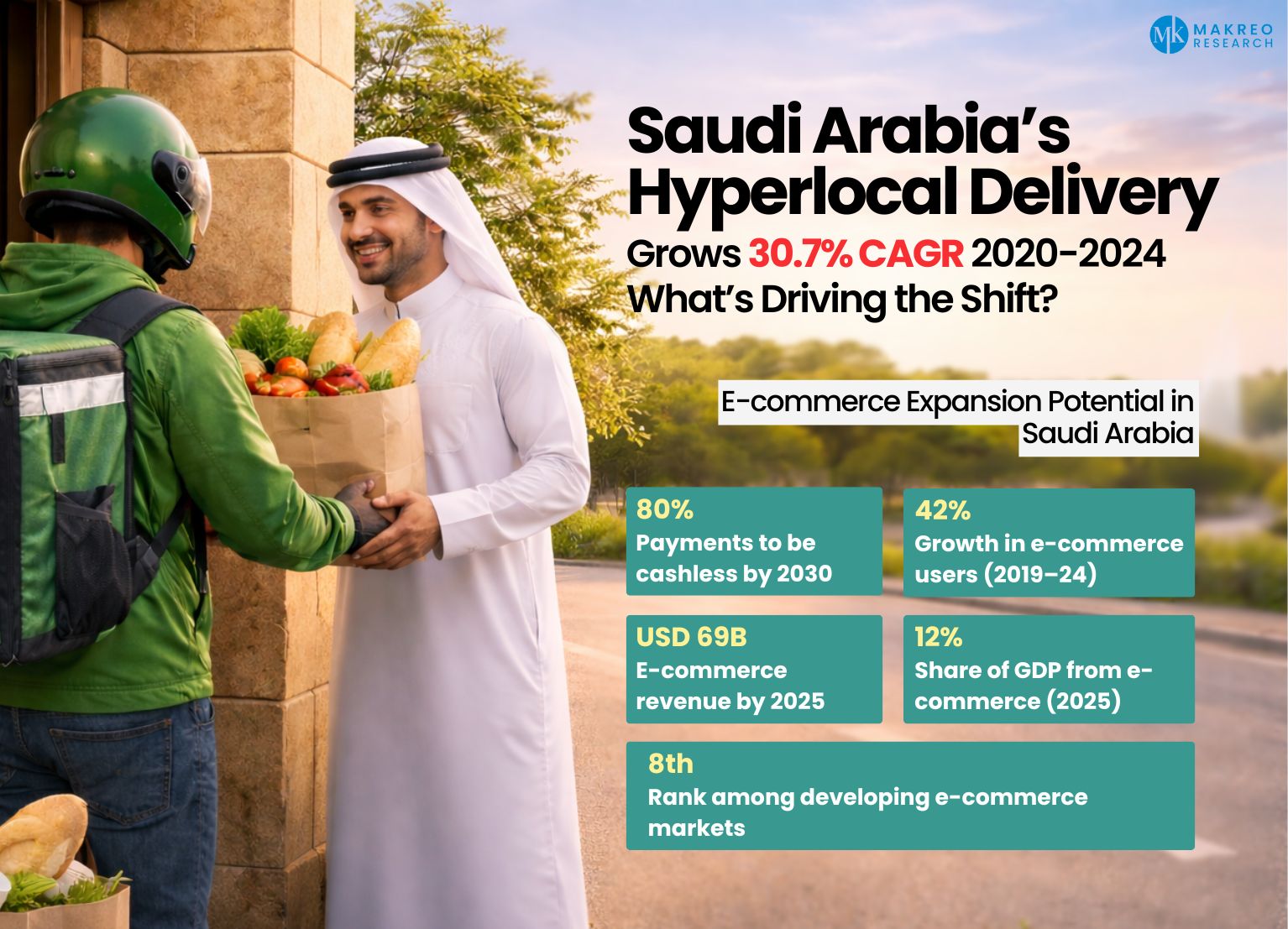
Saudi Arabia’s Hyperlocal Delivery Grows 30.7% CAGR - What’s Driving the Shift?
Saudi Arabia’s hyperlocal delivery market grew at 30.7% CAGR (2020–2024). Explore q-commerce growth, key cities, investments, and 2030 outlook.
Saudi Arabia’s Hyperlocal Delivery Is No Longer Just About Convenience. For years, hyperlocal delivery in Saudi Arabia was seen as an urban convenience, something used occasionally for food orders or last-minute grocery needs. That perception no longer holds.
Between 2020 and 2024, Saudi Arabia’s online delivery order volumes grew at a CAGR of ~30.7%, signaling a deeper structural shift rather than a temporary post-pandemic surge. What was once a food aggregation model has evolved into a multi-category, on-demand commerce ecosystem, spanning groceries, pharmaceuticals, daily essentials, and ready-to-eat meals.
In cities such as Riyadh, Jeddah, and Dammam, hyperlocal platforms now account for a significant share of daily online orders. Dense merchant networks, near-universal smartphone penetration, and a consumer base increasingly conditioned to sub-30-minute delivery windows are redefining how urban Saudi consumers interact with retail.
According to Makreo Research, Saudi Arabia’s hyperlocal delivery market has entered an accelerated growth phase, supported by double-digit CAGR projections through 2030 as Vision 2030 reforms, logistics investment, and platform-led innovation reshape last-mile economics across the Kingdom.
Retail Scale Is Powering the Hyperlocal Boom
Saudi Arabia’s retail fundamentals provide a powerful base for hyperlocal and quick commerce expansion. With a retail market valued at over USD 120 billion and more than 70% of the population living in urban areas, the Kingdom offers the density required for fast, cost-efficient last-mile fulfillment.
Modern trade penetration continues to rise, especially in large metropolitan areas. Organized supermarkets, convenience chains, and neighborhood stores are rapidly being digitized and onboarded into delivery platforms. Riyadh alone contributes a substantial share of national hyperlocal order volumes, driven by high disposable incomes, strong digital adoption, and increasingly time-sensitive consumption patterns.
Retailers and logistics operators are responding by investing heavily in micro-fulfillment centers, dark stores, AI-driven inventory planning, and route optimization, enabling consistent 15–30 minute delivery timelines within dense urban catchments.
Quick Commerce Is Becoming Daily Infrastructure
Saudi Arabia’s quick commerce (q-commerce) segment is emerging as one of the fastest-growing layers within the broader e-commerce ecosystem. Market estimates indicate the Saudi q-commerce market is projected to cross USD 1.3–1.4 billion by 2030, led primarily by groceries, food, and essential goods.
While food delivery remains the anchor category, consumer behavior is clearly shifting toward multi-category baskets, combining meals, beverages, daily essentials, and OTC healthcare products in a single order. This shift is reinforced by Saudi Arabia’s young, digitally native population, which is highly accustomed to app-based, on-demand consumption.
Increasingly, hyperlocal platforms are positioning themselves as daily-use infrastructure rather than discretionary services, signaling structural demand growth rather than cyclical usage spikes.
Structural Drivers Behind Saudi Arabia’s Hyperlocal Momentum
Several interconnected demand- and supply-side factors are shaping Saudi Arabia’s hyperlocal delivery trajectory:
-
High Digital Penetration: Saudi Arabia has one of the highest digital adoption rates globally, with smartphone penetration exceeding 95% and widespread use of mobile wallets and digital payments. This reduces friction across quick commerce platforms and supports mass adoption across income segments.
-
Young, Urban Consumer Base: More than 70% of the population lives in urban areas, with a large share under 35 years old. This demographic prioritizes speed, reliability, and convenience, driving frequent usage of food delivery, grocery, and on-demand services, especially in Riyadh, Jeddah, and Dammam.
-
Rising Disposable Incomes and Lifestyle Shifts: As GDP per capita rises, Saudi consumers are increasingly willing to pay for premium delivery speeds and subscription-based models, reinforcing higher order frequency and basket sizes.
-
Retail Digitization and Merchant Integration: Thousands of local merchants and neighborhood stores are now digitally integrated into hyperlocal platforms. This integration is fueling rapid market expansion, with the segment projected to grow at nearly 20% CAGR through 2030.
-
Logistics Infrastructure and Technology Investment: Vision 2030 continues to accelerate investment in dark stores, micro-fulfillment centers, and AI-enabled routing, compressing delivery timelines toward sub-60-minute, and in many cases sub-30-minute, windows.
Together, these drivers are positioning hyperlocal delivery as a foundational layer of Saudi Arabia’s modern retail ecosystem.
Key Investments Are Flowing Into Speed and Scale
Investment momentum further validates the market’s long-term potential.
-
Ninja, Saudi Arabia’s homegrown quick commerce platform, secured a USD 250+ million pre-IPO funding round, valuing the company at approximately USD 1.5 billion and signaling strong investor confidence in ultra-fast delivery models.
-
Salasa raised USD 30 million in Series B funding, backed by Artal Capital and Saudi government-linked VCs, to expand dark store networks, AI-driven fulfillment, and cross-border logistics.
-
Rabbit, the Egypt-origin q-commerce startup, has expanded into Saudi Arabia, establishing Riyadh operations and scaling regional dark store infrastructure.
-
Meituan-backed Keeta entered Saudi Arabia in late 2024 with an investment commitment of SR 1 billion (~USD 266 million), intensifying competition in ultra-fast food delivery.
Collectively, these investments indicate that Saudi Arabia’s hyperlocal market is not just scaling, it is structurally maturing.
Why Sub-60-Minute Delivery Is Redefining Competition Across the GCC
Across the GCC, delivery platforms are competing aggressively on 10–60 minute fulfillment windows. Speed has become the primary anchor of customer loyalty and platform differentiation.
The model has expanded well beyond groceries to include pharma, electronics, and daily essentials, supported by dense dark store networks, AI-driven routing, and micro-fulfillment centers positioned close to urban demand clusters.
GCC quick commerce revenue is forecast to grow from ~USD 521 million in 2025 to USD 892 million by 2030, reinforcing the scale of opportunity tied to rapid delivery execution.
The Jahez and Noon Alliance - Strategic Alliances Are Redefining Platform Economics
A notable signal of ecosystem maturity is the Jahez–noon alliance, formalized in October 2025.
Under the partnership:
-
Jahez integrates noon Minutes quick-delivery services into its app
-
noon gains access to Jahez’s 50,000+ restaurant network
-
The collaboration spans 100+ cities across Saudi Arabia
Rather than duplicating infrastructure, both platforms leverage complementary strengths, illustrating how ecosystem partnerships are becoming a key path to sustainable scale.
Challenges That Will Define the Next Phase Hyperlocal Market
Despite strong growth prospects, several challenges could affect the long-term sustainability of Saudi Arabia’s hyperlocal and quick commerce ecosystem:
-
High capital requirements for dark stores and AI-driven logistics
-
Margin pressure from sub-60-minute delivery expectations
-
Rider availability and workforce optimization
-
Intense competition and promotional intensity
-
Inventory complexity across high-SKU assortments
-
Limited scalability beyond Tier-1 cities
The winners will be platforms that balance speed with operational discipline, rather than growth at any cost.
The Long-Term Outlook - Hyperlocal as Core Retail Infrastructure
While profitability challenges persist, Saudi Arabia’s hyperlocal delivery market remains structurally aligned for sustained expansion through 2030, according to Makreo Research.
Riyadh, Jeddah, and Dammam are emerging as innovation clusters, where AI-powered logistics, hybrid fulfillment models, and data-driven forecasting are improving both efficiency and unit economics.
As consumer expectations continue to shift toward instant access and reliability, hyperlocal delivery is evolving from a convenience service into critical retail infrastructure.
Makreo Research’s study, "Saudi Arabia Hyperlocal Delivery Market Size and Forecast (2021–2030)", provides a detailed assessment of service models, delivery types, city-level dynamics, investments, and competitive positioning shaping this transformation.
The report highlights several defining trends shaping the sector:
-
Rapid expansion of quick commerce and sub-60-minute delivery models
-
Growing integration of hyperlocal platforms with retail and grocery networks
-
Rising consumer demand for instant, scheduled, and on-demand delivery services
Hyperlocal delivery in Saudi Arabia has moved far beyond being a simple convenience. It is a permanent, structural shift in the Kingdom’s retail landscape, fundamentally altering how consumers access goods and services. The powerful convergence of advanced logistics technology, strategic capital, and ecosystem-level alliances is redefining consumer expectations around on-demand access. These players are actively laying the rails for a high-velocity, digitally native retail economy.
The question now is no longer whether hyperlocal delivery will scale, but which platforms can scale sustainably in a market where speed is expected, not rewarded.
Market Segmentation of Saudi Arabia Hyperlocal Delivery Market:
By Services
-
Online Food Delivery
-
Online Grocery Delivery
-
Quick Commerce (Q-Commerce)
-
Pharmacy & Health Product Delivery
-
Hyperlocal Logistics / On-Demand Courier Delivery
Companies Covered:
Hyperlocal Delivery Companies
-
Jahez International Company for Information System Technology
-
Keeta Technologies Arabia Limited (Keeta)
Logistics and Fulfilment Companies
-
Aramex Saudi Limited Company
-
Almajdouie Logistics Company L.L.C.
The study covers a total of 6 hyperlocal delivery platforms and 13 logistics and fulfilment companies. To know more, please refer to the full report.
Saudi Arabia Hyperlocal Delivery Market, Saudi Arabia Quick Commerce Market, Saudi Arabia Q-Commerce, Riyadh Hyperlocal Delivery, Jeddah Hyperlocal Delivery, Saudi Arabia Dark Store Market, Saudi Arabia Instant Delivery, GCC Quick Commerce Market, Saudi Arabia Last Mile Delivery