
How Market Research Is Redefining India’s Retail, Ecommerce & Hyperlocal Quick Commerce Revolution
India’s retail and quick commerce landscape is evolving fast. Explore how market research, data-driven insights, and pin-code intelligence are shaping omnichannel growth.
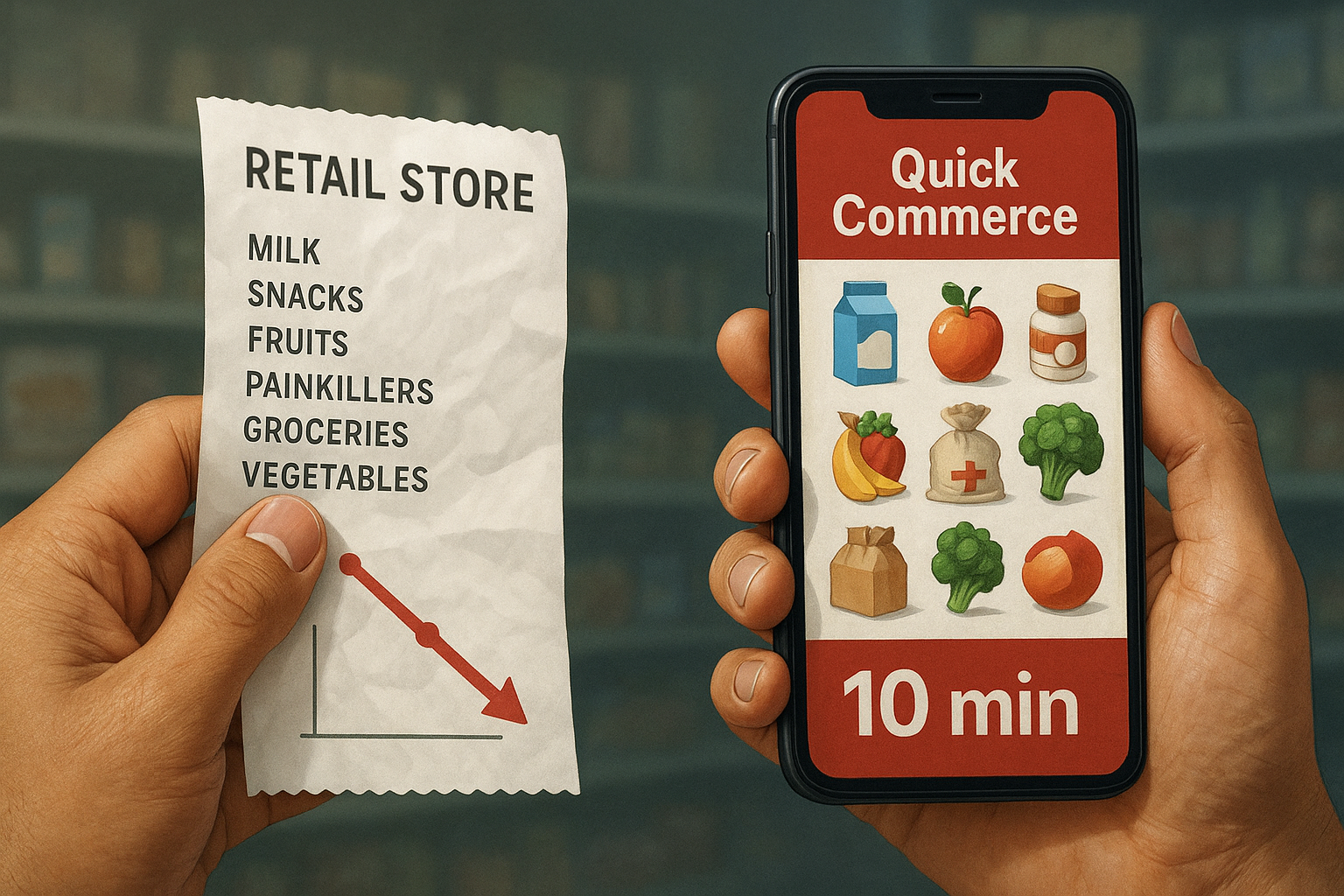
It has become almost routine in urban India: you need milk, a snack, or an OTC medicine, and it arrives in 10–20 minutes. Quick commerce (q-commerce) is no longer an innovation, it’s everyday behavior.
This shift wasn’t accidental. While technology and delivery networks enabled scale, the true driver of this transformation is data-led decision-making. Success in q-commerce depends not on assumptions but on understanding pin-code-level realities, what people buy, how often, and what speed they truly need.
India’s q-commerce landscape has evolved at a pace that feels ahead of its time — prompting many global observers to remark, “India feels like 2030.” Dense dark-store networks and highly optimized last-mile operations are redefining convenience and reshaping consumer expectations.
The market’s momentum reflects this shift: q-commerce is projected to reach ₹2 lakh crore by FY28, and 70–75% of e-grocery demand in major cities is already fulfilled through instant delivery models.
In this high-stakes environment, instinct has no place. Decisions must be grounded in:
-
Demand forecasting
-
Micro-market segmentation
-
SKU-level behavioral insights
-
Delivery radius performance
-
Unit-economics at a pin-code level
This is where Makreo Research & Consulting plays a critical role, translating complexity into clarity and enabling brands to scale with confidence, precision, and competitive advantage.
Why Every Brand Is Going Omnichannel?
A Side-by-Side Market Comparison
Much of the confusion in strategy and execution comes from mixing up hyperlocal delivery, q-commerce, and Retail, Ecommerce . Each serves a different purpose in India’s retail ecosystem. The following snapshot highlights how these models differ.
The 5 Surprising Truths Fueling India's 10-Minute Delivery Boom
1. It's Not a Monolith: There's No Such Thing as a "Typical" Q-Commerce Shopper
Treating India as a single, homogeneous market is a recipe for failure in quick commerce. The assumption that every shopper wants the same thing, delivered at the same speed, is fundamentally flawed. In reality, consumer needs are hyper-segmented, and a successful strategy hinges on understanding this nuance.
A shopper's expectations are shaped by:
-
The Context of the Order: From an emergency painkiller purchase to a casual top-up of weekly groceries, the "why" behind the buy dictates everything.
-
The Geography of the Customer: The high-velocity SKUs in a dense metro cluster, like FMCG, dairy, snacks, and beverages—are entirely different from those in a sprawling Tier-II neighborhood.
-
The True Value of Time: Not every order is a race. A 30-minute reliable delivery is often far better for a planned refill than a risky 10-minute gamble
This level of segmentation is critical. It informs everything from which products to stock in a specific dark store to how marketing campaigns are targeted, ensuring that resources aren't wasted on a one-size-fits-all strategy.
2. The Biggest Bottlenecks Aren't High-Tech, They're Hyperlocal
While advanced apps and logistics software are the face of q-commerce, the greatest barriers to efficiency are surprisingly low-tech. In q-commerce, profitability isn't won in the boardroom; it's won or lost on the ground, in the second-by-second optimization of hyperlocal workflows.
These real-world challenges, or "workflow friction," include:
-
The actual time it takes for a worker to pick and pack an order in a crowded, busy dark store.
-
The difficulties delivery riders face navigating dense neighborhoods with narrow, congested lanes.
-
Sudden, unpredictable surges in orders from a specific neighborhood cluster during peak hours.
Solving these small, on-the-ground problems is where the battle for profitability is won or lost. Even minor improvements to these workflows can significantly cut the cost-per-delivery, a crucial advantage in a market that operates on notoriously tight margins.
3. Profit Isn't Made Nationally, It's Made at the Pin-Code Level
Anyone viewing quick commerce through a national lens is missing the point entirely. Profitability isn't a national strategy; it's a pin-code-by-pin-code puzzle. The unit economics that work in a Mumbai high-rise are inverted in a Tier-II city.
A comparison of city types reveals this stark contrast:
-
Metros: Profitability is driven by extreme order density. A high volume of customers in a small radius is the only way to offset soaring real estate and operational costs.
-
Smaller Cities (Tier II & III): Profitability is achieved through lower rental costs for dark stores. This allows companies to operate with a much wider delivery radius (1.5–3 km) and still remain economically viable.
The impact of smaller cities is undeniable, as Tier II and III locations now account for a staggering 35–40% of all q-commerce gross merchandise value (GMV). This proves why a deep, pin-code-level economic analysis is an absolute prerequisite before opening a single new dark store.
4. Predictability, Not Just Speed, Is the Real Customer Lock-In
While the 10-minute delivery promise grabs headlines, speed alone is a fragile competitive advantage. Long-term customer loyalty isn't built on speed, but on the bedrock of reliability.
The factors that truly build trust and drive adoption are:
-
Order accuracy: Receiving exactly what you ordered, every single time.
-
Reliable real-time tracking: Knowing precisely where your order is and when it will arrive.
-
Transparent and consistent delivery times: Getting your order within the promised window, even during holidays or peak hours.
Companies must overcome deep-seated consumer fears of incorrect product substitutions or finding an essential item is out of stock after placing an order. Ultimately, the battle for customer retention isn't fought over a few minutes of delivery time, but over the currency of trust and unwavering reliability.
5. The Real Revolution Is Fueled by Data, Not Just Delivery Bikes
These four truths, the nuance of the consumer, the reality of hyperlocal friction, the pin-code-level economics, and the demand for predictability, all point to a single, unifying force: the strategic application of data. The real revolution isn't just about delivery bikes; it's about the research that tells them exactly where to go.
Successful companies have grasped that "Consumers in India have changed faster than the companies serving them," and they use market research as a "risk-reduction engine" to close that gap. This evidence-based approach answers the most critical strategic questions:
-
Where should we launch new dark stores? (Directly solves the "Pin-Code Level Profit" challenge by identifying underserved micro-markets).
-
What specific products will sell best in this exact neighborhood? (Directly addresses the "No Typical Shopper" problem with localized SKU assortments).
-
What is the optimal delivery radius? (Uses demand mapping to balance reach and efficiency).
This commitment to an evidence-based strategy is what separates the winners from the losers. In this high-stakes game, the companies that invest in understanding the market at a granular level are the ones building sustainable, profitable businesses.
Why Partner with Makreo Research for Your Omnichannel Commerce Strategy?
However, the market is evolving. According to Makreo Research, a Mumbai-based consulting and market intelligence partner, retail and commerce businesses can no longer rely on intuition alone. Decisions now need to be grounded in granular data, real-world benchmarking, and sharp, forward-looking insights.
Makreo Research and Consulting is a leading India-based market research and business consulting firm, specializing in custom research, market surveys, industry analysis, and market mapping across global markets. We work closely with retailers, eCommerce platforms, quick commerce players, hyperlocal delivery networks, and broader retail commerce ecosystems to turn market complexity into clear, actionable strategy. Our role is simple: convert your challenges into growth opportunities through evidence-led decision-making.
Whether you are scaling eCommerce, building a quick commerce model, expanding hyperlocal delivery, or strengthening your omnichannel presence, Makreo Research becomes the backbone of intelligent, data-driven expansion. Our 360° market perspective and tailored research frameworks help brands stay ahead of demand shifts, competitive intensity, operational constraints, and fast-changing consumer behavior.
In omnichannel and Q-commerce, the questions that matter most are often hyper-specific. We help you answer them with precision, such as:
-
Where should you open the next dark store or micro-fulfilment center?
-
Which delivery radius (1 km vs. 2 km) delivers the optimal balance of speed, cost, and reliability?
-
Which SKUs move fastest in each micro-market, locality, or cluster?
-
Do your priority customers value speed more than price, or convenience more than assortment depth?
-
How do city-level economics vary across markets like Delhi, Pune, Jaipur, Coimbatore, and other emerging hubs, and what does that mean for your P&L?
Custom Research - The Intelligence Behind Every Market Move
Beyond our published reports, Makreo Research offers custom research solutions that are molded around your exact business questions. From highly localized market assessments to category-level demand mapping, price-sensitivity analysis, competitive intelligence, and consumer behavior studies, every engagement is tailored to your objectives, not a one-size-fits-all template.
Our custom research work spans key sectors such as Retail, BFSI, Logistics, Healthcare, Automotive, Education, and Manufacturing, serving clients across India, the Middle East, Africa, Southeast Asia (including the Philippines, Indonesia, Vietnam), Europe, Australia, and the Americas. We’re not just a service provider, we position ourselves as your research partner in progress, working as an extension of your team to guide measurable outcomes.
A Diagnostic Lens on Every Touchpoint
As brands scale their omnichannel and hyperlocal presence, Makreo Research strengthens decision-making through deep diagnostic insights that go far beyond top-line data. Our research framework covers every operational and consumer touchpoint, including:
-
Geo-Granular Analysis: Pin-code level demand mapping, heatmaps, catchment-area behavior, and cluster-wise profitability to identify the most viable micro-markets for store or dark store expansion.
-
Consumer Behaviour Segmentation: Understanding how Metro, Tier II, and Tier III customers differ in shopping frequency, speed expectations, convenience needs, and preferred categories, so your proposition matches the reality on the ground.
-
Operational Workflow Studies: Evaluating pick-pack times, rider routing and constraints, fulfilment bottlenecks, inventory leakages, and replenishment gaps to help you streamline operations and protect margins.
-
Category-Level Strategy: Identifying high-velocity SKUs and margin-accretive categories, mapping impulse-led versus planned baskets, and analyzing refill cycles to optimize assortment and promotions at a very local level.
These layers of insight ensure that every key decision, launching a dark store, entering a new pin code, optimizing marketplace listings, designing hyperlocal partnerships, or building q-commerce collaborations, is backed by evidence, not assumptions.
Intelligence, Not Just Speed, Will Shape the Next Wave
The story of India’s quick commerce boom is more than a retail success headline, it’s a playbook for the next generation of consumer-facing businesses in high-growth markets. The real edge is not just delivery in minutes; it’s the intelligence behind every minute.
The future belongs to businesses that are hyper-local in strategy and rigorously evidence-led in execution. By understanding customers at pin-code level, aligning operations with ground realities, and constantly testing what truly drives convenience, speed, accuracy, price, or seamless experience, retailers can build ecosystems that feel truly “future-ready.”
As instant delivery becomes the baseline expectation, a new question emerges: What form of convenience will customers demand next, and are you preparing for it today?
India’s retail revolution is powered by innovation plus intelligence.
If your organisation is exploring omnichannel expansion, hyperlocal entry, or q-commerce growth, Makreo Research can help you build a clear, data-backed roadmap tailored to your markets and categories.
Email us at [email protected] to discuss your research needs and explore how we can become your research partner in progress.
Market Research India, Retail Market India, Ecommerce Market India, Quick Commerce India, Hyperlocal Delivery Market, Q-Commerce Market Research, Omnichannel Retail Strategy, Consumer Behavior India, Dark Store Market India, Last-Mile Delivery India, Pin-Code Level Insights India, India Online Grocery Market, Instant Delivery Market India, Hyperlocal Commerce Trends, Retail Digital Transformation India, Demand Forecasting in Retail, SKU-Level Insights India, Retail Analytics in India, Market Intelligence Consulting, India Startup Ecosystem Retail, Micro Market Segmentation India, Retail Expansion Strategy India, Custom Market Research India, How quick commerce is evolving in India, Why q-commerce is growing in India, Future of omnichannel retail in India, Role of market research in retail decision-making, India dark store expansion strategy, Tier II and Tier III retail growth India, Competitive benchmarking in retail India, Ecommerce vs Q-Commerce India, Demand mapping for retail expansion, Data-driven retail strategy India, Makreo Research Reports, Custom Research Consulting India, Market Mapping Services India, Industry Insights India, Retail Business Intelligence, Business Expansion Strategy India, Pin-Code Demand Analysis, Operational Workflow Benchmarking, Category-Level Market Forecasting, 10-minute delivery trend India, Instant grocery delivery insights, Blinkit vs Zepto vs Swiggy Instamart analysis, Retail future India 2030, Consumer shopping patterns India, Hyperlocal commerce growth drivers, Retail profitability India, Market trends 2025 India retail